
24/7 Customer Support

Free returns

Same-day & Next-day Delivery

Quality Guaranteed

Unlock Your Welcome Offers: FREE Delivery | Up to 80% OFF | Free 30-day JoyPlus trial
Download the APP
A dual compartment kitchen bin can make everyday recycling easier, but the wrong design may create more work than it removes. UK households often buy a bin based on appearance or advertised capacity, only to discover that the compartments are awkward to empty, the pedal mechanism is uncomfortable or the full unit does not fit beneath a worktop.
Before choosing a kitchen recycling bin, look beyond the headline capacity. The most useful checks concern real internal volume, external dimensions, cleaning access and lid operation.
A listing described as a 40L kitchen bin may contain two 20-litre sections, rather than one large 40-litre space. This is useful for separating general waste and recycling, but each compartment may fill at a different rate.
A 2 x 20L kitchen bin suits households that produce moderate daily waste and want a compact footprint. Larger families may prefer a 2 x 30L recycling bin, particularly if they regularly collect packaging, tins and bottles before taking them outside.
A bin can fit beneath a worktop when closed but become difficult to use when the lid opens. Check both the closed height and the clearance above it. For example, some dual-compartment models reach approximately 92cm with the lid open, which may affect positioning beneath wall cabinets.
Also measure the available width and depth, including space for the pedal. Open-plan kitchens usually benefit from a neat stainless steel kitchen bin or dark metal pedal bin, but appearance should not replace practical measurements.
An odour-seal rubbish bin can help keep unwanted smells contained when the lid is closed, but it does not remove the need to empty and clean the buckets. Wet food waste should be bagged appropriately, and the inner containers should be wiped or washed regularly.
Likewise, a soft-close kitchen bin reduces lid noise and slamming; it does not necessarily mean the lid is airtight. Check the product description for specific wording such as “airtight” or “odour seal” rather than assuming every soft-close model offers the same containment.
For a couple or smaller household, a 2 compartment pedal bin with two 20-litre buckets can provide a practical balance between sorting and footprint. Families may need two 30-litre compartments, although the resulting bin will usually require more floor space.
Consider what each side will hold. General waste may be heavier and wetter, while recycling can be bulkier. Equal compartments are straightforward, but they may not match every household’s waste pattern.
A steel outer shell gives a metal pedal bin a firm structure and a wipe-clean exterior. Rust-resistant steel is a useful feature for a kitchen environment, where splashes and condensation are common. Avoid abrasive cleaners and steel wool, which can mark the finish.
A removable bucket bin is generally easier to empty than a fixed-body design. Look for handles, a secure liner position and enough clearance to lift the bucket out without scraping it against the lid mechanism. A rear bag hole, where provided, can help hold liners in position and make changes less awkward.
A pedal-operated lid supports hands-free use, which can be convenient while preparing food. Check that the pedal is positioned where you can operate it comfortably and that the bin stands securely on a flat floor.
A soft-close lid should lower quietly rather than drop suddenly. Some designs can remain open at approximately 90 degrees, which is useful during cleaning or when disposing of larger items. Keep pedal mechanisms dry and avoid placing heavy objects on the lid.
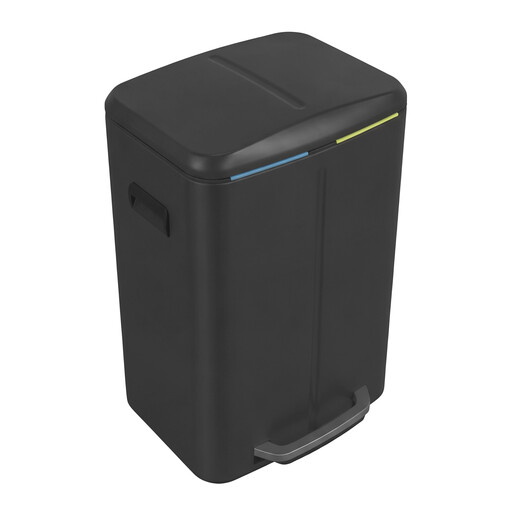
Why This Fits Their Persona: The two-compartment 40-litre format gives smaller households a straightforward way to divide everyday rubbish and recycling without moving to a larger 60-litre unit.
The listing specifies two removable plastic inner buckets, rather than relying on a single difficult-to-clean cavity. Its stated soft-close lid also avoids abrupt slamming.
40-litre total capacity; steel exterior, removable buckets, pedal operation and 15 supplied rubbish bags.
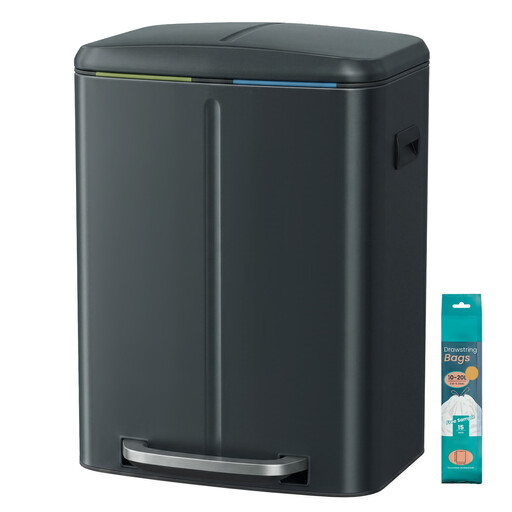
Why This Fits Their Persona: Its dark carbon-grey steel finish is suited to contemporary or open-plan kitchens where the bin remains visible rather than hidden inside a cupboard.
The stated dimensions are 44.4 x 40.8 x 60.2cm with the pedal, and the open-lid height is listed as 92cm, making planning easier than buying from capacity alone.
Two 20-litre buckets; soft-close lids; stated odour seal; rear liner hole; 15 custom-designed bags included.
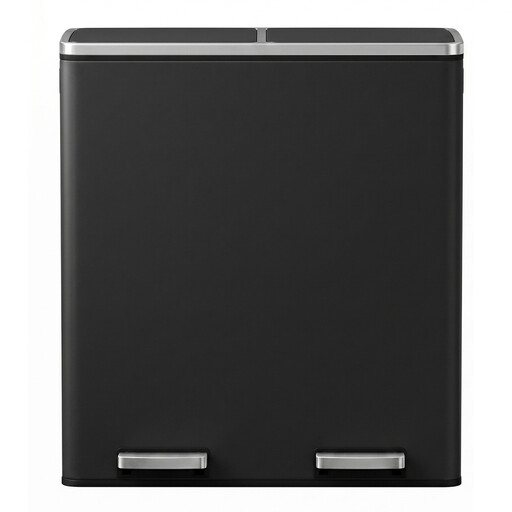
Why This Fits Their Persona: Two 30-litre sections provide more holding space for larger families or households that prefer fewer trips to an outside wheelie bin or recycling box.
The larger capacity is divided into removable buckets, helping prevent one overloaded mixed compartment and making emptying more manageable.
Two 30-litre compartments; steel outer body; handles on inner buckets; pedal-operated soft-close lids; 15 liners included.
We have compiled a complete, real-time list of products that fully satisfy these strict selection criteria and UK safety regulations.
Place the bin on a flat, stable indoor surface, leaving enough room for the pedal and open lid. Fit liners securely around each bucket rather than allowing them to hang into the hinge area. Do not overload either compartment, as excessive weight can make removal difficult and place strain on the pedal or lid.
For routine care:
Check your local council’s recycling guidance before assigning each compartment. Accepted materials and collection arrangements vary across the UK, so the bin’s two sections should match your local waste system.
It can be worthwhile if you regularly separate general waste and recycling indoors. It reduces the need for two separate bins and keeps sorting close to where waste is produced. However, equal-sized compartments may not suit households that generate considerably more recycling than general rubbish.
A 40-litre model, such as two 20-litre compartments, may suit a smaller household with frequent collection. A 2 x 30L recycling bin offers more room for busy family kitchens, but requires more floor space and may become heavy when full.
Soft-close describes the lid movement and noise level, not necessarily odour containment. For smell control, look for a listing that specifically mentions an odour seal or airtight lid, then empty wet waste regularly and clean the removable buckets.