
24/7 Customer Support

Free returns

Same-day & Next-day Delivery

Quality Guaranteed

Unlock Your Welcome Offers: FREE Delivery | Up to 80% OFF | Free 30-day JoyPlus trial
Download the APP
A dual compartment kitchen bin can make household sorting much easier, but choosing the wrong design may create more problems than it solves. UK kitchens often have limited floor space, and a bin that looks compact online may be awkward to open, difficult to line or too shallow for a busy family home.
Before buying, look beyond capacity claims and decorative finishes. The practical details that affect daily use include the size of each compartment, how the lid operates, whether the inner buckets can be removed and how easily the exterior can be cleaned.
A listing advertising a 60L kitchen bin may mean 60 litres in total, divided into two 30L sections. That is useful for separating general waste and recycling, but each side has considerably less space than a single 60L rubbish bin.
Check whether the capacity is shown as:
The right arrangement depends on your household’s waste habits. A family that produces plenty of packaging may prefer a 2 x 30L rubbish bin, while a smaller household may find 2 x 20L easier to fit beneath a worktop or beside a cabinet.
A soft-close rubbish bin should lower the lid gradually rather than slam shut. However, the lid mechanism still needs enough clearance behind and above the bin to operate correctly. Some models also include a 90-degree stay-open function, which is helpful when changing liners or cleaning.
Do not place the bin tightly against a wall without checking the product instructions. Certain designs require a small gap behind the body, while an open lid can add more than 25cm to the total height.
Stainless steel, coated steel and carbon steel can all appear in product descriptions, but the finish and construction still matter. A fingerprint-resistant coating can reduce visible marks, while plastic inner buckets help prevent leaks from reaching the outer casing.
Also check how the pedal, hinges and lid are constructed. A stylish exterior cannot compensate for a pedal that is uncomfortable to use or an inner liner that slips into the bucket.
Measure the available space before ordering. Compare the product’s width, depth and height, not just its litre rating. For example, a 40L model may be easier to position in a narrow kitchen, while a 60L model can reduce the frequency of liner changes but needs more floor space.
Remember to check:
A dual waste and recycling bin is most useful when the two sections suit your local sorting routine. You might use one side for general waste and the other for mixed recycling, although local council collections differ. Always follow your council’s current recycling guidance rather than assuming every material belongs in the same compartment.
Removable inner buckets are particularly practical. Handles make it easier to lift a full liner out, rinse the bucket and deal with accidental spills. Bag-fixing rings, rear liner holes or retaining features can also help stop bags from slipping into the compartment.
A stainless steel pedal bin or coated metal model offers a wipe-clean outer surface, while a hands-free kitchen bin reduces the need to touch the lid during food preparation. Dual pedals can be useful when each compartment has a separate lid, but a shared lid may provide a simpler silhouette.
For routine care, use a soft damp cloth and mild detergent where permitted by the instructions. Avoid abrasive cleaners and steel wool, which can mark coated or polished surfaces. Keep the pedal mechanism dry and place the bin on a flat, stable indoor surface.
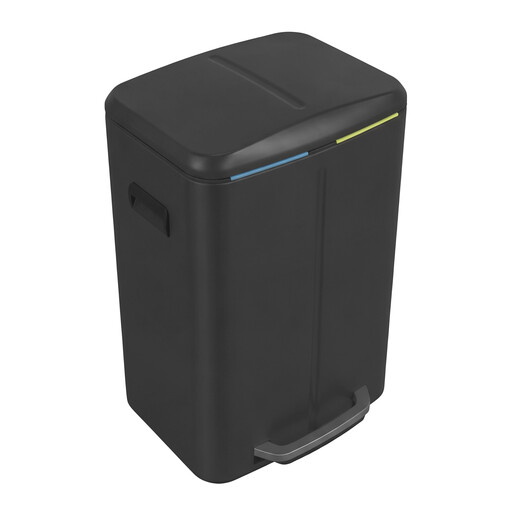
Why This Fits Their Persona: A practical 2 x 20L format suits smaller UK kitchens, flats and households starting a separate waste and recycling routine without moving straight to a large recycling bin.
The stated total capacity is clearly divided between two compartments, while removable buckets address liner changes and cleaning.
Steel outer body, two plastic inner buckets, soft-close lid, 90-degree stay-open function and 15 included rubbish bags.
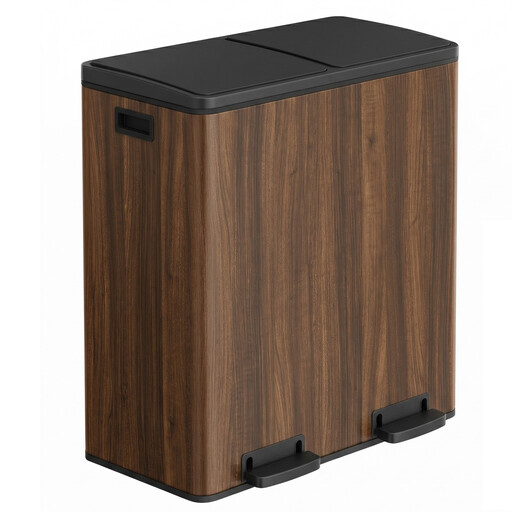
Why This Fits Their Persona: The walnut finish is suited to open-plan kitchens where the bin remains visible, while the 2 x 30L layout provides substantial everyday capacity for a family home.
The product information states the capacity per compartment and includes handles on the removable buckets, rather than relying only on an overall capacity headline.
Steel outer casing, ABS lids, pedal-operated soft close, removable PP buckets and 15 starter liners.
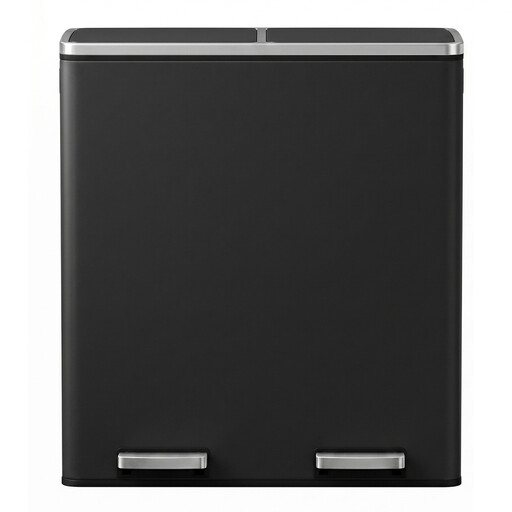
Why This Fits Their Persona: Two 30L sections work for larger households that want separate waste and recycling storage without using two standalone bins.
The two-bucket structure makes the internal capacity clear, while pedal-operated lids avoid hand contact during cooking and food preparation.
Listed dimensions are 59 x 36.5 x 65.2cm, with removable inner buckets, soft-close lids and 15 included liners.
We have compiled a complete, real-time list of products that fully satisfy these strict selection criteria and UK safety regulations.
Place the bin on a level indoor surface with enough space for the pedal and lid movement. Fit liners securely around each inner bucket and keep the lid mechanism free from obstructions. Avoid forcing a soft-close lid down by hand, standing on the bin or overloading one side.
For recycling, label each compartment if several household members use the bin. Check local council guidance for accepted packaging, food waste and contaminated materials, as collection rules vary across the UK.
It can be, particularly a 2 x 30L rubbish bin. The practical choice depends on how much waste and recycling your household produces and whether the available floor space can accommodate the bin and its open-lid clearance.
A soft-close mechanism reduces lid slamming and can be more comfortable in open-plan kitchens or at night. It does not remove the need for routine cleaning or careful use, and the hinges should be kept clear.
The main ongoing costs are replacement liners, cleaning products and any damaged mechanisms caused by overloading or misuse. Some models include starter bags, but check their size and availability before relying on them for long-term use.