
24/7 Customer Support

Free returns

Same-day & Next-day Delivery

Quality Guaranteed

Unlock Your Welcome Offers: FREE Delivery | Up to 80% OFF | Free 30-day JoyPlus trial
Download the APP
A kitchen bin should be a quiet, reliable part of your home. Yet, many of us have faced the frustration of a lid that slams shut, a pedal that snaps or a bin that looks perpetually smudged just days after a deep clean. Choosing a new dual compartment kitchen bin can feel overwhelming, with countless options all promising convenience and style.
As the Joybuy Product Recommendation Officer, my role is to help you see past the marketing claims. Before you invest in a new kitchen recycling bin, it is crucial to understand the common design flaws that lead to disappointment. Many seemingly good bins fail due to a few recurring issues that are easy to spot if you know what to look for.
stainless steel recycling bin finish attract smudges and water marks relentlessly, demanding constant polishing to look presentable and failing to deliver on their low-maintenance promise.By focusing on a few key parameters, you can confidently select a durable and practical waste separator bin that genuinely makes your kitchen routine easier.
Navigating the specifications is simpler when you know which features have the biggest impact on daily use. Here are the non-negotiable factors to consider.
The most common configuration is a 60L kitchen bin, typically split into two 30-litre compartments. This is generally a suitable size for a small family's weekly general waste and recycling. However, total capacity is only half the story.
The opening and closing mechanism determines the bin's longevity and user experience. A quality double pedal bin is essential for hygiene and convenience.
soft close kitchen bin is no longer a luxury feature. It prevents noisy slamming, reduces wear and tear on the hinge and helps to contain odours more effectively. Some models also offer a stay-open function, which is useful for longer food prep tasks.The material of your 2 compartment bin affects both its appearance and how easy it is to keep clean.
stainless steel recycling bin specifically described as having a fingerprint-resistant coating.Instead of a one-size-fits-all approach, we have matched a few standout options to different household needs and priorities.
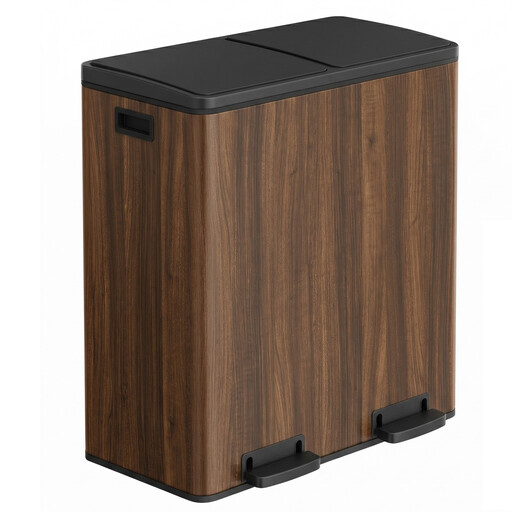
Why This Fits Their Persona: For those who see every kitchen item as part of the overall decor, this bin's dark walnut finish offers a warm, sophisticated alternative to standard metal or plastic. It integrates seamlessly with modern and traditional kitchen designs featuring wood elements.
The steel body with a walnut finish avoids the smudging and streaking common with basic stainless steel, while the robust pedal mechanism is built for longevity.
Elevated aesthetic with a unique finish. Includes all key practical features: dual pedals, soft-close lids and removable inner buckets with handles.

Why This Fits Their Persona: This bin is a workhorse. The large 60L total capacity is ideal for family life, and the stainless steel exterior is described as fingerprint-resistant, making it a practical choice for a high-traffic kitchen where durability and ease of cleaning are top priorities.
It directly addresses the slipping liner issue with built-in bin liner fixing rings. Its high-density stainless steel pedals are designed to withstand repeated use.
Focuses on robust, practical features like dual pedals, a 90° stay-open lid option and a large, family-friendly capacity.
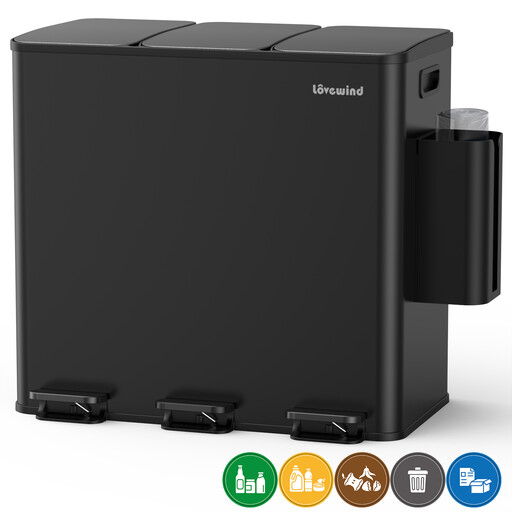
Why This Fits Their Persona: For the household that separates more than just general waste and mixed recycling. This three-compartment bin allows for more granular sorting (e.g., adding food waste, glass or paper) within a single, streamlined unit.
It moves beyond the basic dual-bin limitation by offering a more comprehensive sorting system, preventing the need for multiple separate bins cluttering the kitchen.
Maximum sorting efficiency in one unit. Includes magnetic colour-coded labels to help everyone in the house sort correctly.
We have compiled a complete, real-time list of products that fully satisfy these strict selection criteria and UK safety regulations.
This is a very common issue. The most effective solution is to choose a bin that has a specific feature to prevent this. Look for models with either a full "bag fixing ring" that clamps the liner in place or small holes in the inner bucket's rim that allow you to tuck the excess bag through, holding it taut. If your bin lacks these, a large, strong elastic band stretched around the rim of the inner bucket can also work as a temporary fix.
For most UK households with standard council collections, a 60L bin (split into 2 x 30L compartments) is a popular and effective size. It typically provides enough space for a week's worth of general waste and a similar volume of mixed recycling. If your family produces a large amount of recycling or if you have fortnightly collections, you may want to consider a larger model or supplementing with a separate recycling box.
The key is to use the right cloth and technique. A soft microfibre cloth is ideal. For general cleaning, simply dampen the cloth with water and a tiny drop of washing-up liquid. Always wipe in the direction of the steel's grain, not against it. For a final polish and to remove any remaining streaks, use a second, dry microfibre cloth. Avoid abrasive sponges or harsh chemical cleaners, which can scratch the surface.