
24/7 Customer Support

Free returns

Same-day & Next-day Delivery

Quality Guaranteed

Unlock Your Welcome Offers: FREE Delivery | Up to 80% OFF | Free 30-day JoyPlus trial
Download the APP
Finding the right kitchen bin is about more than just hiding rubbish; it's about making daily life simpler, cleaner and more organised. A dual compartment kitchen recycling bin is a practical solution for any environmentally-conscious household, streamlining the separation of general waste and recyclables. However, the market is filled with options that look great online but fail to perform in a busy home.
Before you invest in a new kitchen rubbish and recycling bin, it's worth knowing the common design flaws that can turn a promising purchase into a daily frustration.
Many bins promise convenience but fall short due to overlooked design weaknesses. Here are three frequent issues to watch out for:
To find a reliable double kitchen bin, focus on a few core parameters that determine its long-term performance and value.
The right capacity depends on your household size and how often you produce waste.
The material of your bin affects its longevity, ease of cleaning and appearance. A stainless steel waste separation bin is a popular choice for its modern look and durability. Look for models with a fingerprint-resistant coating to minimise smudges and keep the surface looking clean. High-grade steel is also less prone to rust and dents. Alternatively, powder-coated steel offers a variety of colours to match your kitchen décor, while still providing a robust and easy-to-clean exterior.
The functional parts of the bin are where quality really counts. For a pedal recycling bin, inspect the pedal's construction. A wide, sturdy pedal made from reinforced steel or high-density plastic is a good indicator of durability.
For a soft close kitchen bin, the quality of the hydraulic damper is crucial. A well-engineered mechanism will provide a smooth, silent closure for years. Some models also feature a 'stay-open' function, which holds the lid at 90 degrees—a highly practical feature for longer tasks like peeling vegetables or clearing plates.
To help you navigate the options, we've matched a few well-designed bins to different household needs. These selections are chosen based on their practical features and ability to avoid the common pitfalls mentioned earlier.
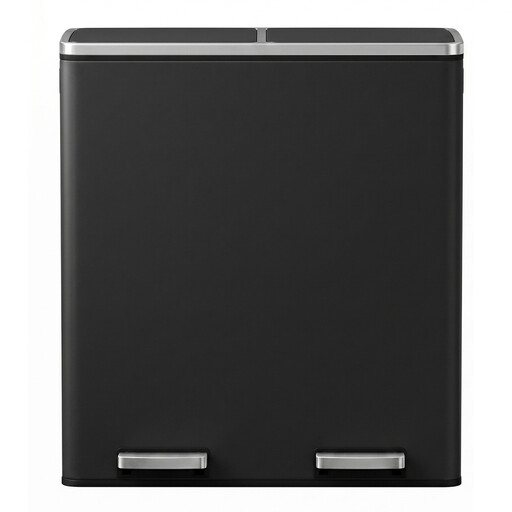
Why This Fits Their Persona: With a generous 60L total capacity, this bin is built for the demands of a busy family kitchen. The dual 30L compartments make it easy to manage both general waste and a high volume of recycling without constant emptying.
It features two independent, sturdy foot pedals and soft-close lids, reducing wear on a single mechanism. The removable inner buckets have metal handles, making them easy to lift out and clean.
The separate lids for each compartment help to contain odours more effectively than a single-lid design. The sleek black steel finish is modern and easy to wipe down.
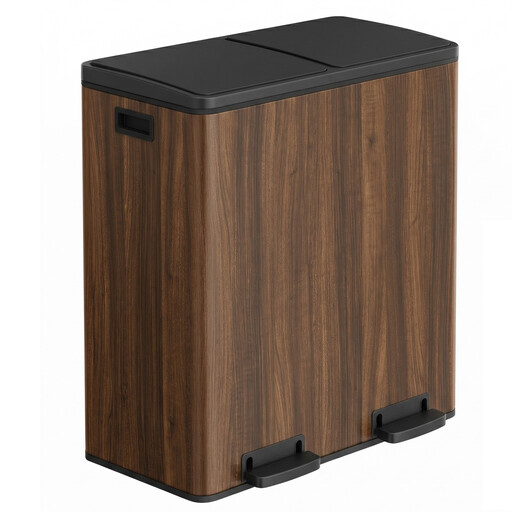
Why This Fits Their Persona: For those who see the kitchen bin as part of the décor, this model's dark walnut finish offers a warm, sophisticated alternative to standard stainless steel. It integrates seamlessly into modern and traditional kitchens alike.
Despite its stylish exterior, it doesn't compromise on function. It includes robust pedals, soft-close lids, and practical inner buckets with handles, addressing all the common failure points.
The unique finish elevates an everyday utility item into a design feature. The dual-pedal system ensures hygienic, hands-free operation for both compartments.
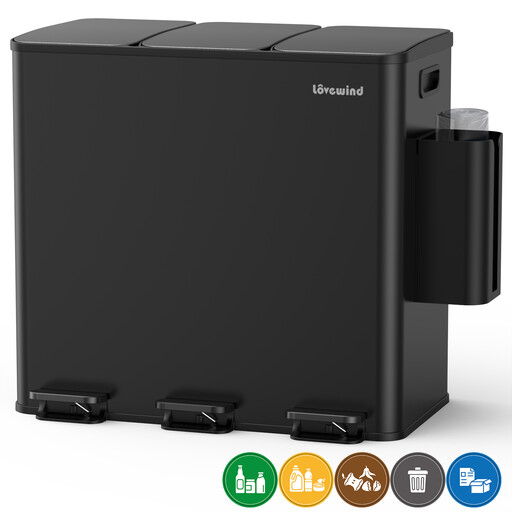
Why This Fits Their Persona: For households that separate waste beyond just 'recycling' and 'general' (e.g., food waste, glass and paper), a three-compartment bin is the ideal all-in-one solution. This model offers maximum sorting capability in a single unit.
It provides three independent pedals and soft-close lids, ensuring each section is robust. It also includes magnetic labels to clearly mark each compartment, avoiding confusion and making recycling effortless.
The three-way split (3 x 20L) is highly efficient for dedicated recyclers. The inclusion of a magnetic bin bag holder and activated carbon filters adds extra layers of convenience and odour control.
We have compiled a complete, real-time list of products that fully satisfy these strict selection criteria and UK safety regulations.
Many modern bins solve this with a small hole or clasp on the inner bucket. You can tuck the excess top of the liner through this hole to hold it taut and prevent it from falling in. If your bin doesn't have this, a large, sturdy rubber band stretched around the rim of the inner bucket can also work well.
This varies greatly with quality. A low-cost bin with a flimsy plastic pedal may only last 6-12 months with daily use. A bin with a reinforced steel pedal and a well-made hinge mechanism is designed to withstand tens of thousands of uses, potentially lasting for many years. It's one area where investing a little more upfront pays off in longevity.
While standard stainless steel can show fingerprints and water spots, many modern bins use a fingerprint-proof or smudge-resistant coating. This makes them surprisingly easy to maintain. A quick wipe with a soft, damp microfibre cloth is usually all that's needed to keep the exterior looking pristine. Avoid using abrasive scourers or harsh chemical cleaners, which can damage the finish.