
24/7 Customer Support

Free returns

Same-day & Next-day Delivery

Quality Guaranteed

Unlock Your Welcome Offers: FREE Delivery | Up to 80% OFF | Free 30-day JoyPlus trial
Download the APP
A dual compartment kitchen recycling bin can make household waste separation far simpler, but the wrong design may create more problems than it solves. A bin that looks spacious online may have narrow compartments, awkward inner buckets or a lid that becomes frustrating after daily use.
For UK kitchens, offices and shared facilities, the most useful choice depends on available floor space, the type of waste you produce and how often the bin will be emptied. This guide explains the practical details worth checking before you buy, followed by our top recommendations for different users.
A product described as a 2 x 20L bin usually provides two separate 20-litre compartments, but the inner buckets may be smaller than expected because of the outer housing and lid mechanism. Check the dimensions of each bucket, not just the headline capacity.
A 2 x 30L model offers more room but is also wider and heavier when full. Measure the intended position carefully, including space needed to open the lid and remove the buckets.
Two equal compartments are useful for general rubbish and recycling, but not every home produces both waste streams at the same rate. If one side fills much faster, you may need to empty the bin unevenly or use different liner sizes.
For offices, schools and catering areas, a separate 40L recycling bin or open recycling station may be more practical where one clearly identified waste stream is collected at a time.
A metal exterior can be easy to wipe, but spills often collect inside the base or around the rim. Fixed compartments make thorough cleaning more difficult. Look for removable inner buckets, secure liner holders and surfaces that can be cleaned with a soft, damp cloth.
A soft-close lid is convenient, but it should not be treated as a substitute for regular cleaning or careful use. Avoid putting hot materials, liquids likely to leak or hazardous items into a household kitchen bin.
Start by estimating your daily waste volume. A small household may manage well with two 20-litre sections, while families or shared kitchens may benefit from a 2 x 30L design. Consider the following:
For commercial environments, compare capacity with collection schedules. An open-top commercial recycling bin supports quick disposal, while a lidded pedal bin may be more appropriate where odour control and concealed waste are priorities.
A stainless steel kitchen bin or rust-resistant steel body can provide a wipe-clean exterior suitable for everyday indoor use. However, the internal components may still be made from polypropylene, PP or ABS plastic, so check the full material specification rather than judging the exterior alone.
For shared facilities, a polypropylene commercial recycling bin may be easier to move and clean regularly. Metallic finishes can look tidy in offices and utility spaces, but appearance should not replace checking stability, capacity and cleaning instructions.
A hands-free rubbish bin with a pedal allows disposal without touching the lid. This can be useful when preparing food or when hands are occupied. A soft-close mechanism reduces noise and helps prevent the lid from slamming, although it should be operated through the pedal rather than forced down by hand.
A stay-open function is also useful when changing liners or cleaning larger items. Check whether the lid opens high enough for comfortable access.
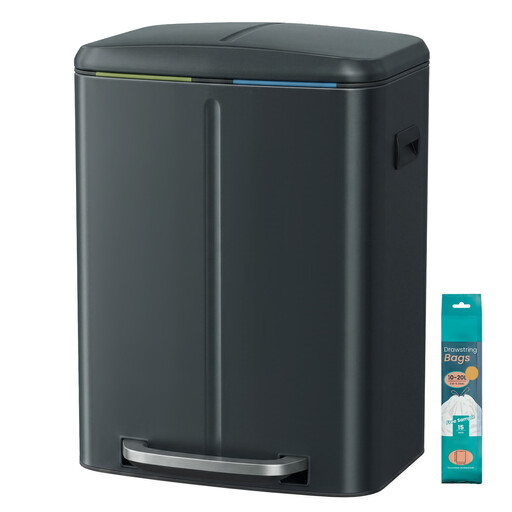
Why This Fits Their Persona: A practical option for renters, couples and smaller UK kitchens that need two waste streams without moving to a larger 2 x 30L bin.
The two removable plastic inner buckets make liner changes and spill cleaning more manageable than a fixed internal divider. A rear bag hole helps keep liners in position.
Two 20L sections, soft-close lids, a 90-degree stay-open function and 15 supplied rubbish bags.
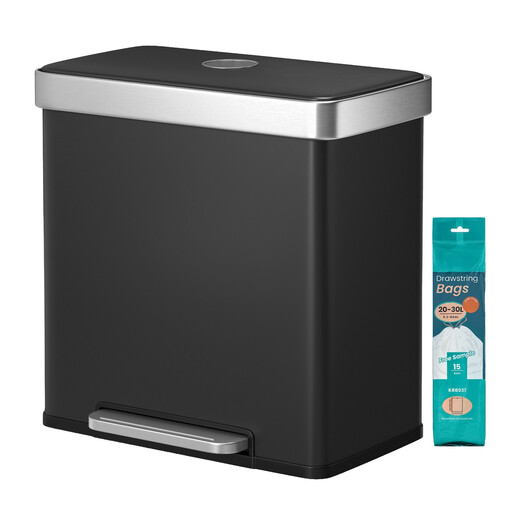
Why This Fits Their Persona: Suitable for larger households that want generous separated capacity, hands-free opening and a neutral grey finish for a modern kitchen.
The listed inner buckets are removable, while the pedal avoids frequent contact with the lid. Its soft-close system addresses noise from repeated opening and closing.
Two 30L compartments, stainless steel outer body, soft-close lid, pedal operation and 15 supplied rubbish bags.
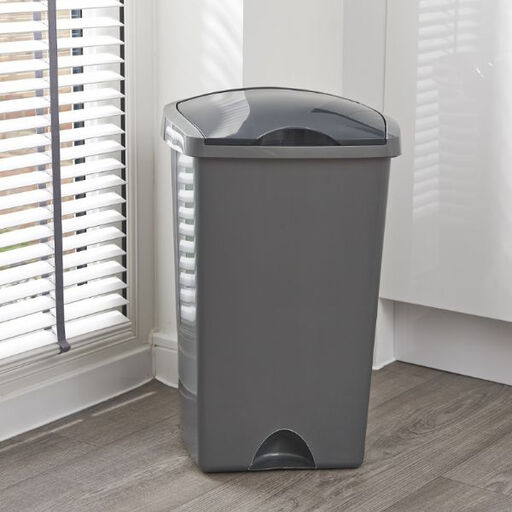
Why This Fits Their Persona: Designed for offices, schools, catering areas, shared buildings and other busy locations where quick disposal and regular emptying are important.
The open-top format avoids a lid mechanism that may slow high-frequency disposal. Its wipe-clean polypropylene surface supports routine maintenance.
40L capacity, open-top access, metallic grey polypropylene construction and listed dimensions of 560 x 380 x 382mm.
Before placing a recycling bin in your kitchen or facility, check the collection guidance from your local council or waste contractor. Accepted materials vary across the UK, so use clear labels or colour coding where different waste streams need to be separated.
For a household dual compartment model:
For a commercial recycling station, position the bin where people naturally dispose of waste and use clear signage. An open design is convenient, but it may not provide the odour control of a lidded kitchen bin.
We have compiled a complete, real-time list of products that fully satisfy these strict selection criteria and UK safety regulations.
It can be, provided the width and depth fit the available area. A 2 x 20L model usually takes less space than a 2 x 30L bin, but measure the full external dimensions and allow room for the lid and pedal.
Lifespan depends on materials, cleaning, loading and how the lid or pedal is used. Rust-resistant steel and removable plastic buckets can help with routine maintenance. Avoid forcing soft-close lids, exceeding the stated capacity or placing hot and hazardous materials inside.
The main ongoing costs are liners, cleaning supplies and waste collection. A pedal bin may use separate liners for each compartment, while an open 40L commercial recycling bin can support high-volume disposal with straightforward emptying. The more suitable option depends on your collection frequency and required level of odour control.