
24/7 Customer Support

Free returns

Same-day & Next-day Delivery

Quality Guaranteed

Unlock Your Welcome Offers: FREE Delivery | Up to 80% OFF | Free 30-day JoyPlus trial
Download the APP
A single-lens security camera can leave you with a difficult choice: monitor a wide area and miss the details, or zoom in on one spot and create blind spots elsewhere. For UK homeowners, renters and families wanting comprehensive peace of mind, this is a common frustration. Whether you're keeping an eye on your property, checking in on a pet, or using it as a baby monitor, you need to see the full picture.
A dual lens security camera offers a practical solution. By combining two lenses in a single unit, these devices can provide both a wide-angle overview and a detailed, tracked view simultaneously. This guide is designed to help you understand what makes these cameras a smart choice for modern home security and to introduce you to some of our top recommendations for 2026.
Navigating the specifications can feel overwhelming. Here are a few key considerations to help you choose the right home security camera UK residents can rely on.
The primary advantage of a dual-lens system is its enhanced field of view. Many models pair a fixed wide-angle lens with a second Pan-Tilt-Zoom (PTZ) lens. This means you can have a constant, uninterrupted view of a room while the second lens automatically tracks movement or allows you to manually look around. This effectively creates a 360 camera experience without the "fisheye" distortion, ensuring no corner is left unwatched.
Constant notifications for swaying trees or passing cars can be a nuisance. Modern cameras use AI human detection to distinguish people from other movements, sending you alerts that actually matter. Some advanced models can even identify pets or recognise the sound of a baby crying, making them a versatile pet camera or baby monitor. Another key feature is colour night vision camera technology, which uses ambient light or built-in spotlights to provide clear, full-colour video after dark, a significant improvement over grainy black-and-white footage.
A reliable WiFi security camera needs a stable connection. Models offering dual-band Wi-Fi can connect to both 2.4GHz and 5G WiFi camera networks. The 2.4GHz band offers better range and wall penetration, while the 5GHz band provides faster speeds for smoother streaming. For storage, you typically have two options: a local microSD card for physical, subscription-free recording or a cloud-based service that securely stores your footage online.
Here are a few standout models that showcase the benefits of dual-lens technology.
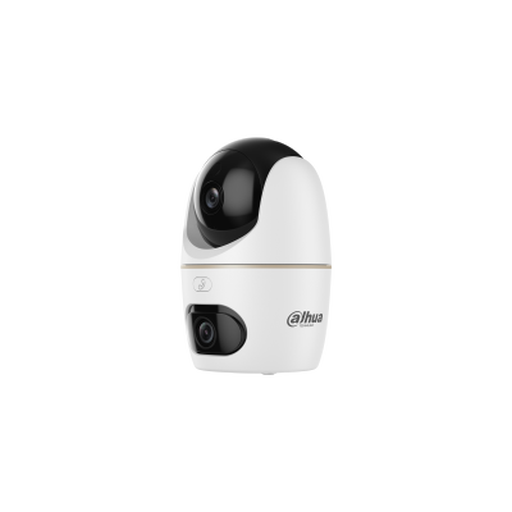
Why It Stands Out: This Dahua camera combines two high-resolution 5MP lenses for exceptionally clear and detailed footage. Its support for Wi-Fi 6 ensures a fast, stable connection with strong anti-interference performance, which is ideal for busy home networks. A unique feature is the one-click proactive call button, allowing someone at home to instantly initiate a call to your phone through the camera.
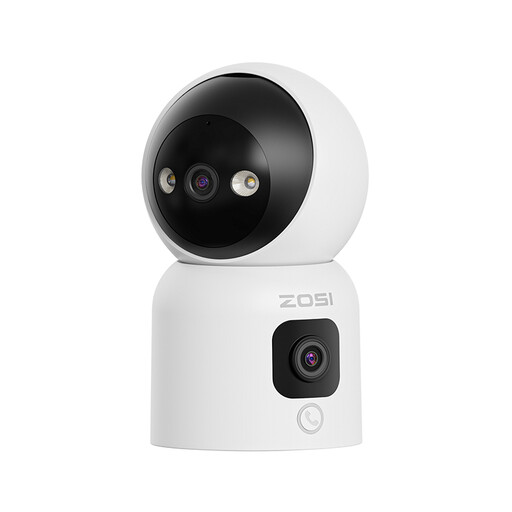
Why It Stands Out: The ZOSI C528D4 is designed with family interaction in mind. Beyond its dual-lens monitoring, it features a one-touch call button and innovative gesture calling—simply making an "OK" gesture in front of the camera initiates a video call to the app. This makes it incredibly accessible for children or elderly relatives who may not be comfortable with smartphones.
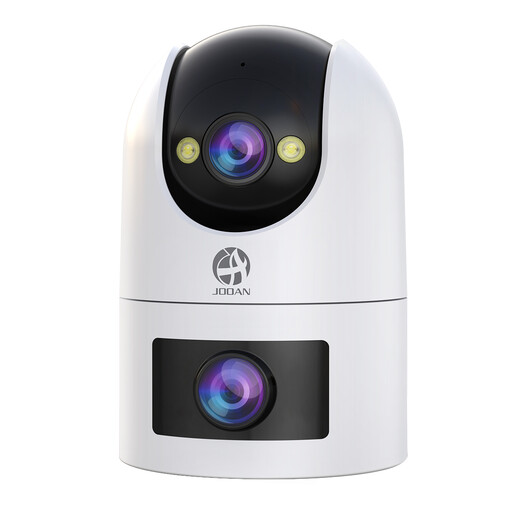
Why It Stands Out: This camera’s IP66 waterproof rating makes it a versatile choice for both indoor and outdoor use. It combines a fixed lens for general monitoring with a PTZ lens for detailed surveillance, all viewable on a dual-screen display within the app. The built-in siren and two way audio also provide an active deterrent against unwanted visitors.
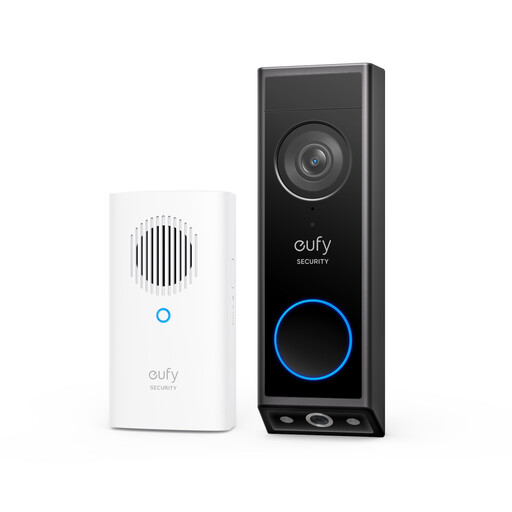
Why It Stands Out: Applying dual-lens technology to the front door, the eufy Video Doorbell E340 uses two cameras for complete coverage. A front-facing camera captures visitors in 2K clarity, while a second, downward-facing camera monitors the floor, eliminating the common blind spot where packages are left.
If our top picks don't quite match what you're looking for or if you'd like to explore a wider range of smart home security solutions, we have more to see. These cameras represent just a fraction of the innovative technology available to help protect your home.
Browse our full collection of Smart lens cameras to find the perfect fit for your needs.
Q1: How does a dual lens security camera work? A: It uses two separate lenses and image sensors within a single housing. Typically, one lens provides a fixed, wide-angle view for overall context, while the second lens can pan, tilt and zoom to focus on and track specific movements. This combination allows you to monitor a large area without losing the ability to see important details.
Q2: Is a 5G WiFi camera better for home security? A: It depends on your home's layout. A 5G WiFi camera offers faster speeds, which is excellent for streaming high-resolution video without lag, but it has a shorter range than 2.4GHz. The 2.4GHz band provides a more stable connection over longer distances and through walls. A camera that supports both bands gives you the flexibility to connect to whichever signal is strongest at the installation point.
Q3: Can I use an indoor security camera to monitor my pets? A: Absolutely. Many indoor security camera models are well-suited for use as a pet camera. For this purpose, look for features like a wide or 360 camera view to follow your pet, two way audio to speak to them remotely and intelligent motion detection that can specifically identify pets to avoid unnecessary alerts.