
24/7 Customer Support

Free returns

Same-day & Next-day Delivery

Quality Guaranteed
Download the APP
Categories
For competitive gamers and tech enthusiasts, the choice has often been a compromise: the immersive detail of 4K resolution or the lightning-fast refresh rates needed for a competitive edge. A new generation of displays is ending that compromise. The dual mode 4K 240Hz OLED monitor has arrived, offering the flexibility to switch between stunning visual fidelity and world-class speed at the touch of a button.
If you're seeking an advantage in performance-critical games without sacrificing image quality for everything else, this technology is designed for you. This guide will walk you through what to look for in these advanced displays and present our top recommendations to help you make an informed decision for your setup.
Navigating the specifications of high-end monitors can be complex. Here are a few key considerations to focus on when selecting a dual-mode display.
The core feature of these monitors is their ability to operate in two distinct modes. The 32 inch 4K 240Hz monitor mode provides breathtakingly sharp and fluid visuals, perfect for story-driven AAA titles, content creation and media consumption.
With a simple settings change, the display can switch to a 1080p 480Hz gaming monitor mode. This lower resolution allows for an exceptionally high refresh rate, giving players in fast-paced shooters and racing sims the smoothest possible motion and quickest reaction times. This versatility means you are essentially getting two specialised monitors in one.
An OLED gaming monitor delivers a visual experience that traditional LCD panels struggle to match. Because each pixel illuminates itself, you get perfect, inky blacks and an almost infinite contrast ratio. This makes an HDR gaming monitor with OLED technology particularly effective, as highlights pop against true black backgrounds.
For competitive gaming, the most significant benefit is the near-instantaneous pixel response time. With specifications around 0.03ms (GTG), these are arguably the fastest response time monitor options available. This speed virtually eliminates ghosting and motion blur, ensuring your view of the action remains crisp and clear, even during the most chaotic moments.
Screen tearing can ruin immersion and distract you at a critical moment. To prevent this, look for monitors that support adaptive sync technologies. A G-Sync compatible OLED monitor is certified by NVIDIA to deliver smooth, tear-free gameplay with their graphics cards. Similarly, AMD FreeSync Premium Pro offers a comparable standard for users with AMD GPUs. Both technologies synchronise the monitor's refresh rate with your graphics card's output for a seamless visual experience.
Based on their features, performance and innovative technology, here are our standout recommendations in this emerging category.
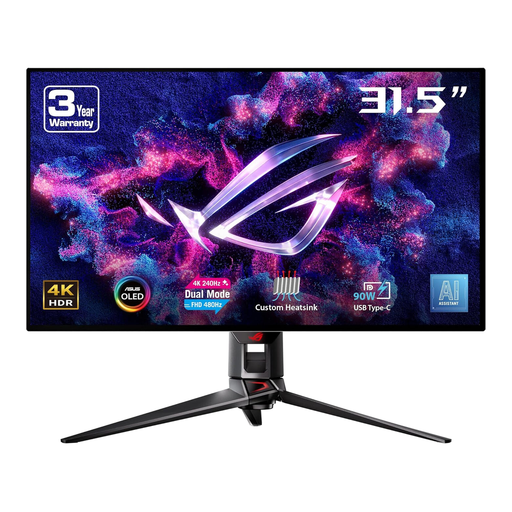
The ASUS PG32UCDP is a formidable entry into the dual-mode market, combining a state-of-the-art WOLED panel with a suite of gamer-centred features.
Why It Stands Out: This monitor’s strength lies in its combination of raw performance and intelligent design. The third-generation WOLED panel technology delivers exceptional brightness and colour, while its custom passive heatsink is engineered for effective, silent cooling to promote panel longevity. The inclusion of AI-driven gaming enhancements provides practical tools for competitive play.
Pros:
Who is it for: This monitor is an excellent choice for serious gamers and content creators who demand premium image quality, top-tier speed and the convenience of advanced connectivity and cooling solutions.
View the ASUS ROG SWIFT PG32UCDP on Joybuy
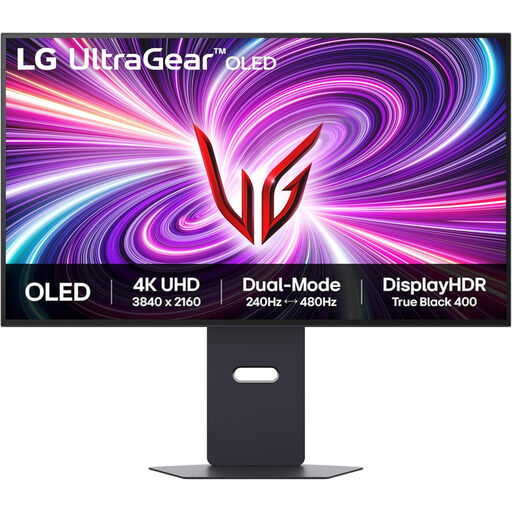
The LG 32GS95UV-B leverages LG's extensive experience in OLED technology to deliver a display built from the ground up for elite gaming performance.
Why It Stands Out: As a pioneer in OLED displays, LG brings its expertise to the forefront with the 32GS95UV-B. A key differentiator is its official certification for both NVIDIA G-SYNC Compatibility and AMD FreeSync Premium Pro, guaranteeing smooth performance regardless of your GPU brand. It also integrates Pixel Sound technology, where the screen itself produces audio, creating a more immersive soundscape.
Pros:
Who is it for: Competitive gamers who prioritise certified adaptive sync compatibility and want a monitor from a leading name in OLED manufacturing will find the LG 32GS95UV-B to be a compelling option.
View the LG UltraGear 32GS95UV-B on Joybuy
The models highlighted here represent the cutting edge of display technology. If your needs or budget differ, or if you're curious about other high-performance displays, a wide range of options is available.
Explore our full range of high-performance gaming OLED screens to find the perfect match for your setup.
1. Is a dual-mode 4K 240Hz OLED monitor worth it for competitive gaming? For players who participate in a variety of genres, it offers exceptional value. You get the ultra-high refresh rate of a 1080p 480Hz gaming monitor for maximum performance in esports titles, combined with the stunning visual detail of a 32 inch 4K 240Hz monitor for immersive single-player games and media. It is an investment in a single, versatile display that excels at everything.
2. What is the risk of burn-in on these new OLED gaming monitors? Image retention, or burn-in, is a known characteristic of OLED technology. However, manufacturers have developed sophisticated mitigation technologies to address this. Modern monitors like the ASUS PG32UCDP and LG 32GS95UV-B include features like pixel shifting, static image detection and specialised cooling systems designed to significantly reduce the risk during normal use. Following the manufacturer's care guidelines will also help maintain the panel's longevity.
3. Do I need a high-end graphics card for a 4K 240Hz monitor? Yes, to fully utilise the 4K 240Hz mode and achieve consistently high frame rates, a top-tier graphics card is required. However, the dual-mode functionality provides a significant advantage here. The FHD 480Hz mode is less graphically demanding, allowing a broader range of powerful GPUs to deliver an extremely high-performance experience.