What matters when choosing?
Start with where you check results most often: an integrated laptop keeps both displays together on the move, while a separate monitor calls for desk space and compatible connections.
Integrated dual-screen laptop
Choose it when: You regularly need results and a reference window visible together away from a fixed desk.
Allow for: Keyboard arrangements and carrying weight vary by model; check whether the setup also works for longer desk sessions.
Laptop with an external monitor
Choose it when: Most result checking happens at a desk where you can position a separate display and input devices.
Allow for: The monitor needs a compatible display connection and space at the workstation; it is not a self-contained travel setup.
| Concern |
What to check |
Who this matters to |
| Portable side-by-side review |
Check the intended screen orientation and whether the keyboard is supplied with the exact model. |
When I move between work locations, I want results and notes visible together without packing a monitor. Around 42% of consumers would make a portable two-screen workspace their primary concern. |
| Prolonged desk use |
Plan screen height and whether a separate keyboard and mouse will fit the workstation. |
For long result-review sessions at one desk, I need room to position the display and input devices comfortably. For around 33% of consumers, that desk setup would come first. |
| Local-analysis configuration |
Compare the software's operating-system, memory, storage and graphics requirements with the exact laptop variant. |
If I process or visualise results locally, I need the machine to run my software, not merely show two windows. That would be the primary concern for around 25% of consumers. |
A dual-screen laptop on Joybuy
This integrated dual-screen laptop suits shoppers looking to keep experiment results beside notes or another application while working away from a fixed desk. Check its exact configuration against the software you use.
 No image available
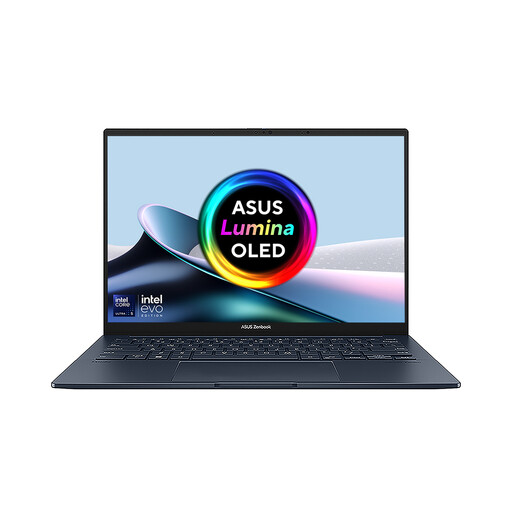
ASUS Zenbook DUO UX8406CA-QL135W 14-inch Dual OLED Touch Laptop
The integrated dual-screen design is suited to viewing experiment results beside notes or another application while mobile.
This listed variant has an Intel Core Ultra 7 255H, 16 GB LPDDR5X RAM and a 1 TB SSD.
Confirm the exact panel resolution and check your analysis software's requirements before ordering. For prolonged desk use, plan how you will position the screens and input devices.
View on Joybuy
Frequently asked questions
Is an integrated dual-screen laptop always preferable to an external monitor?
No. An integrated model keeps both screens together for mobile result checking, while a laptop with an external monitor can suit a regular desk. Microsoft Support describes arranging connected displays in Windows, and the Health and Safety Executive advises using separate input devices so a laptop screen can be raised for prolonged use.
How should I arrange two screens for long result-review sessions?
Plan the screens and input devices as one workstation, rather than choosing by display count alone. For laptop use at a desk, the Health and Safety Executive advises a separate keyboard and mouse so the screen can be elevated; if you connect an external display, arrange the detected screens in Windows to match their physical positions.
Do two screens tell me whether a laptop can run my analysis software?
No. Check the software developer's requirements against the exact laptop variant's operating system, processor, memory, storage and graphics. ASUS UK, for example, lists both 16 GB and 32 GB memory configurations for the Zenbook DUO UX8407, so its model family name alone is not enough.


