
24/7 Customer Support

Free returns

Same-day & Next-day Delivery

Quality Guaranteed

Unlock Your Welcome Offers: FREE Delivery | Up to 80% OFF | Free 30-day JoyPlus trial
Download the APP
As a Joybuy Product Recommendation Officer, I often see the same story: a creative person in the UK invests in a big, promising set of art markers, only to be let down. The excitement of a new project quickly fades when the tools themselves cause frustration. Before you add another set of disappointing pens to your drawer, let’s talk about the common pitfalls and how to sidestep them.
Many fall into the trap of buying markers that look great on the box but fail in practice. The most frequent issues we see are:
Navigating the market for dual tip art markers doesn't have to be a gamble. By understanding a few core features, you can confidently select a set that will serve your creative needs for years to come.
To avoid the common pitfalls, focus on these non-negotiable specifications. They are the true indicators of a marker set's quality and usability, far more than flashy packaging or an inflated colour count.
The main appeal of a dual-tip marker is its versatility. You get two distinct tools in one barrel, but only if both ends are well-made.
Not all water-based markers are created equal. While this type of ink is celebrated for being low-odour and easy to clean, its quality varies dramatically. A superior water-based ink should be:
Instead of providing a simple list, we've matched our recommendations to specific creative profiles. This helps you find a set that not only performs well but is perfectly suited to your projects.
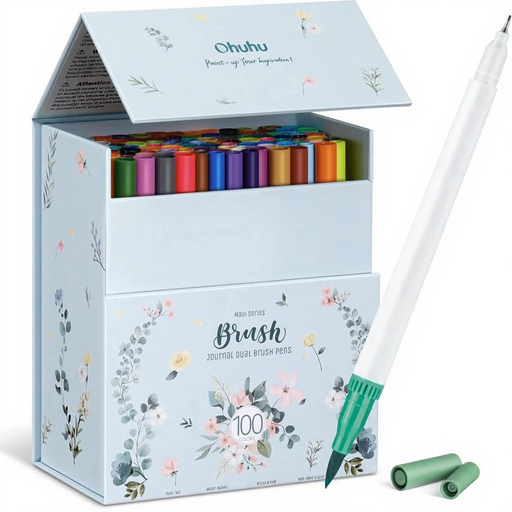
Why This Fits Their Persona: For the creative who does it all—from detailed journalling to expansive colouring projects—this 100 colour marker set provides the ultimate toolkit. The sheer variety of colours and the dual-tip functionality mean you always have the right tool at hand without needing multiple sets.
This set directly counters the "100 shades of grey" pitfall by offering a genuinely diverse and vibrant palette. The inclusion of replacement tips also addresses concerns about the longevity of the "one-week wonder" tips.
A comprehensive range of 100 numbered colours with a DIY swatch card. The dual tips (0.4mm fineliner and 1-6mm brush) offer maximum versatility for any project.
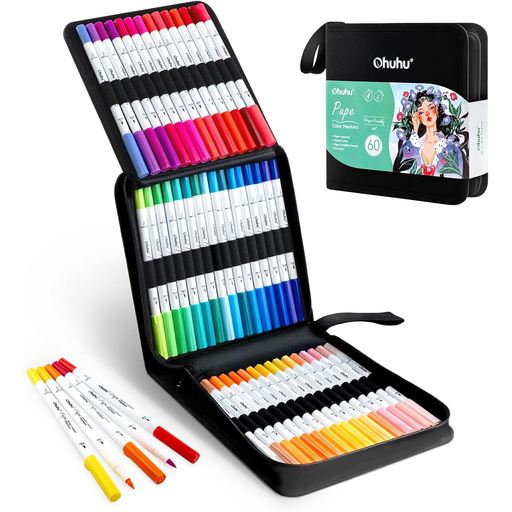
Why This Fits Their Persona: Perfect for those who spend hours with adult colouring books. This user's main concern is ink that applies smoothly and doesn't damage the delicate paper of their books. The 60-colour palette is substantial and curated for artistic projects.
It directly solves the "paper-shredding" problem. The ink is specifically formulated to minimise paper pilling and fluffing, a common issue with standard water-based markers on colouring book paper.
Features an upgraded paper-friendly water-based ink. The set includes 59 colours plus a colourless blender for creating smooth gradients and is certified non-toxic (ASTM D-4236).
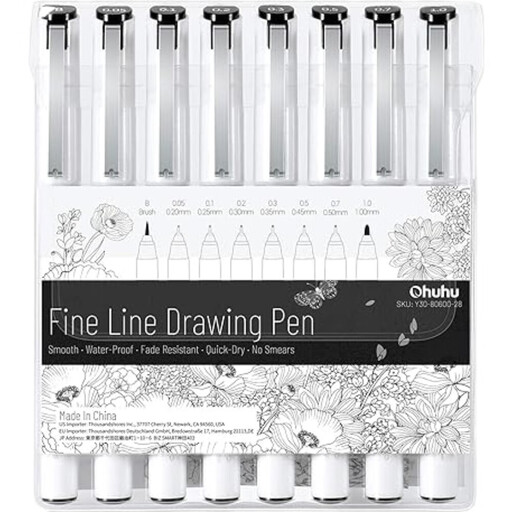
Why This Fits Their Persona: Ideal for artists, illustrators and students who prioritise precision. This set of drawing pens for artists focuses on providing a range of fine tip sizes for technical drawing, sketching and manga art, where line control is paramount.
This set avoids the "one-week wonder" fineliner tip by offering purpose-built, durable tips of varying sizes (0.05mm to 1.0mm). The quick-drying, waterproof ink also prevents smudging, a common frustration for illustrators.
Includes 7 different fineliner sizes plus a brush pen for dynamic strokes. The high-quality black ink is fade-proof and water-resistant, making it suitable for professional work that may be combined with other media.
The most important habit is to always replace the cap tightly and immediately after use, ensuring you hear a 'click'. For optimal ink flow and longevity, it is advisable to store your markers horizontally. This prevents ink from pooling at one end, ensuring both the fineliner and brush tips remain saturated.
Water-based markers use a solution of water and pigment or dye. They are low-odour and the colours can be blended with water, much like watercolour paints. They are generally less prone to bleeding through paper. Alcohol-based markers use alcohol as a solvent, which evaporates quickly to create very smooth, streak-free coverage. They are favoured by professionals for seamless blending but have a strong odour and will bleed through most standard papers.
The brush tip end of a dual-tip marker is excellent for modern calligraphy pens. Its flexibility allows you to create the thick downstrokes and thin upstrokes characteristic of brush lettering. The fineliner tip is not suitable for traditional calligraphy but can be used to create a "faux calligraphy" effect by manually thickening the downstrokes or for adding small decorative elements to your lettering.