
24/7 Customer Support

Free returns

Same-day & Next-day Delivery

Quality Guaranteed

Unlock Your Welcome Offers: FREE Delivery | Up to 80% OFF | Free 30-day JoyPlus trial
Download the APP
Finding the right set of pens can feel overwhelming. Whether you are bringing an adult colouring book to life, perfecting your calligraphy, or organising a bullet journal, the tools you choose make all the difference. Dual tip brush pens have become a popular choice for their versatility, offering both precision and broad coverage in a single instrument.
As the Joybuy Product Recommendation Officer, my role is to help you navigate the options. This guide cuts through the clutter, focusing on practical features to help you find a set that truly suits your creative needs. We will look at what makes a great dual tip pen and highlight a few standout options available today.
Before diving into specific products, let's outline a few key considerations. Keeping these in mind will help you select the right journaling pens set or art markers for drawing.
Dual tip pens are not all the same. The most common combination is a flexible brush tip paired with a fine point nib. These fineliner and brush pens are excellent for projects that require both expressive, variable-width strokes and sharp, consistent lines—perfect for illustration and detailed lettering.
Another combination features a brush tip and a chisel tip. The chisel tip is ideal for broad, even strokes, filling in large areas of colour, or creating bold, block-style lettering. This pairing is often favoured for poster-making, highlighting and simpler colouring projects.
The ink is the heart of the marker. Water-based colouring pens are a fantastic choice for most hobbyists. They typically have low odour, are easy to clean up and are less likely to bleed through standard paper weights. They also offer the ability to blend colours smoothly, often with the help of a water brush or a colourless blender pen to create watercolour-like effects. For these reasons, they are a go-to for adult colouring pens and journaling.
Alcohol-based markers, on the other hand, dry faster and are waterproof once dry, but they have a stronger smell and a higher chance of bleeding through paper.
Consider the scope of your projects. A basic set of 12-24 colours may be sufficient for simple journaling or casual colouring. However, if you are an aspiring illustrator or a dedicated artist, a larger set of 60, 100, or more colours will provide the nuance and variety needed for shading, blending and creating complex palettes. Look for sets that include a good range of tones and a colourless blender for maximum creative freedom.
Here are a few recommendations that cater to different needs, from family craft sessions to detailed artistic endeavours.
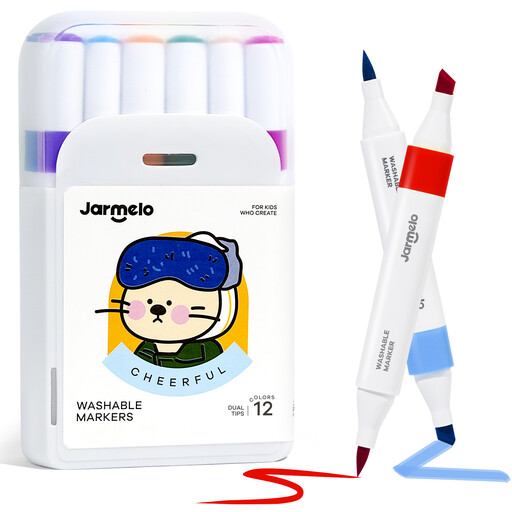
Why It Stands Out: This set is designed with practicality and safety in mind. The combination of a brush tip and a chisel tip offers great versatility for both colouring and bold lettering. Its standout feature is the highly washable, non-toxic ink, making it a stress-free option for creative activities with children.
Pros:
Who is it for? This set is an excellent choice for families, educators, or anyone looking for a reliable and low-mess set of markers for casual crafting, school projects and colouring.
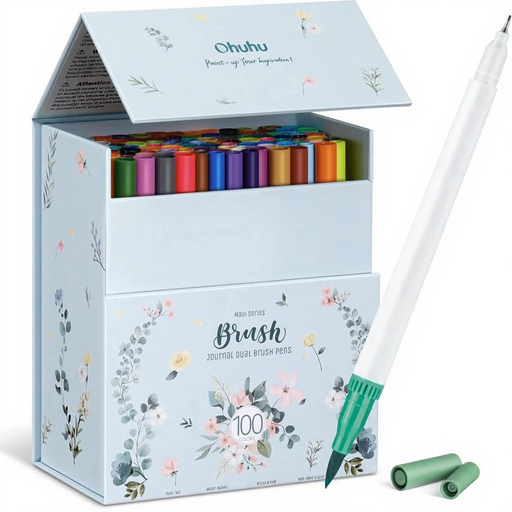
Why It Stands Out: For the artist who craves colour, this Ohuhu set delivers an expansive palette of 100 vibrant shades. It pairs a flexible brush tip with a 0.4mm fineliner tip, providing the control needed for intricate details and the flexibility for expressive strokes. The inclusion of replacement tips adds to the set's long-term value.
Pros:
Who is it for? This set is geared towards serious hobbyists, illustrators and bullet journal enthusiasts who require a comprehensive colour library and the precision of a fineliner.
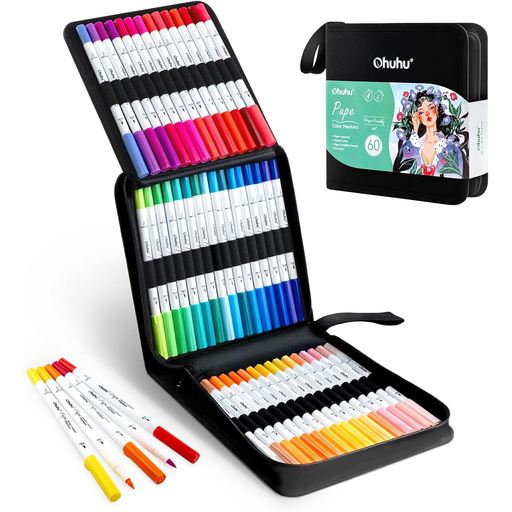
Why It Stands Out: A common frustration for artists is ink that bleeds, smudges, or damages the paper surface. This Ohuhu set directly addresses that with its upgraded paper-friendly water-based ink. It is formulated to minimise paper fluffing and peeling, making it an excellent choice for use in journals and colouring books where paper quality can vary.
Pros:
Who is it for? These calligraphy markers are ideal for adult colouring book enthusiasts, journalers and illustrators who work primarily on paper and want to achieve clean, vibrant results without damaging their work surface.
The world of art supplies is vast, and the right tool can unlock new creative possibilities. While these recommendations cover some of the most popular needs, your perfect match might be waiting.
Explore our full collection of paint markers to find a wider variety of tip styles, ink types and colour sets for your next project.
What are dual tip brush pens used for? Their versatility makes them suitable for a wide range of activities. The brush tip is excellent for modern calligraphy, colouring and creating expressive, variable-width lines. The fine or chisel tip is used for outlining, writing, detailed illustrations and adding precise details. This makes them a popular all-in-one tool for artists, crafters and students.
How do you prevent water-based art markers for drawing from bleeding through paper? While many water-based inks are less prone to bleeding than alcohol-based ones, it can still happen on thinner paper. To minimise it, use paper with a heavier weight (160gsm or higher is often recommended). You can also place a spare sheet of paper, known as a blotter sheet, underneath your working page. Finally, try to avoid going over the same spot multiple times, as this saturates the paper fibres.
Can you blend dual tip brush pens? Yes, blending is one of the key advantages of water-based colouring pens. There are a few common techniques. You can use a colourless blender pen to merge two colours directly on the page. Another method is to apply colours to a non-porous surface (like a ceramic plate or plastic sheet), pick them up with a lighter-coloured pen or a water brush and then apply them to your paper for a smooth gradient.