
24/7 Customer Support

Free returns

Same-day & Next-day Delivery

Quality Guaranteed

Unlock Your Welcome Offers: FREE Delivery | Up to 80% OFF | Free 30-day JoyPlus trial
Download the APP
A dumbbell set can support strength training, cardio circuits and muscle toning without taking over a spare room. However, product pages often focus on colour, transformation claims and headline weight while leaving practical details unclear.
Before buying, check how the weight is measured, whether the handles are comfortable and how securely the equipment rests or locks. A compact set that suits your available space and training level is usually more useful than a larger collection that remains unused.
A listing described as a 10 kg dumbbell set may contain 10 kg in total, rather than two 10 kg dumbbells. This distinction affects the resistance available for presses, rows and lower-body movements.
Always check:
For beginners, lighter fixed weights may be easier to use consistently. Progressing users may prefer an adjustable dumbbell set that allows resistance to change between exercises.
Neoprene can provide a tactile, slip-resistant surface, but it does not remove the need for a controlled grip. A handle that is too narrow, too thick or poorly shaped may become uncomfortable during longer sessions.
Look for the specified grip dimensions and consider how the dumbbells will be used. Short cardio intervals may call for easy handling, while heavier dumbbells for strength training require secure collars, stable plates and a firm grip.
Round-ended weights can roll beneath furniture or across hard flooring. Hex dumbbells are useful for home training because their flat ends can remain stationary when placed down. Even so, weights should be lowered carefully rather than dropped, particularly on laminate, tiles or upstairs flooring.
A multifunctional product can save space, but more connection parts also mean more assembly and inspection. Check threads, locking nuts and handles regularly before use.
Choose a resistance level that suits your current ability while leaving room for gradual progression. A pair of 5 kg dumbbells can work for many upper-body movements, light circuits and general conditioning. Heavier weights may be more suitable for rows, squats and deadlift variations, depending on the user.
An adjustable system is practical where storage is limited. It can offer several resistance settings without requiring a full rack of home workout weights. Confirm that plates can be adjusted evenly on both sides and that the locking mechanism is fully tightened before every session.
Common options include cast iron, steel and coated metal. Cast iron provides a dense core, while neoprene or other outer coatings can improve handling and reduce direct contact with the floor.
A coating should be checked for:
Product specifications should take priority over colour or appearance when comparing neoprene dumbbells.
Measure your storage area before ordering. A dumbbell that fits beneath a sofa may still be too long for a drawer or compact shelving unit. Also consider handle length, diameter and the space needed to change plates.
For floor-based routines, hexagonal ends can help prevent rolling. For adjustable designs, inspect every joining point and use the equipment only in the configuration described by the manufacturer.
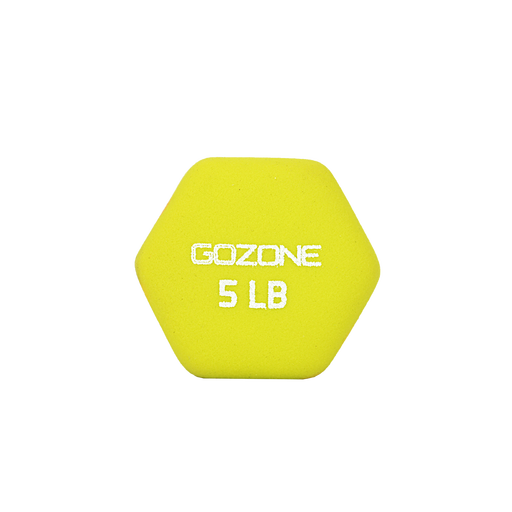
Why This Fits Their Persona: A straightforward option for beginners building a home routine, with a compact fixed-weight format for exercise rooms, flats or limited storage.
The product states a 5 lb weight, uses printed weight markings and has hexagonal ends to reduce rolling during storage.
PVC and iron construction; neoprene texture and non-slip grip; available in multiple sizes for future expansion.
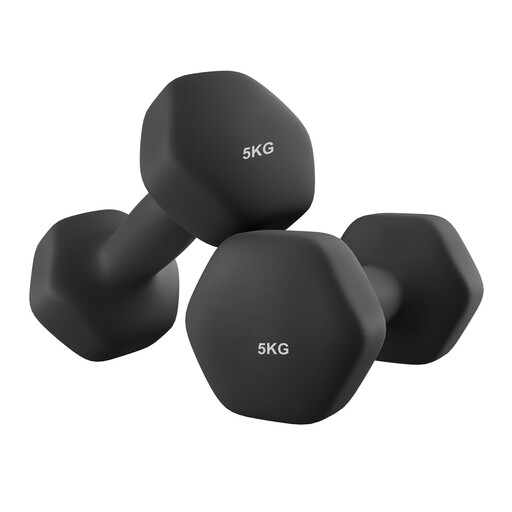
Why This Fits Their Persona: Suitable for shoppers who want a fixed pair with a substantial 5 kg load per dumbbell for home strength and cardio sessions.
The listing specifies 2 x 5 kg, rather than leaving the total load open to interpretation, and notes a possible 3% weight discrepancy.
Solid iron core; neoprene coating; hexagonal ends; stated grip dimensions of approximately 11.5 cm by 4.1 cm.
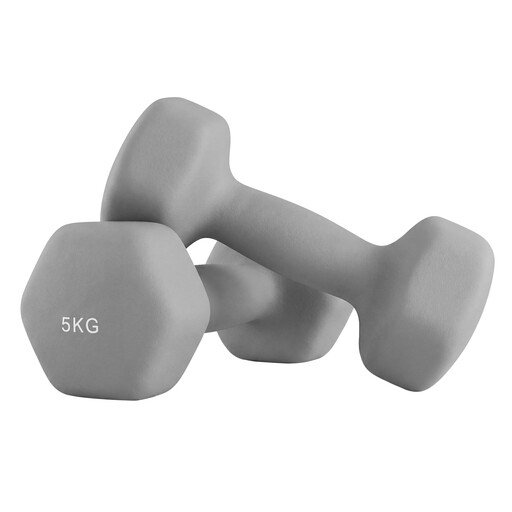
Why This Fits Their Persona: A fixed pair for users who prioritise a coordinated home-gym appearance alongside a clearly specified 5 kg-per-dumbbell format.
Its hexagonal shape helps keep the pair in place, while the product notes advise placing the dumbbells down gently after use.
Cast iron with neoprene coating; 21 cm overall length; supplied as two 5 kg dumbbells.
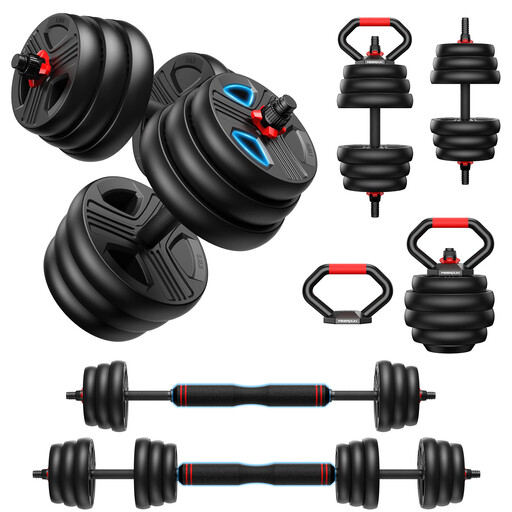
Why This Fits Their Persona: Designed for users wanting one compact piece of home gym equipment that can be configured for several movement types.
The product specifies a 10 kg total set and requires users to secure all plates and conversion components before exercising.
Cast iron with anti-slip coating; dumbbell, barbell, kettlebell and push-up stand configurations; compact storage format.
We have compiled a complete, real-time list of products that fully satisfy these strict selection criteria and UK safety regulations.
Use dumbbells on a stable, level surface with sufficient clearance for your arms and legs. Avoid exercising near glass, radiators, low furniture or trailing cables. For adjustable equipment, tighten every collar and check that no plate moves before starting.
Wipe sweat and moisture from metal components after training. Store weights low down where possible, rather than on a high shelf. Keep children and pets away from the workout area, and follow the supplied instructions and stated maximum load.
They may suit beginners for some exercises, but suitability depends on the movement and the individual. A 5 kg weight can feel demanding for lateral raises but comparatively light for certain lower-body exercises. Start with controlled repetitions and select a load that allows stable technique.
It can be useful where storage is limited because one set may replace several fixed weights. However, adjustment takes longer and the locking components need checking before each use. Choose fixed neoprene dumbbells if quick transitions and simple handling matter more than variable resistance.
Lifespan depends on materials, frequency of use, storage and handling. Cast iron can remain serviceable for a long period when kept dry, while coatings may show wear sooner if weights are dropped or stored in damp conditions. Inspect handles, collars, threads and coverings regularly, and replace damaged components rather than continuing to use them.