
24/7 Customer Support

Free returns

Same-day & Next-day Delivery

Quality Guaranteed

Unlock Your Welcome Offers: FREE Delivery | Up to 80% OFF | Free 30-day JoyPlus trial
Download the APP
A dumbbell set can make home strength training more convenient, but the wrong purchase may leave you with loose plates, uncomfortable handles or equipment that takes up more room than expected. For UK households where storage space is often limited, choosing the right configuration matters as much as the total weight.
Before buying home workout weights, watch for three common traps:
A pair described as 10 kg total generally means the combined weight of both dumbbells, not 10 kg per hand. Confirm whether the listed figure includes bars, collars and plates, and check how many resistance levels are possible.
Beginners may prefer lighter neoprene dumbbells in several fixed weights for movements such as lateral raises, shoulder presses and light circuits. If you expect to progress, an adjustable dumbbell set can provide more flexibility without requiring several separate pairs.
For full-body workout weights, consider whether the set supports both lower-body and upper-body exercises. Squats, lunges and rows usually require more resistance than small isolation movements.
Cast iron provides a dense, traditional weight format. A coating can make the surface more comfortable to handle and may reduce direct contact between the metal and flooring. However, coating type varies, so check whether it is neoprene, rubber or another anti-slip finish.
An anti-slip handle should feel secure without forcing you to grip excessively tightly. Look for a clearly stated handle diameter and length where available. For hand weights for home exercise, colour-coded or clearly marked weights also reduce the chance of selecting the wrong pair during a fast workout.
Hexagonal dumbbells are less likely to roll during floor-based exercises, including rows and supported plank variations. A dumbbells with stand format can also keep pairs together and make a compact home gym easier to maintain.
Measure the storage area before ordering. Product dimensions may refer to the stand, individual dumbbells or the packaged item, so check which measurement is provided. Place weights on a stable, level surface and avoid storing them on high shelves where they could fall.
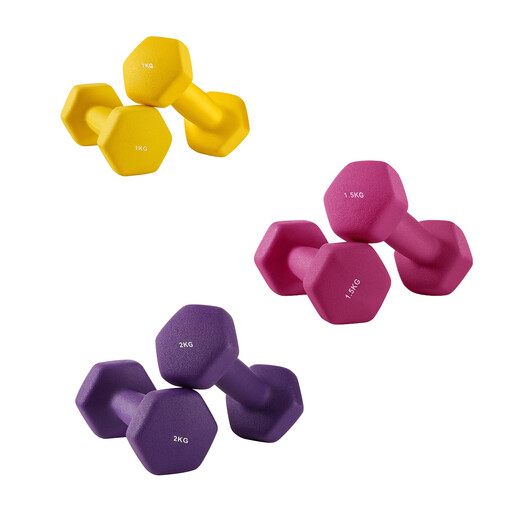
Why This Fits Their Persona: The 1 kg, 1.5 kg and 2 kg pairs offer a straightforward starting range for beginners, busy professionals and anyone creating a small exercise area in a flat or spare room.
The six fixed dumbbells have stated individual weights, while the hexagonal shape helps prevent rolling and the included PP stand provides defined storage.
Three fixed weight options; cast iron construction with neoprene coating; compact stand included.
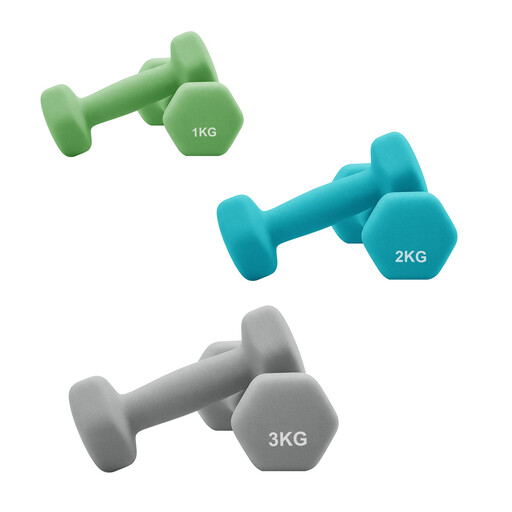
Why This Fits Their Persona: This option suits shoppers who want clearly separated weights, coordinated storage and a more substantial 3 kg pair for progressing beyond introductory hand weights.
The listing provides dimensions for each pair and the stand, helping buyers check storage space rather than relying on general compactness claims.
Includes 1 kg, 2 kg and 3 kg pairs; cast iron with neoprene matte coating; stand dimensions of 38.5 x 35.5 x 14.5 cm.
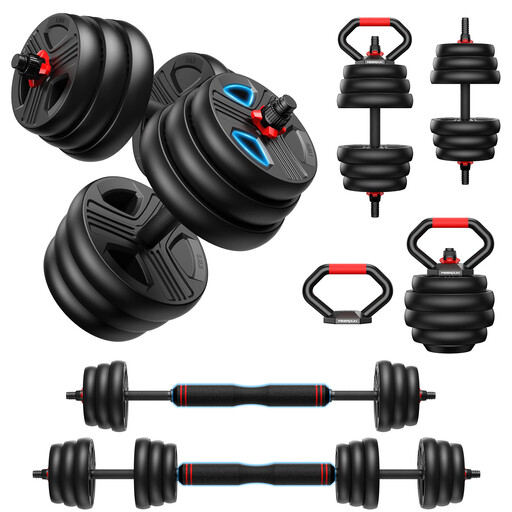
Why This Fits Their Persona: This is suited to users who want one adaptable piece of strength training equipment for varied home sessions, including people with limited storage and changing resistance requirements.
The listing states the 10 kg total weight, adjustable system and conversion components, making its functionality clearer than a vague multi-piece count.
Cast iron with anti-slip coating; converts between dumbbell, barbell, kettlebell and push-up stand configurations; adjustable resistance.
Follow the supplied assembly instructions and check every collar, threaded connection and locking nut before use. Do not exceed the stated total weight or use an incomplete configuration. A stable, flat surface is particularly important when using a barbell conversion or push-up stand.
After training, wipe sweat and moisture from the handles, plates and connectors with a dry cloth. Periodically inspect threads, collars and coatings for wear. Set dumbbells down gently to protect flooring and feet, and keep them away from children and high surfaces.
For UK homes, also consider noise and floor protection. A rubber exercise mat can reduce contact noise and provide a more stable area, but it should not cover damage or instability in the equipment itself.
We have compiled a complete, real-time list of products that fully satisfy these strict selection criteria and UK safety regulations.
Choose a set that allows controlled movement through your planned exercises. Fixed pairs from 1 kg to 3 kg can suit many introductory exercises, while an adjustable set may be more practical if you want to change resistance over time. Prioritise secure fittings and comfortable handling over a large advertised piece count.
They can be, provided the adjustment range matches your intended exercises and every component locks securely. An adjustable set can support presses, rows, curls, lunges and squats, although heavier lower-body training may eventually require equipment with a greater maximum load.
Lifespan depends on loading, storage, cleaning and how carefully the equipment is placed down. Cast iron is durable, but collars, threads and coatings still need inspection. Keeping weights dry, tightening connections correctly and storing them on a stable stand can help maintain their condition.