
24/7 Customer Support

Free returns

Same-day & Next-day Delivery

Quality Guaranteed

Unlock Your Welcome Offers: FREE Delivery | Up to 80% OFF | Free 30-day JoyPlus trial
Download the APP
Buying dumbbell sets for home workouts can seem straightforward until you compare weight ranges, coatings, handles and storage options. A pair that looks suitable online may be too light for your main exercises, awkward to grip or difficult to store in a smaller UK home.
The right choice depends on how you train, how much space you have and whether you expect your strength to progress. Use this guide to avoid common buying traps and compare practical options for beginners, busy professionals and more committed home gym users.
Compact hand weights can look substantial in product images, but the actual resistance may not suit every exercise. A pair of 1 kg dumbbells could be useful for light movement and controlled upper-body routines, while larger muscle groups may require 3 kg, 4 kg, 5 kg or more.
Before buying, consider the exercises you intend to perform:
Neoprene dumbbells and other coated exercise weights are often selected for their softer feel. However, grip diameter, handle shape and surface texture also affect control. A coating alone does not guarantee that a dumbbell will feel comfortable during a longer session.
Look for the stated grip length and diameter, particularly if you have smaller or larger hands. A matte or textured finish can also be more practical than a smooth surface when your palms become warm during exercise.
Round dumbbells can roll under furniture or across hard flooring between sets. This is inconvenient in a living room or home office and may create a trip hazard. Hex dumbbells have flat ends that can remain stationary when placed down, making them more practical for floor-based exercises and compact workout areas.
If you are buying several pairs, consider dumbbells with stand storage. A rack keeps weights together and reduces the temptation to leave them on the floor.
Check whether the listed weight refers to one dumbbell or the complete pair. For example, “2 x 2.5 kg” means the set contains two dumbbells, each weighing 2.5 kg, with a combined listed weight of 5 kg.
Also allow for the stated tolerance. Several products in this range note that individual dumbbells may have up to a 3% weight discrepancy. This is worth considering if you need closely matched weights for symmetrical exercises.
A fixed pair is simple to use, while an adjustable dumbbell set can be more adaptable as your training develops. Adjustable designs may require more assembly and checks before use, so ensure plates, handles and locking components are securely fitted.
Common choices include neoprene dumbbells, PVC-coated weights and bare metal designs. Neoprene and similar coatings can provide a softer contact surface and may be more comfortable for floor exercises. The practical details to compare are:
A secure grip should complement, not replace, controlled technique. Put weights down gently rather than dropping them, especially on hard floors.
Hexagonal ends help prevent rolling, but larger weights naturally occupy more room. Check the listed dimensions against your storage shelf, cupboard or stand. A compact pair may be convenient for a flat or home office, whereas a complete set with a rack needs a dedicated corner.
Cast iron cores provide the weight, while the outer coating influences comfort and contact with flooring. Review the full material specification rather than relying on promotional wording such as “premium” or “professional”.
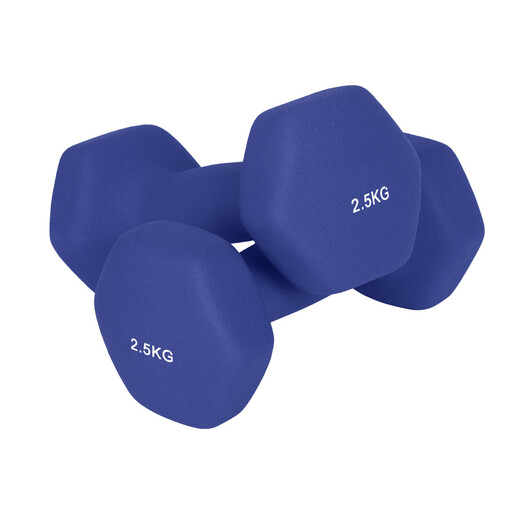
Why This Fits Their Persona: A manageable fixed pair for beginners building a simple home routine in a flat, bedroom or home office.
The 2 x 2.5 kg specification is clearly stated, while hexagonal ends reduce rolling between sets.
Cast iron core, neoprene coating, 18 x 8.5 cm dimensions and an 11 cm handle.
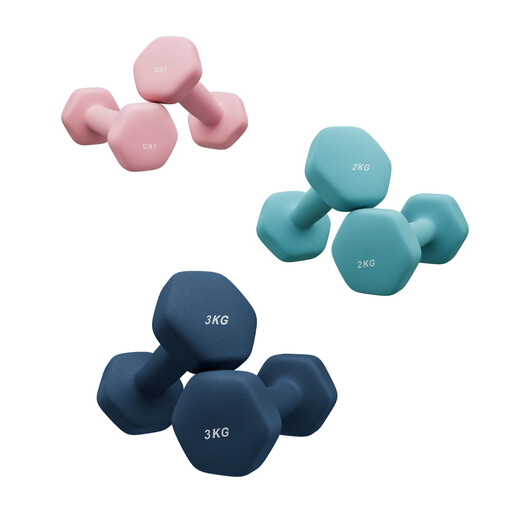
Why This Fits Their Persona: Suitable for households wanting several resistance options with dedicated storage rather than loose weights around the room.
The set includes six labelled dumbbells and a PP plastic stand, helping address storage and weight-selection problems.
Includes pairs of 1 kg, 2 kg and 3 kg weights, with neoprene coating and hexagonal heads.
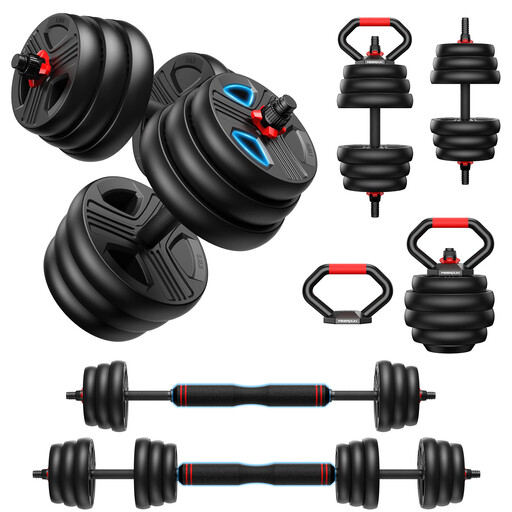
Why This Fits Their Persona: A space-conscious option for men and women who want one adaptable system for varied strength-training sessions.
Its adjustable format avoids buying several fixed pairs, provided the conversion parts are assembled and locked correctly.
The 10 kg set converts between dumbbell, barbell, kettlebell and push-up stand configurations.
Place dumbbells on a stable, level surface and leave enough room to move without striking furniture. Check handles, coatings, plates and locking nuts regularly for visible wear. For adjustable equipment, tighten each connection before use and do not exceed the stated total weight.
Wipe coated and metal surfaces with a dry or lightly damp cloth after training. Avoid storing weights in elevated locations where they could fall. Keep them away from children and place them down gently to protect both the floor and your feet.
We have compiled a complete, real-time list of products that fully satisfy these strict selection criteria and UK safety regulations.
Yes, fixed pairs such as 2 x 2.5 kg can provide a straightforward starting point for controlled exercises. Select a weight that allows stable technique through your planned repetitions without forcing you to swing or lose control. A set with several lighter pairs may suit households where different people train at home.
“Better” depends on your priorities, but hexagonal ends offer a clear practical feature: they help prevent rolling when weights are placed on the floor. This can be useful for renegade rows, floor exercises and rooms where weights need to remain in one position. They do not remove the need for safe handling or adequate floor space.
Most fixed coated dumbbells require limited upkeep: wipe them after use, inspect for damage and store them somewhere dry and stable. Adjustable models need additional checks because weight plates, conversion bars and locking mechanisms must remain secure. With either type, avoiding drops and excessive moisture can help preserve the coating and surrounding surfaces.