
24/7 Customer Support

Free returns

Same-day & Next-day Delivery

Quality Guaranteed

Unlock Your Welcome Offers: FREE Delivery | Up to 80% OFF | Free 30-day JoyPlus trial
Download the APP
For any serious badminton player, the sound of a shuttlecock feather snapping mid-rally is a familiar and frustrating experience. You invest in what are marketed as premium feather shuttlecocks, only to find them failing after a few powerful smashes. This not only disrupts the flow of a competitive match but also significantly increases the cost of your sport over a season.
As the Joybuy Product Recommendation Officer, my role is to help you navigate the market and identify products that deliver on their promises. Many players fall into common purchasing traps, wasting money on shuttlecocks that simply aren't up to the demands of club-level play. The two most frequent issues are:
To avoid these pitfalls, you need to look past the marketing and focus on the core construction parameters. For competitive and dedicated recreational players in the UK, three factors are non-negotiable when selecting durable goose feather shuttlecocks.
The foundation of any high-performance shuttlecock is the feather itself. Goose feathers are widely recognised for their superior durability and aerodynamic properties compared to duck feathers. They possess thicker, stronger quills and a more uniform structure, which contributes to a consistent and stable flight. When inspecting a shuttle, look for feathers that are straight, robust and evenly spaced. This is a key indicator of the quality you'd expect from professional badminton shuttlecocks.
The number on a shuttlecock tube is not a quality grade; it indicates its speed. The correct speed is crucial for consistent play and depends on the ambient temperature and altitude of your playing environment.
Choosing the wrong speed can make your shots feel off and lead to unforced errors, so it's vital to match the shuttle to your typical playing conditions.
The base of the shuttlecock, or the head, endures the most impact. While traditionalists may favour full cork, a high-quality composite ball head often provides superior durability for intense training and matches. These heads are engineered to withstand repeated, powerful impacts without deforming or cracking. This resilience, combined with a strong adhesive and a high-intensity coil holding the feathers, is what separates a true competition shuttlecock from a standard one.
Based on these critical parameters, we've identified a product that aligns with the needs of serious players who prioritise longevity and performance.
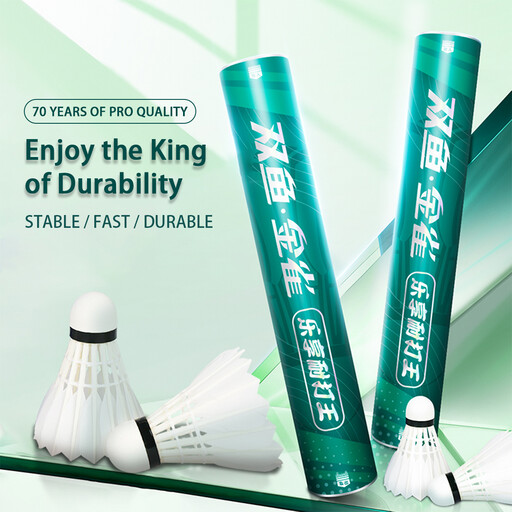
Why This Fits Their Persona: For UK club players and coaches, consistency and cost-effectiveness are paramount. These shuttles are designed for exceptional longevity, reducing the number of birdies used per session. This makes them a practical choice for both high-intensity badminton training shuttlecocks and competitive matches where a reliable flight path is non-negotiable.
It directly counters the "premium" illusion by using genuine premium goose feathers with straight, robust quills. The durable composite ball head and uniform glue application address the hidden flaw of premature structural failure, ensuring the shuttle holds up to aggressive play.
Engineered for exceptional longevity, which lowers the overall cost per game. It provides a consistent, stable trajectory suitable for tournament-spec play, making this badminton shuttlecocks 12 pack a reliable investment.
We have compiled a complete, real-time list of products that fully satisfy these strict selection criteria and UK safety regulations.
The primary cause of premature feather breakage is dryness. To extend the life of your shuttles, you should humidify them before play. The most common method is to store the tube with the ends open in a humid environment (like a bathroom after a shower) for a few hours. Alternatively, you can place a small, damp sponge inside a dedicated humidifier cap that fits onto the tube. This simple step keeps the feathers pliable and far more resistant to snapping on impact.
Speed 77 is a widely used standard in many UK badminton clubs as it performs well in average indoor temperatures (around 18-22°C). Speed 76 shuttlecocks are slightly slower. They are an excellent choice for warmer sports halls, summer league matches or for players who want a little more time to play their shots during fast exchanges. It's often a matter of personal preference and local conditions.
For casual or beginner players, the difference may not be immediately apparent. However, for competitive and serious recreational players, the answer is almost always yes. Goose feathers provide a more consistent and predictable flight path and are noticeably more durable. While the initial cost of a tube of premium feather shuttlecocks made from goose is higher, their extended lifespan during intense play often makes them more economical in the long run compared to cheaper, less durable alternatives.