PDF close readers
If your criticism arrives as journal articles or scanned chapters, footnotes and fixed page layouts make a sample PDF more useful than a format label alone. Check whether you can navigate and mark up the pages you actually receive.


Choose an e-reader around the files you read and the notes you need to keep. Kobo Elipsa 2E suits supported EPUBs and PDFs you can mark up; Kindle Scribe suits readers using Kindle books and Amazon’s document-import route; BOOX Note Air6 C is worth considering when compatible Android apps or a large local library matter. For fixed-layout criticism, check a representative PDF at the device’s screen size: file permissions, import methods and annotation export can matter more than the presence of a pen.
If your criticism arrives as journal articles or scanned chapters, footnotes and fixed page layouts make a sample PDF more useful than a format label alone. Check whether you can navigate and mark up the pages you actually receive.
If handwritten comments and quotations are central to your reading, check where the pen works and how you will retain your annotations. Kobo and Amazon describe different file and import conditions for their writing features.
If your reading spans personal files, library services and reading apps, start with the formats and access rules for those sources. Storage capacity alone cannot establish that a required app or protected document will work.
Decide where your criticism comes from and how you annotate it before comparing screens and pens: each route has different conditions for documents and notes.
Consider it when: Your reading centres on supported EPUBs and PDFs and you want the included Kobo Stylus 2 for notes and markup.
Check: Rakuten Kobo excludes DRM-protected or markup-disabled PDFs from stylus writing, and its stated book-annotation export feature applies to Kobo and Kobo Plus purchases.
Consider it when: Your books are mainly in the Kindle ecosystem and you also want to write on compatible imported documents.
Check: Amazon says direct writing on PDF pages requires a compatible Send to Kindle import; copying a PDF by USB-C does not provide the same support.
Consider it when: Your workflow calls for compatible Android reading apps or room for a large local document collection.
Check: Confirm your required apps and their document-access rules, as well as the seller’s support and warranty terms.
| Concern | What to check | Who this matters to |
|---|---|---|
| Fixed-layout PDFs | Try a representative article with footnotes; inspect page navigation, zoom and whether that file permits markup. | If journal pages or scanned chapters are my main reading, I need to follow their layout without losing my place. Around 36% of consumers would put readable PDF handling first. |
| Handwritten notes | Check pen inclusion, writing eligibility for your files and how annotations can be retained or exported. | When I build arguments from marginal notes, keeping those comments usable afterwards matters most. For around 29% of consumers, retaining annotations would be the primary concern. |
| Books and reading services | List your usual file sources, then check their formats, DRM conditions and any required app. | My reading is spread across books, personal documents and services, so access to the collection comes before extra writing features. That would be the first concern for around 21% of consumers. |
| Size and simplicity | Decide how often you need full-page PDFs or handwriting rather than reflowable eBooks alone. | If I mostly read reflowable books, I would rather carry a simpler reader than prioritise a large writing screen. Around 14% of consumers would make that trade-off their main consideration. |
Rakuten Kobo excludes DRM-protected and markup-disabled PDFs from stylus writing. Amazon’s direct-on-page PDF writing on Kindle Scribe depends on the Send to Kindle import route.
Check the permissions and import method for a journal article or chapter from your normal source before choosing a device for handwritten PDF comments.
Kobo’s stated export feature for annotations in Kobo or Kobo Plus books is distinct from its guidance on handwritten notes in eligible non-protected PDFs.
Decide where your notes must end up, then check the export route for the particular type and source of file you read.
BOOX’s Note Air6 C specifications describe the device, but an Android version or storage figure does not establish compatibility with an institution’s reading service.
Confirm your required app and its DRM rules, then check the UK seller’s warranty, returns and charger details before ordering.
The Kobo Elipsa 2E is a route for readers working with supported eBooks and PDFs who want a 10.3-inch E Ink screen and the included Kobo Stylus 2.
Kindle Scribe is a pen-enabled route for readers whose books and documents fit the Kindle workflow.
The BOOX Note Air6 C is an Android ePaper route to examine if compatible reading apps and a large local collection are priorities.
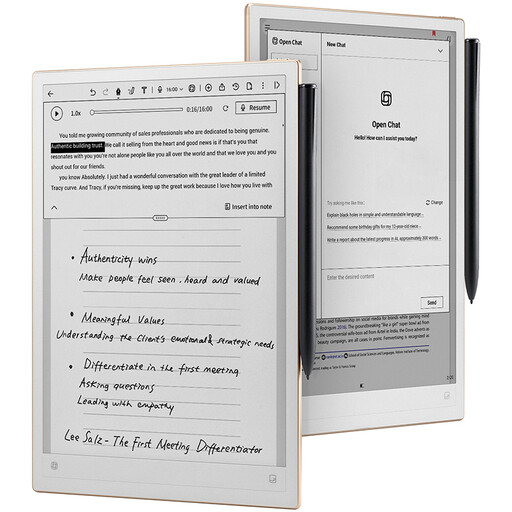
This Joybuy choice is a larger E Ink tablet to assess for reading criticism. Check its handling of your PDFs and note-taking workflow before treating it as a substitute for any of the devices discussed above.
 No image available
If you read criticism as PDFs or EPUBs, assess a sample document on this tablet and check whether your stylus can annotate that reading file directly. The product title identifies a 10.65-inch E Ink tablet and a protective-case bundle; confirm annotation export and compatibility with any library apps you need.
No. Rakuten Kobo says its stylus can write on eligible PDFs, but not on DRM-protected PDFs or files that disable annotations and markup. Check a file from your library, publisher or course if writing on it is essential.
Not through the same direct-on-page writing feature. Amazon states that this feature requires a PDF imported through Send to Kindle; check that route against the way you manage your existing documents.
No. Kobo’s stated book-annotation export feature covers Kobo and Kobo Plus purchases; its guidance for handwritten notes in eligible non-protected PDFs is separate. Check the export method for the files you use before relying on it to archive research notes.