
24/7 Customer Support

Free returns

Same-day & Next-day Delivery

Quality Guaranteed

Unlock Your Welcome Offers: FREE Delivery | Up to 80% OFF | Free 30-day JoyPlus trial
Download the APP
Choosing the right light bulb might seem like a simple task, but when it's a decorative feature in your home, the details matter. An E27 LED globe filament bulb is more than just a light source; it's a style statement. It combines the vintage charm of old-fashioned filament lighting with the energy efficiency and longevity of modern LED technology.
However, with so many options available—from a simple warm white filament bulb to a fully-featured smart e27 bulb—finding the right one for your space can be confusing. This guide is here to help you understand the key features to look for, ensuring you can confidently select a bulb that perfectly matches your home's aesthetic and your lighting needs.
Navigating the specifications on the box can feel a little technical. Here are a few key points to focus on to simplify your decision.
Forget watts; modern bulbs are measured in lumens. The higher the lumen count, the brighter the light. For a soft, ambient glow, look for a 40W equivalent E27 bulb (around 470 lumens). For brighter, general room lighting, a 60W equivalent LED (around 800 lumens) is a more suitable choice.
Colour temperature, measured in Kelvin (K), defines the character of the light.
Your choice here depends on the level of control you want over your lighting.
We've looked at the options to find bulbs that offer a great combination of style, function and value.
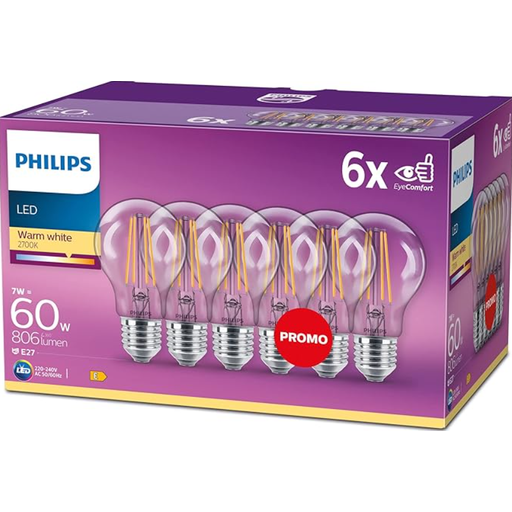
Why It Stands Out: This Philips bulb is a fantastic, no-fuss replacement for traditional incandescent bulbs. It delivers a classic vintage style light bulb look with its visible filament and clear glass, providing a consistent and comfortable warm white light.
According to Philips, its design is intended to be easy on the eyes, reducing the harsh glare and flicker that can cause strain. It provides the brightness of a traditional 60W bulb while consuming significantly less energy.
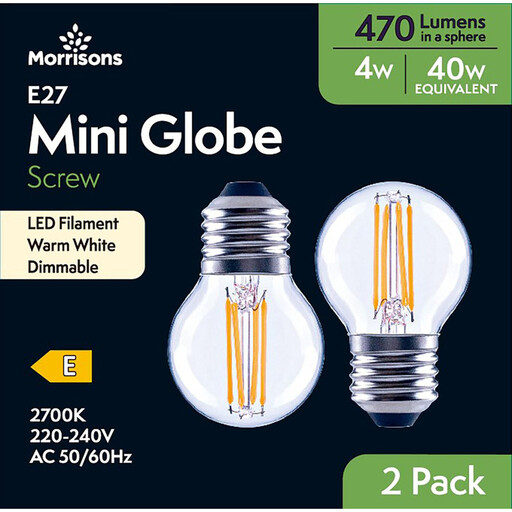
Why It Stands Out: This dimmable LED globe bulb from Morrisons offers excellent versatility. Its 40W equivalent output provides a softer light that's perfect for creating a relaxed atmosphere, and the dimming capability gives you the freedom to adjust the brightness to suit any occasion.
The mini globe shape and clear filament design make it an attractive choice for pendant lights, table lamps and multi-bulb fixtures where the bulb itself is part of the decor.
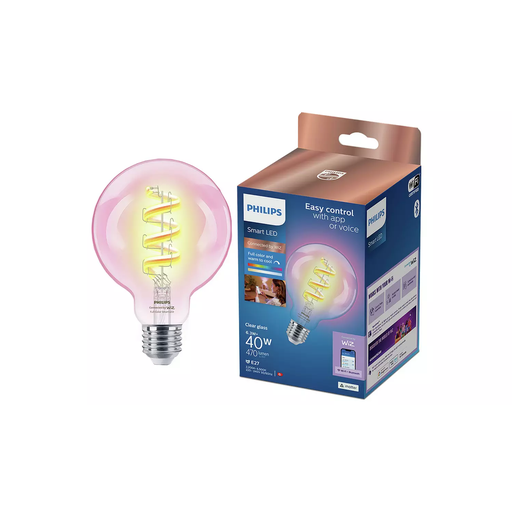
Why It Stands Out: For the tech-savvy homeowner, this Philips smart bulb UK model is a game-changer. It connects directly to your Wi-Fi without needing a separate hub, making setup incredibly simple. Using the WiZ app, you can choose from millions of colours and a spectrum of warm-to-cool white light.
You can automate your lighting with schedules, control it from anywhere with your phone and even use dynamic light modes like 'Fireplace' or 'Ocean' to create a unique atmosphere. It combines the classic filament look with cutting-edge smart technology.
If these specific models aren't quite what you're looking for, or if you'd like to see different shapes and brightness levels, there are many more choices available.
Explore our full range of filament LED bulbs to find the perfect fit for your light fittings.
1. What is the difference between an E27 and B22 bulb? The code refers to the base of the bulb. E27 stands for Edison Screw, 27mm, which is the larger screw-in fitting common across the UK and Europe. B22 stands for Bayonet Cap, 22mm, which is the 'push and twist' fitting also widely used in the UK. Always check your light fitting before purchasing.
2. Can I use a dimmable LED bulb in a non-dimmable socket? Yes, you can. A dimmable bulb will work perfectly fine in a standard, non-dimmable fixture; it will simply operate at 100% brightness. However, you cannot use a non-dimmable bulb with a dimmer switch, as this can cause damage to the bulb and the switch.
3. How much energy does an E27 LED globe filament bulb save? LED bulbs are significantly more efficient than their incandescent predecessors. For example, an LED bulb that produces the same brightness as a 60W incandescent bulb (a 60W equivalent LED) typically uses only 7-9 watts of power. This can lead to substantial savings on your electricity bills over the bulb's long lifespan.