
24/7 Customer Support

Free returns

Same-day & Next-day Delivery

Quality Guaranteed

Unlock Your Welcome Offers: FREE Delivery | Up to 80% OFF | Free 30-day JoyPlus trial
Download the APP
Choosing educational building toys for children can be harder than it appears. Product listings often highlight large piece counts, bright colours or impressive-looking finished models, but these details do not always indicate how enjoyable or practical a set will be over time.
Parents and gift buyers should look beyond the packaging. The right construction toy should match a child’s age, patience, available play space and interest in open-ended or instruction-led activities. This guide explains the main pitfalls to avoid, the specifications worth checking and a selection of building toys for ages 3 to 10 and beyond.
A box containing 150 pieces may sound more substantial than a 60-piece set. However, the total can include many small connectors, repeated tiles or minor accessories. Check what types of pieces are included and whether they allow several different builds.
For younger children, a smaller collection of large, easy-to-connect components may provide more satisfying play than a larger set with fiddly parts. For older children, variety and compatibility with expansion packs can matter more than the headline quantity.
Magnetic building blocks and construction toys are not automatically suitable for every child. Small components can present a choking hazard, while advanced mechanical model kits may be frustrating for a pre-school child.
Always check the stated age range, warning label and supervision guidance. Some products are marked from age 3, while others, such as detailed engine models, are intended for children aged 10 and over. Age guidance should be treated as a practical suitability indicator, not merely a marketing suggestion.
A marble run toy or modular track can occupy considerably more room once assembled than it does in its box. Likewise, sets with dozens of magnetic tiles are easier to use when pieces can be sorted and stored properly.
Before buying, consider whether the child will build on the floor, a table or another stable surface. A reusable storage bucket, gift box or dedicated container can reduce lost pieces and make repeated play more convenient.
For plastic creative building sets, look for clear material information such as ABS plastic, particularly where the product listing provides it. Smooth or rounded edges can make pieces more comfortable to handle, although parents should still inspect components for damage before use.
Toys sold in Great Britain should carry appropriate conformity information and safety details for the applicable market. Check the packaging or listing for relevant CE or UKCA marking, the manufacturer or responsible person details, age guidance and warnings. A safety mark should not replace sensible supervision, especially where magnets, batteries or small parts are involved.
Magnetic tile sets should connect securely enough for simple structures but remain manageable for small hands. Look at the shapes provided: squares and triangles support basic structures, while wheels, windows, arches, spirals or special-track pieces add further possibilities.
Traditional construction toys use studs, bolts, nuts, connectors or snap-fit joints. These can offer a different type of challenge from magnetic building blocks and may be more suitable for children who enjoy following instructions or learning how parts hold together.
Check the finished dimensions where available, particularly for marble runs and track systems. A product may be suitable for a child but unsuitable for a small bedroom or shared living space.
For STEM building toys and engineering toys for kids, check whether tools, batteries or glue are required. Some mechanical model kits use batteries to power lights or movement, while others are entirely manual. Battery compartments should remain inaccessible to young children, and button or coin battery warnings should be taken seriously.
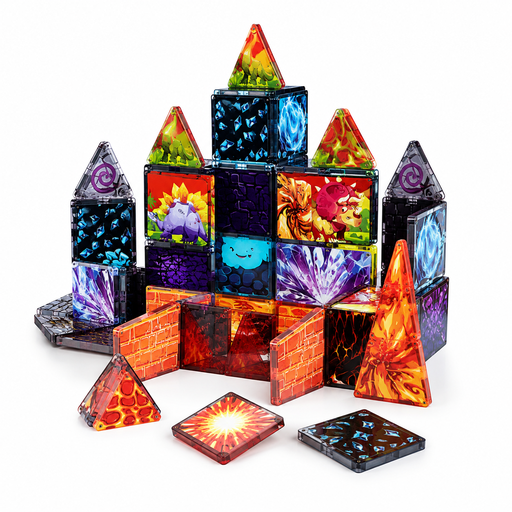
Why This Fits Their Persona: A 60-piece farm-themed set offers a manageable starting point for younger children who are new to magnetic construction and imaginative play.
The moderate piece count is easier to organise than a very large starter box, while the themed format gives children a clear way into open-ended building.
60 magnetic building pieces; farm theme; suitable for collaborative parent-child play.
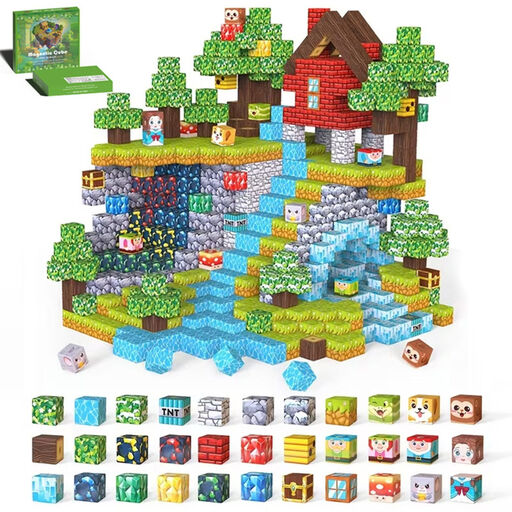
Why This Fits Their Persona: This larger set suits households wanting more shape variety for shared play and progressively more ambitious structures.
Its 150-piece format provides more scope than a basic starter set, but buyers should still confirm storage space and the exact contents before ordering.
150 pieces; ABS construction listed; positioned as a STEM building toy.
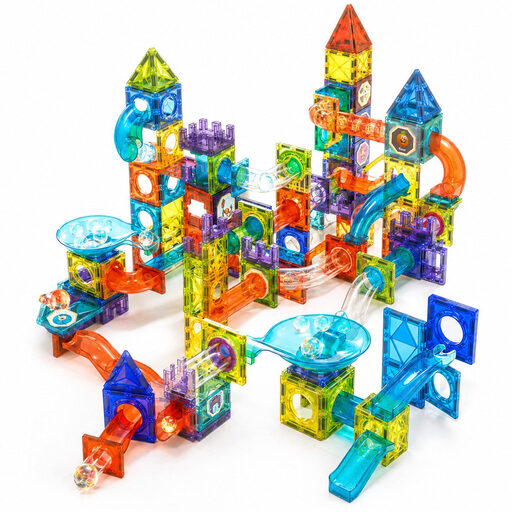
Why This Fits Their Persona: A child who enjoys testing routes, drops and cause-and-effect movement may prefer this focused marble run format to a general building box.
The play objective is clear: assemble a track and observe movement. Check the required floor or table area before purchase.
126 pieces; ABS plastic listed; intended for children from age 5.
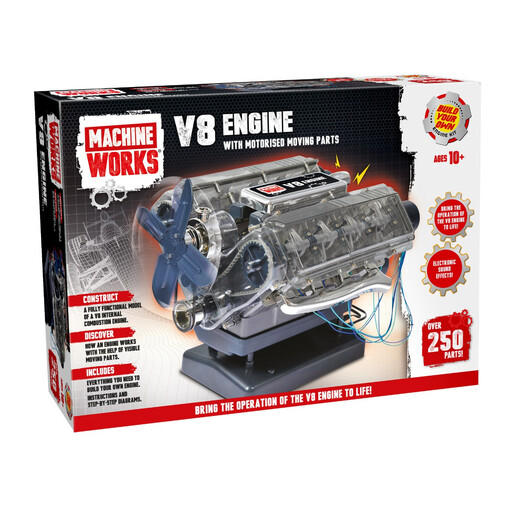
Why This Fits Their Persona: This detailed project is aimed at children aged 10 and over, teenagers and hobbyists who prefer structured assembly and working mechanisms.
The listing states the age guidance, part count and battery requirement, helping buyers assess commitment before ordering.
Over 250 precision parts; transparent case; electronic sound and lighting; 3xAA batteries required and not included.
We have compiled a complete, real-time list of products that fully satisfy these strict selection criteria and UK safety regulations.
Some are, but suitability depends on the design and stated age guidance. Choose larger magnetic tiles or chunky components for younger children, and avoid products containing small parts unless the listing specifically confirms suitability. Adult supervision remains sensible for magnetic sets, marble runs and mixed-piece kits.
Most basic magnetic building blocks do not require batteries. A magnetic tile set with lights, moving features or electronic effects may need them. Check whether batteries are included, the battery type and whether the compartment is secured before buying.
Store pieces in a dry container, keep magnetic tiles away from excessive heat and inspect them regularly for cracks, loose parts or damaged coverings. Follow the cleaning instructions rather than soaking components unless the product specifically states that it is washable. Sorting pieces after play also makes the set easier to use repeatedly.