
24/7 Customer Support

Free returns

Same-day & Next-day Delivery

Quality Guaranteed

Unlock Your Welcome Offers: FREE Delivery | Up to 80% OFF | Free 30-day JoyPlus trial
Download the APP
Choosing educational building toys for children can seem straightforward until you compare age labels, piece counts, materials and safety warnings. A colourful box may promise creativity and STEM learning, but the toy still needs to suit the child’s developmental stage, available space and level of supervision.
Whether you are buying for a family home, nursery, classroom or children’s birthday gift, look beyond the headline feature. The right choice should be usable, easy to store and suitable for the way the child actually plays.
A 150-piece set may appear more economical than a 36-piece set, but quantity is only useful when the pieces are appropriate for the child and support varied builds. Very small components can be difficult for younger children to handle, while a large set may require substantial storage space.
Consider the child’s age, hand size and interests first. A smaller starter set can provide a more manageable introduction to construction, while larger collections are useful for siblings, group play or children who already enjoy building.
Words such as STEM, Montessori-inspired and “early learning” describe a play approach, not an automatic guarantee that a product suits every child. Magnetic building blocks with small parts may be suitable for children aged 3+, but they are not appropriate for babies or toddlers who still mouth objects.
Always check the manufacturer’s recommended age and warning information. In particular, magnetic toys require careful supervision because swallowed magnets can cause serious internal injuries.
Construction toys are often used on the floor, where pieces collect dust and are easily misplaced. Before buying, check whether the set comes with a box or storage container, whether pieces can be wiped clean and whether the finished builds need a large play surface.
For active toddlers, soft-play climbing blocks need enough clear indoor space around them. A toy that cannot be safely set up is unlikely to become part of a regular play routine.
The age label is a safety guide, not simply a marketing category. For children under 3, choose products designed specifically for that age group and avoid loose small parts. Magnetic tiles, pixel blocks and many children’s construction sets are commonly marked 3+ because of their component size.
For older children, a magnetic marble run may add sequencing and cause-and-effect play, but its marbles and connectors need to remain away from younger siblings.
Look for clearly stated materials, such as ABS plastic, wood, MDF, PU or EPE foam, alongside relevant safety information. Products in this selection include references to EN71-1-2-3, which covers areas of toy safety including mechanical and physical properties, flammability and certain chemical requirements. This information should be read alongside the product’s specific warnings and instructions.
Rounded or polished edges are useful practical details. For magnetic products, inspect the tiles regularly and stop using them if a piece cracks or a magnet becomes exposed.
A toddler activity cube measuring around 28W x 26.2D x 32H cm can fit beside a sofa or in a play corner, while a 10-piece soft-play set can occupy an area of approximately 152L x 82W x 70H cm. Measure the intended space before ordering.
For table-top play, check individual piece dimensions. The Tokky magnetic tiles measure approximately 3.5 x 3.5 x 0.8 cm, while the pixel-style magnetic blocks use 2.5 cm pieces. Smaller formats can support detailed designs but demand closer supervision.
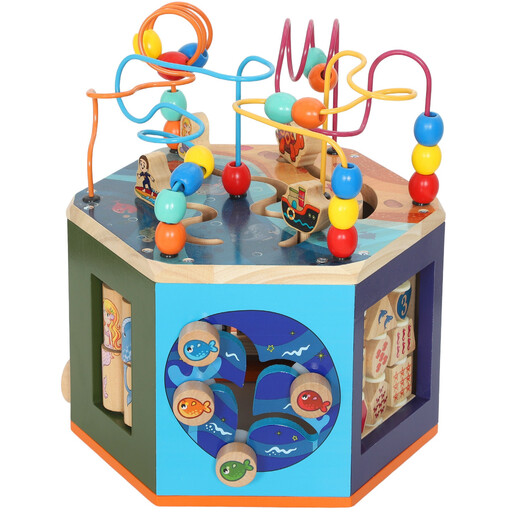
Why This Fits Their Persona: A compact option for families wanting several activities without buying multiple separate toys. It is recommended for toddlers aged 18+ months and measures 28W x 26.2D x 32H cm.
It does not depend on a high loose-piece count. Bead maze, number learning, pattern matching and movement activities are built into one solid structure.
Wood and MDF construction, polished edges, EN71-1-2-3 safety standard information and no batteries required.
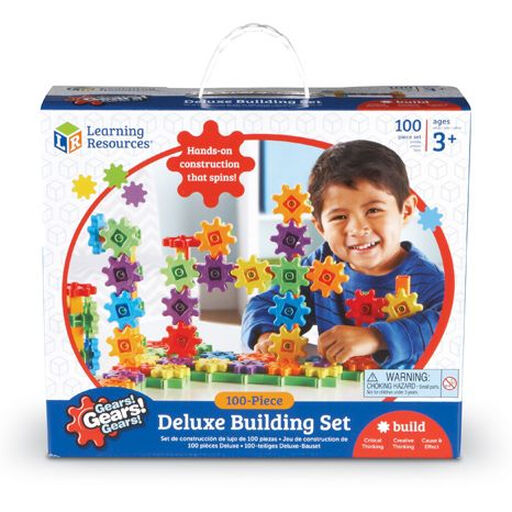
Why This Fits Their Persona: Suitable for households, nurseries and classrooms looking for a reusable construction activity with a clear mechanical theme. It is designed for children aged 3+.
The 100-piece set is not solely about quantity: interlocking gears and a crank handle give the pieces a defined moving function.
Includes 100 pieces, colourful interlocking gears, a crank handle and no batteries. Small-part warning applies.
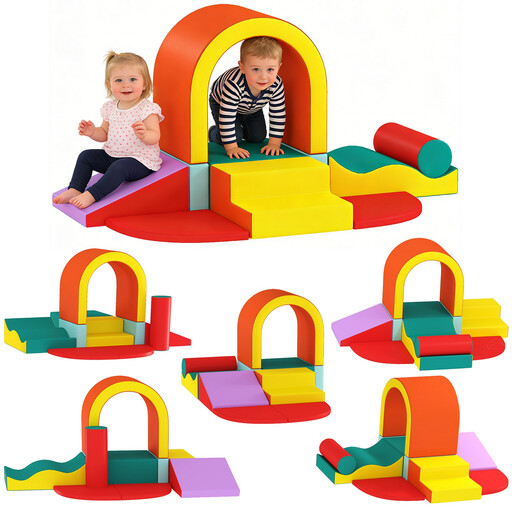
Why This Fits Their Persona: Intended for active toddlers aged 12–36 months in a suitably arranged playroom, nursery or indoor activity area. The modules can be rearranged into different routes.
The product is designed for movement rather than relying on a small-piece construction claim. Anti-slip hook-and-loop pads help hold modules together, but adult supervision and suitable flooring remain important.
Ten PU and EPE modules, wipe-clean surfaces, rearrangeable layouts and stated overall dimensions of 152L x 82W x 70H cm.
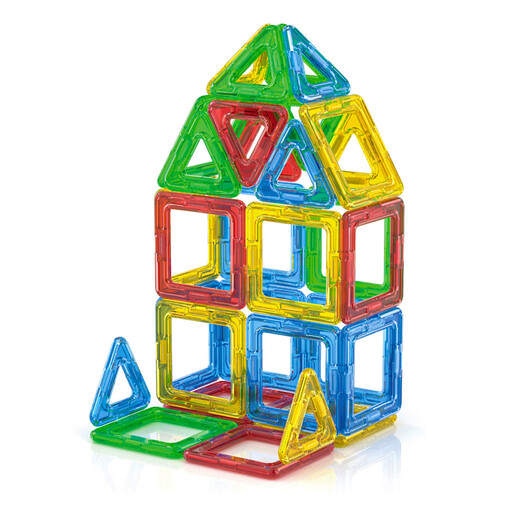
Why This Fits Their Persona: A practical introduction to magnetic tiles for children aged 3+, with lightweight pieces that are easy to arrange on a table or play mat.
The set states its 36-piece count, approximate tile size and 3+ age range clearly, making it easier to judge suitability before purchase.
ABS plastic, rounded edges, strong magnetic connections, colour box packaging and no batteries required.
We have compiled a complete, real-time list of products that fully satisfy these strict selection criteria and UK safety regulations.
For babies and younger toddlers, prioritise robust, fixed activities such as an activity cube. For children aged 3+, magnetic building blocks, gears and other STEM construction toys can encourage open-ended designs, sorting and cause-and-effect exploration. Older children may prefer larger magnetic sets, themed blocks or a magnetic marble run.
Before checkout, confirm the age label, small-part warnings, magnet information, dimensions, cleaning instructions and storage method. These details are more useful than a broad educational promise when deciding whether a toy will work in a real UK home or learning environment.
Some are, but only when the product is specifically labelled for that age group. Avoid magnetic tiles, marble runs, gears and other toys containing small parts unless the manufacturer states they are suitable. The AIYAPLAY wooden activity cube is listed for 18+ months, while the Tokky magnetic tiles and Learning Resources gears set are marked 3+.
The listed magnetic tiles, wooden activity cube and gears set do not require batteries. Ongoing costs mainly relate to replacement pieces, storage and cleaning supplies. Soft-play products generally need no power, but their covers and surfaces should be maintained according to the instructions.
Store loose pieces in their original box or a labelled container, keep magnetic products dry and inspect them regularly for cracks or exposed magnets. Wipe plastic components as directed, avoid immersing products unless the instructions allow it, and remove damaged parts from play immediately.