
24/7 Customer Support

Free returns

Same-day & Next-day Delivery

Quality Guaranteed

Unlock Your Welcome Offers: FREE Delivery | Up to 80% OFF | Free 30-day JoyPlus trial
Download the APP
Choosing educational toys for babies and toddlers can feel harder than it should. Product pages often highlight flashing lights, dozens of sounds and long lists of supposed developmental benefits, while leaving out practical details such as battery use, cleaning, storage and age suitability.
Before buying, watch for three common traps:
The right choice should match the child’s stage, the available space and the type of play they enjoy.
For babies, choose toys that can be used while sitting, lying on the floor or during supervised tummy time. Sensory toys for babies often work well when they offer contrasting colours, tactile surfaces, simple sounds or easy-to-grip controls.
For toddlers, consider whether the toy supports floor play, standing play or table-top activity. A toy labelled for 6–36 months may be versatile, but check whether removable legs, loose accessories or small components are involved.
Products for older children should offer a suitable level of challenge. For example, educational toys for one- to three-year-olds may introduce colours, numbers and cause-and-effect play, while toys for preschool children can involve sequencing, early maths, language and logic.
Look for clear material descriptions and relevant markings. EN71 refers to European toy safety standards covering areas such as mechanical and physical properties, flammability and certain chemical requirements. A CE or UKCA marking may be present depending on the product and market route; however, a marking alone should not replace reading the manufacturer’s age guidance and warnings.
For wooden Montessori toys, inspect the finish, corners and construction. Smooth edges are useful, but parents should still check for splinters, detachable pieces and assembly requirements. For plastic toys, look for rounded edges, secure battery compartments and instructions for cleaning.
Interactive learning toys can be engaging, but sound volume matters in shared homes, flats and bedrooms. An adjustable volume control or mute function is a practical feature for everyday use.
Check whether batteries are included, how many are required and whether the toy has a rechargeable battery. Battery compartments should be secured, and button batteries require particular care because swallowing one can cause serious internal injury. Keep new and used batteries away from children and follow the disposal instructions.
A toy is more likely to remain useful when it offers several types of play: pressing, turning, matching, listening, storytelling or role play. These functions can support early exploration without relying on a screen.
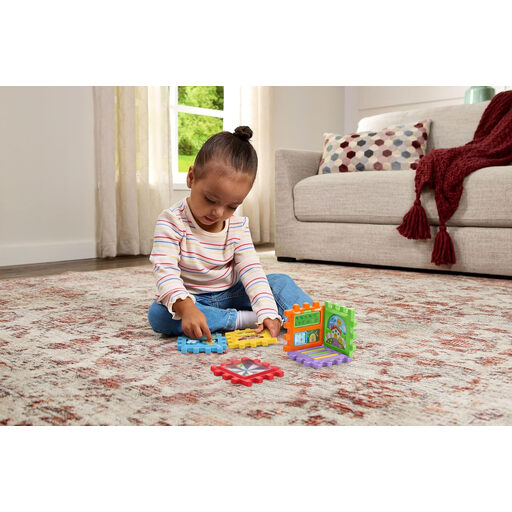
Why This Fits Their Persona: A compact choice for grandparents, smaller play areas or families wanting several activities in one portable format. It is listed for children aged 6 months to 3 years.
Its six-sided design provides different tactile activities rather than relying on one light or sound feature. The small-parts warning still means adult supervision is needed.
Sliding beads, rotating gears, textured surfaces and a light-up music button support varied fine motor play. Two AAA batteries are included.
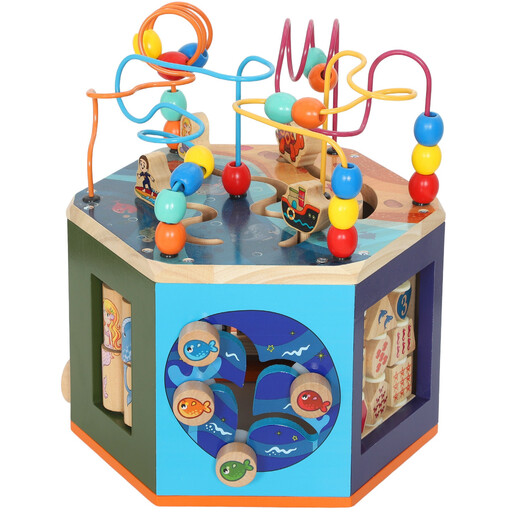
Why This Fits Their Persona: Suitable for households seeking a screen-free wooden activity centre with a defined place in the playroom. It is recommended for children aged 18 months and over.
It clearly lists its materials, dimensions and EN71-1-2-3 safety standard. Assembly is required, so buyers should allow time to construct and check it before use.
The 28 x 26.2 x 32 cm cube includes a bead maze, number learning, pattern matching and movement activities.
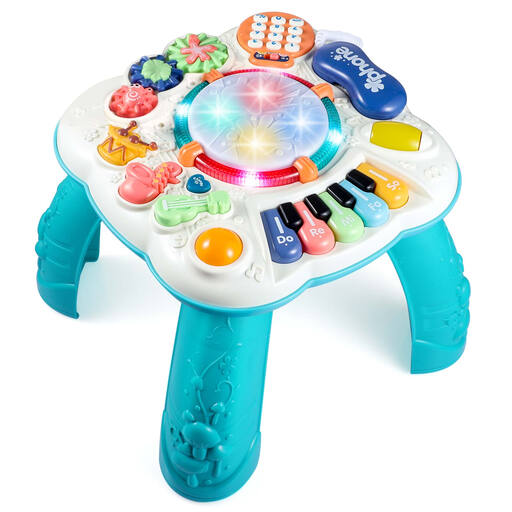
Why This Fits Their Persona: A practical fit for toddlers who enjoy repeated pressing, tapping and spinning, and for families wanting a play centre that changes as the child develops.
The removable legs allow floor-panel use for younger babies and standing-table use later. Adjustable volume and mute functions help limit unwanted noise.
Six play zones include piano keys, a drum, gears, a toy telephone and instrument sound buttons. Batteries are not included.
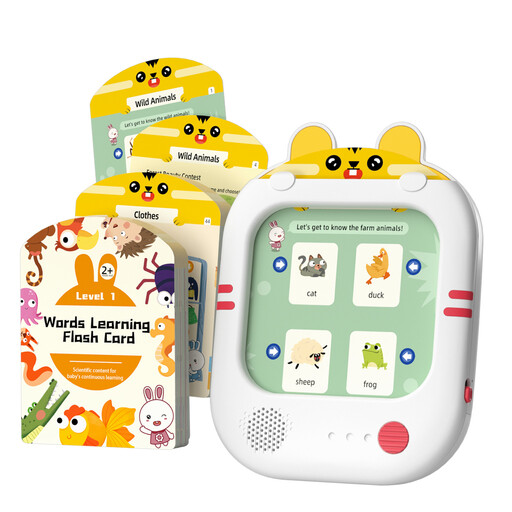
Why This Fits Their Persona: Designed for children aged 3 and above, this suits gift buyers looking for portable language, alphabet and logic activities without an internet-connected screen.
The set states what is included: books, 47 double-sided cards, audio content and recording stickers. Small parts mean it is not suitable for children under 3.
The rechargeable pen provides audio responses, with stated content of over 180 words and 180 logic games. Approximate playtime is six hours.
We have compiled a complete, real-time list of products that fully satisfy these strict selection criteria and UK safety regulations.
Some are, provided they are specifically labelled for that age and contain no detachable small parts. Look for large, easy-to-hold components, simple textures and sounds, and use them under supervision. Avoid toys intended for older toddlers, even if the child appears interested in them.
Lifespan depends on construction, frequency of use, cleaning and whether the toy grows with the child. Multi-stage products, such as activity tables with removable legs or cubes with several play surfaces, may remain relevant for longer. Check moving parts, battery compartments and fastenings regularly, and stop using a toy if it becomes damaged.
Battery-powered toys have an ongoing battery cost, especially when lights, motors and sound are used frequently. Before buying, check the battery type, whether batteries are included and whether the toy has volume or mute controls. Rechargeable products can reduce disposable battery use, but remember that charging should be carried out according to the instructions and by an adult where required.