
24/7 Customer Support

Free returns

Same-day & Next-day Delivery

Quality Guaranteed

Unlock Your Welcome Offers: FREE Delivery | Up to 80% OFF | Free 30-day JoyPlus trial
Download the APP
Buying educational toys for children can feel straightforward until you compare age labels, batteries, noise levels, small parts and build quality. A colourful box may promise learning, creativity and development, yet the product may be unsuitable for your child’s stage or difficult to use in a typical UK home.
This guide explains what to check before buying, then matches selected products to different families and play styles.
A toy marked “1–3 years” may still contain sounds, moving sections or detachable accessories that require close supervision. Age guidance is a starting point, not a substitute for checking the full warning label. For babies and toddlers, look for smooth edges, secure components and a design that suits how your child actually plays.
Interactive features can encourage cause-and-effect play, but too many modes may overwhelm younger children or become irritating in a small flat. Musical toys for toddlers are more practical when they include adjustable volume or mute control, allowing parents to manage sound during meals, nap times and shared living.
Electronic toys often need batteries, while remote control toys for children may require both rechargeable power and disposable batteries for the controller. Also check whether the toy can be stored neatly. Foldable race tracks, removable stands and portable activity cubes can be more useful than a larger toy that remains on the floor.
For children under three, avoid toys marked with a small-parts choking warning. Some dinosaur toys and miniature vehicle sets are intended for older children even if the theme appeals to toddlers. Check the recommended age, warning text and whether accessories can be removed.
Products such as the dinosaur pull-back car set are listed for ages 2–6 but also carry a warning that it is not suitable for children under 36 months because of small parts. Always follow the stricter instruction.
For baby and toddler toys, look for smooth, rounded edges, sturdy construction and a stable base. Several listed products use BPA-free ABS plastic, but material wording alone should not replace checking the product information and care instructions.
A toy with a wide base may be preferable for energetic play. For example, a standing drum or activity table should not easily tip when a child taps, pulls or leans on it.
Check whether batteries are included, what type is needed and whether the battery compartment is secured. The product listings for many early development toys state that batteries are not included. Musical toys should ideally offer volume adjustment, while water-play or amphibious toys need careful drying and use only in the conditions specified by the seller.
For Montessori learning toys, focus on the activity itself rather than the label. Pressing buttons, turning gears, matching shapes and pretending to make phone calls can support hands-on exploration without promising a specific developmental outcome.
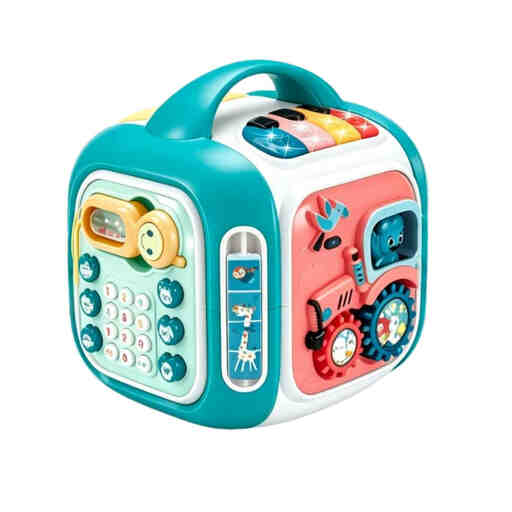
Why This Fits Their Persona: A compact option for families wanting several toddler activity toys in one portable format, particularly where storage space is limited.
It combines eight play modes in one cube, reducing the need to buy several separate toys. The listing states that it has rounded edges and no loose parts.
Includes piano, guitar, gears and pretend-phone activities; measures 23 × 23 × 24 cm and has a carry handle.
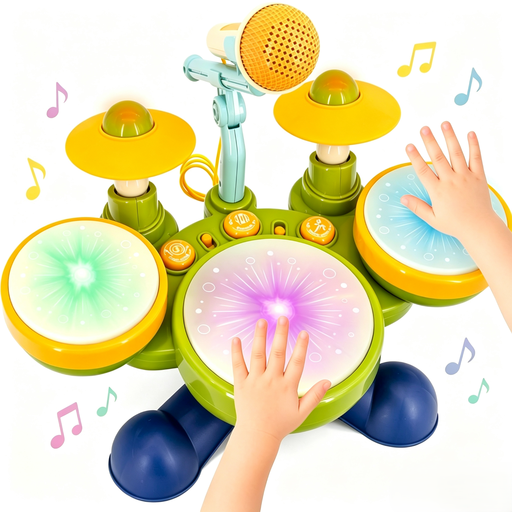
Why This Fits Their Persona: Suits households seeking a more substantial musical play station with features that parents can adjust for indoor use.
The built-in volume dial addresses the common problem of electronic toys being too loud for shared rooms. The stand is removable for floor play.
Includes three light-up drum pads, liftable cymbals and a working microphone. The listing specifies BPA-free ABS and rounded edges.
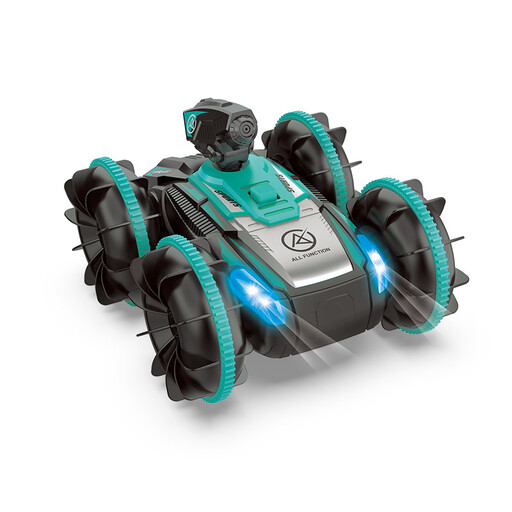
Why This Fits Their Persona: Designed for older children who want active outdoor play across suitable land and shallow-water settings, with adult supervision.
It offers two control methods and is designed for both land and water play, rather than being limited to one indoor surface.
Features 4WD, 2.4 GHz control, LED lights, 360-degree rotation and a sealed body listed for shallow-water use.
For babies, prioritise sensory toys for babies with large, easy-to-press features, stable bases and simple cause-and-effect actions. The musical activity table and frog-shaped drum are examples of products listed for younger children, although supervision remains important.
For toddlers, a keyboard, drum set or activity cube can support shared play. Children’s musical instruments with volume control are especially practical indoors.
For children aged three and above, toy cars and trucks, dinosaur vehicles and construction sets can encourage storytelling, sorting and cooperative play. A foldable transport truck with 12 die-cast cars may suit siblings, while a construction truck set with a play mat creates a larger themed play area.
For older children, remote control toys for children can provide active play and hand-eye practice. Check the operating range, charging requirements, water restrictions and warning labels before use.
We have compiled a complete, real-time list of products that fully meet these strict selection criteria and UK safety regulations.
Look for an age-appropriate design, secure parts, rounded edges and activities that can be understood through hands-on play. Buttons, gears, shape sorters and simple musical actions are generally easier for toddlers to explore than complex instructions.
They can be, provided the volume is kept comfortable, the toy is used as directed and children are supervised. Adjustable volume or mute modes are useful in flats and during quiet periods. Check batteries and keep electronic toys away from unsuitable moisture.
Lifespan depends on construction, frequency of use and storage. Choose sturdy designs with removable or foldable components where appropriate, keep battery compartments dry and inspect toys regularly for cracks, loose parts or damaged controls.