
24/7 Customer Support

Free returns

Same-day & Next-day Delivery

Quality Guaranteed

Unlock Your Welcome Offers: FREE Delivery | Up to 80% OFF | Free 30-day JoyPlus trial
Download the APP
Buying educational toys for children can feel straightforward until you compare age labels, materials, batteries and dozens of claims about learning benefits. A toy may look engaging online yet prove too noisy, difficult to assemble or unsuitable for the child’s actual stage of development.
This guide focuses on practical checks rather than marketing language, helping parents, grandparents and gift buyers choose early learning toys, sensory play products and STEM building toys with greater confidence.
A toy marked “for ages 1 to 5” may not suit every child in that range. Babies need large, simple actions such as pressing, reaching and tracking movement. Older children may need construction challenges, rules or open-ended play.
Check the product’s stated age, dimensions and small-parts warning. A set designed for children aged 5 and above should not be passed to a younger child, even if they are confident with toys.
Terms such as “Montessori-inspired”, “STEM” and “sensory” describe a style or play opportunity, not a guaranteed developmental outcome. A magnetic marble run, for example, may encourage planning and cause-and-effect play, but it still needs suitable supervision and an appropriate skill level.
Look for specific actions the child can perform: sorting shapes, joining pieces, adjusting volume, following a build sequence or creating a story. These details are more useful than general claims about intelligence or learning.
Musical toys, cameras and walkie talkies may require batteries, charging equipment, paper or replacement accessories. Noise can also be a concern in flats, shared homes and during quieter routines.
Before ordering, check whether batteries are included, whether volume can be adjusted and whether the toy has a footprint suitable for your available space.
Use the manufacturer’s age guidance as a starting point, then consider the individual child’s coordination and play habits. Toys containing small components, marbles or detachable accessories require close supervision where appropriate. The dinosaur walkie talkies listed below, for example, are marked for children aged 3 and above and include a choking-hazard warning.
For babies, choose products intended for tummy time, reaching and supervised floor play. A baby activity table with removable legs can be more practical than a fixed design because it can be used as a floor panel before a child is ready to stand.
For plastic toys, review the material description, edge finish and connection points. Product listings may state features such as ABS plastic, BPA-free materials, rounded edges and no loose parts. These are useful details, but buyers should still inspect the toy on arrival and follow the supplied instructions.
Look for clear compliance information, including the CE marking where applicable, and retain packaging and instructions. A CE mark is not a substitute for checking age suitability, assembly quality or supervision. If a listing states compliance with EN71, treat that as product information supplied by the seller and check the packaging or documentation for the relevant details.
Magnetic products need particular care. Check that magnets are securely enclosed and discontinue use if a component becomes damaged or a magnet is exposed.
For toddler musical toys, a volume control or mute function is useful for indoor play. The listed drum sets include adjustable volume, while the baby musical toys use lights, melodies, animal sounds and shape buttons. These features can create interactive play, but they may not suit every household’s noise limits.
Also check battery type and quantity. Some products in this guide state that batteries are not included; the walkie talkies require six AAA batteries. An instant print camera for children may require charging and consumables, so check the product page for operating and safety instructions before purchase.
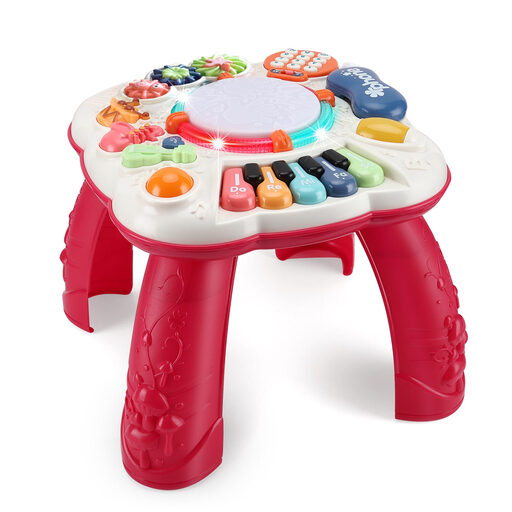
Why This Fits Their Persona: A multi-use option for families buying one engaging present for a baby or young toddler, particularly where floor space is limited.
Its removable legs allow floor play before standing use, and the listing specifies adjustable volume and a quiet mode.
Six play zones, including a keyboard, drum, gears and toy telephone; stated size is approximately 11.8 × 11.8 × 12.2 inches.
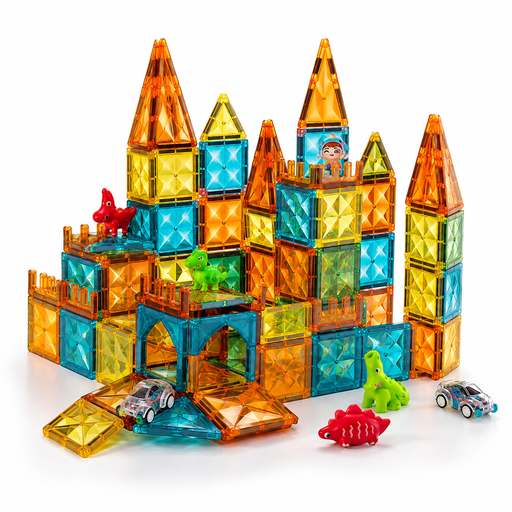
Why This Fits Their Persona: Suitable for children aged 3 to 10 who enjoy construction, imaginative scenes and repeatable open-ended play.
The listing specifies ultrasonic-welded magnetic building blocks, giving buyers a construction detail to check rather than relying only on “strong magnets” wording.
Combines magnetic construction with an illuminated Ferris wheel; suitable for both solo builds and shared play.
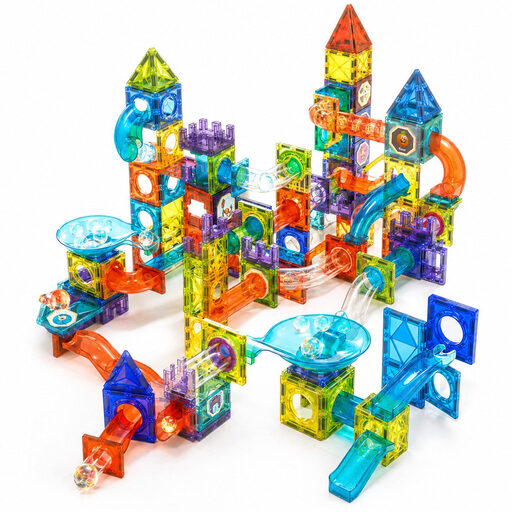
Why This Fits Their Persona: A better match for children aged 5 and above who want to build, alter routes and solve construction problems over multiple sessions.
The 126-piece count and stated expandable format make the play scope clearer than a vague promise of “endless” building.
Made from ABS plastic according to the listing; combines magnetic construction with marble-run cause-and-effect play.
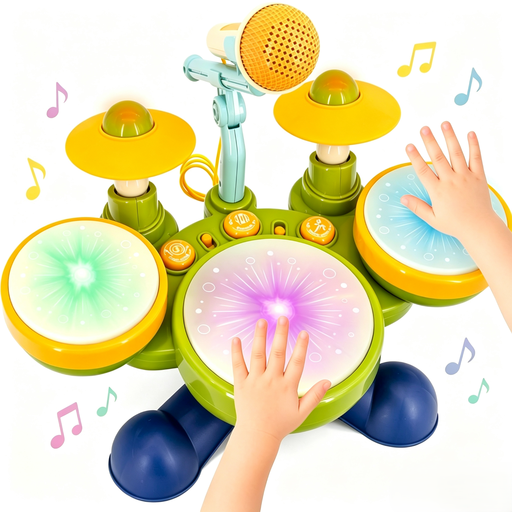
Why This Fits Their Persona: Designed for toddlers aged 1 to 3 who enjoy active music-making and shared parent-child play at home.
The adjustable volume helps address household noise, while the removable stand offers a floor-play configuration.
Includes three light-up drum pads, two liftable cymbals and a working microphone; batteries are not included.
We have compiled a complete, real-time list of products that fully satisfy these strict selection criteria and UK safety regulations.
For younger babies, sensory toys for babies include the frog-shaped musical drum, which combines shape sorting, lights and animal sounds for supervised play from around 6 months. A crawling penguin toy may also suit families seeking movement-based tummy-time play.
For children aged 3 to 6, the dinosaur building set combines snap-together figures with scenery accessories, lights and sounds. Children who prefer role-play may enjoy kids walkie talkies, while an instant print camera for children can encourage photography and creative storytelling. For seasonal gifting, a children’s advent calendar offers a daily activity or surprise, but check the contents and age guidance carefully.
A toy is more useful when it encourages a clear, repeatable action such as building, sorting, sequencing, creating music or telling stories. Adult interaction can extend the play: ask a child to predict where a marble will travel or describe the world built around a dinosaur.
Lifespan depends on construction, storage and how the toy is used. Open-ended products such as magnetic building blocks can remain interesting as children create more complex designs. Keep pieces organised, remove damaged parts and follow cleaning instructions. Battery-powered toys may also need fresh batteries or charging over time.
Some have no ongoing cost beyond normal care. Musical toys and walkie talkies need batteries, while instant print cameras may need charging and printing paper. Compare the initial price with accessory availability, battery requirements and the likelihood of regular use before purchasing birthday gifts for boys and girls or Christmas gifts for children.