For one person preparing several packed lunches, a six- or seven-egg cooker is a sensible starting point: it offers room for a short batch without making a 12- or 16-egg machine the default. Choose poaching or omelette accessories only if you will use them, and check the exact model’s water guide, cleaning instructions and steam precautions. Cooked eggs still need cooling and refrigeration before they go into a packed lunch.
Who is an egg cooker for?
Solo packed-lunch batch cook
You want several hard-boiled eggs ready across your lunches. A clear water or timing guide for your usual batch matters more than the largest advertised capacity; Salter’s instructions, for instance, distinguish between cooking one egg and cooking up to six.
One-person mixed-egg lunch planner
You mainly pack boiled eggs but sometimes prepare another egg dish. Poaching or omelette attachments may be useful if those lunches are part of your routine; Salter and Lakeland list such functions on particular models.
Safety- and storage-conscious lunch preparer
You want a manageable way to handle hot steam and clean the cooker without immersing its electrical base. You also need a plan to cool and refrigerate cooked food before packing it, in line with the NHS’s food-handling advice for children’s food.
What matters when choosing an egg cooker?
Start with the number of eggs you actually prepare and how firm you want them. Then weigh storage and cleaning against any extra cooking functions you would use.
| Concern |
What to check |
Who this matters to |
| Consistent hard-boiled eggs |
Check for hard-boiled instructions covering your usual egg count and a clear water or timing guide. Salter manuals note that egg size and water quantity can affect results. |
I prepare eggs for several lunches and want to know how to repeat the firmness I prefer. Around 42% of consumers put consistent boiled-egg results first. |
| Capacity and storage |
Compare the tray capacity with your usual batch, then check the appliance’s dimensions and where its accessories will go. |
I cook for one person and do not want unused capacity taking up cupboard space. Compact solo-use practicality comes first for around 33% of consumers. |
| Extra functions and handling |
Check whether you would use the poaching or omelette trays, which parts are removable, and what the manual says about steam and cleaning the base. |
I sometimes want a different egg lunch, but the extra parts must be practical to clean and handle. Around 25% of consumers put versatility, cleaning and handling first. |
Common buying mistakes
-
Buying the largest capacity for a solo routine
Six- and seven-egg cookers can cover a short batch of lunches. A 12- or 16-egg capacity becomes more relevant if you regularly prepare eggs for others or make substantially larger batches.
Choose around the number of eggs you normally cook in one session, rather than the maximum printed on the listing.
A larger unit and its accessories also need somewhere to be stored between uses.
-
Expecting a timer to guarantee the same firmness
Salter’s manuals say cooking times are approximate and can vary with egg size and water quantity. Its guidance also distinguishes between a one-egg load and a fuller tray.
Follow the guide for your usual batch, try it with the egg size you normally buy and note any adjustment you prefer.
-
Washing the electrical base like a food tray
Salter’s safety instructions say not to immerse the appliance in water and to unplug it and let it cool before cleaning. Removable food-contact parts and the powered base need different treatment.
Check the model’s cleaning instructions before washing any component, and wipe the base only as the manual directs.
-
Planning the cooking but not the packed-lunch storage
An egg cooker does not keep food chilled after cooking. NHS guidance written for children’s food advises cooling cooked food promptly and refrigerating it.
Make time to cool and refrigerate the eggs, and plan how the packed lunch will stay chilled when it is away from a fridge.
Egg-cooker brands to consider
Lakeland
Lakeland lists both a seven-egg boiler and a six-egg cooker with additional egg-dish functions.
- Lakeland describes the seven-egg model as suitable for soft- and hard-boiled eggs, with a timer and buzzer.
- The six-egg model’s poaching and omelette parts add little to a routine that only calls for boiled eggs.
Salter
Salter offers six-egg models with different combinations of boiling, poaching and digital controls.
- Its listed models let buyers choose whether poaching accessories or a countdown display would be useful.
- Salter’s manuals caution that egg size and water quantity affect results, so a display does not replace the model’s cooking guide.
Quest
A Quest cooker is listed with a seven-egg capacity and automatic power-off.
- The listed capacity allows several eggs to be prepared in one batch.
- Check the model’s water instructions and dimensions against your usual batch and storage space; capacity alone cannot tell you how it will fit your routine.
VonShef
A VonShef 16-egg cooker is listed for substantially larger batches.
- Its stated capacity is relevant if you regularly prepare eggs for others as well as your own lunches.
- For one person’s usual packed lunches, decide whether those larger batches justify storing a higher-capacity cooker.
Egg cookers on Joybuy
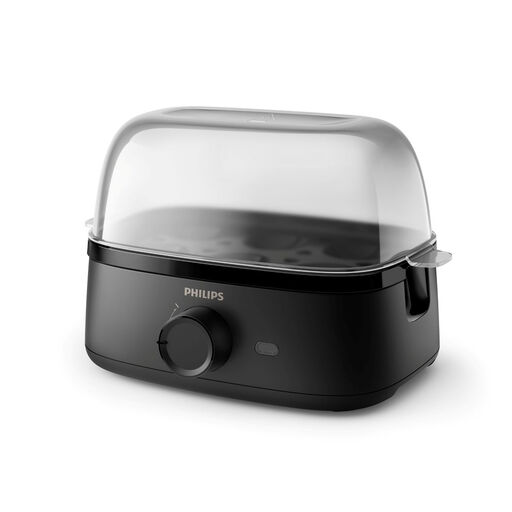
This Philips egg cooker is a product to assess for one-person egg preparation. Check its model instructions against the batch size and firmness you want for packed lunches.
 No image available
Philips 3000 series Egg Cooker HD9137/91
For a solo packed-lunch routine, check the HD9137/91 manual for guidance on your usual number and size of eggs before relying on repeat batches.
Take care around the hot lid and steam, and follow the model’s instructions for cleaning its electrical base.
View on Joybuy
Questions about egg cookers and packed lunches
What capacity makes sense for one person’s packed lunches?
A six- or seven-egg tray is a useful starting point if you prepare several lunches at once. Lakeland, Salter and Quest list models in that range; consider a 12- or 16-egg cooker when larger or shared batches are a regular part of your routine.
Will an automatic cooker make every batch equally firm?
Not necessarily. Salter’s manual says cooking times are approximate and vary with egg size and water used. Follow the instructions for your exact model and usual batch size, then adjust to your preferred firmness.
How should I handle cooked eggs before packing lunch?
Cool cooked food promptly and refrigerate it rather than leaving it out until lunchtime. NHS advice written for children’s food recommends prompt cooling and refrigeration; if your lunch will be away from a fridge, plan how to keep it chilled.
What should I watch for when cleaning an egg cooker?
Keep the electrical base out of water and follow the exact model’s instructions for its removable parts. Salter’s safety instructions also say to unplug the appliance and let it cool before cleaning; take care around hot lids, steam and any egg piercer.


