Small-batch salad preparers
If you usually prepare a few hard-boiled eggs for your own lunches, a compact cooker may be easier to put away after use. Salter and Lakeland both describe six-egg models.


Choose a compact six-egg cooker if one small batch usually covers the salads being prepared and cupboard space matters. If several people regularly need more eggs at once, compare seven-egg models to avoid a routine second cycle, while allowing for more worktop and storage space. Whichever size you choose, plan how its parts will be cleaned and where the cooked food will be chilled.
If you usually prepare a few hard-boiled eggs for your own lunches, a compact cooker may be easier to put away after use. Salter and Lakeland both describe six-egg models.
If several people prepare salads together, compare stated capacity with the number of eggs needed in one session. Lakeland and Quest each list seven-egg models, which may avoid a repeat cycle when six eggs would not be enough.
If worktops, sockets and fridge space are shared, you need a safe place to operate the cooker and a plan for chilling the cooked food. Electrical Safety First highlights water, hot surfaces and trailing cables as kitchen hazards; GOV.UK advises prompt chilling of cooked food.
Start with the batch you normally prepare, then consider who will wash and store the parts and where the eggs will be chilled.
| Concern | What to check | Who this matters to |
|---|---|---|
| Batch capacity | Compare the exact model’s stated boiled-egg capacity with the eggs needed in one preparation session. | If several salads need eggs at once, I would rather finish the batch without waiting for another cycle. Around 31% of consumers put batch capacity first. |
| Cleaning and space | Check which parts are removable, which are described as dishwasher-safe, and where the cooker and accessories will be stored. | When I share a worktop and washing-up space, loose trays and a cooker left out to cool can get in everyone’s way. Cleaning and storage come first for around 25% of consumers. |
| Hard-boiled results | Confirm that the model supports hard-boiled eggs and check its timing or water-measuring instructions. | For eggs I can peel and chop into salads, I want a cooking method that everyone using the appliance can follow. Around 19% of consumers prioritise that consistency. |
| Safe use and chilling | Plan a dry, stable cooking position away from water and crowded sockets, plus containers and fridge space for the cooked food. | If lunch is being prepared ahead, I need somewhere safe to run the hot cooker and somewhere to chill the eggs afterwards. This is the primary concern for around 25% of consumers. |
A larger stated batch may save a second cycle, but the cooker and its parts still need space on a shared worktop and somewhere to go afterwards.
Choose a capacity that normally covers the shared batch, then check the appliance footprint and how its removable parts will be washed and stored.
Poaching trays, omelette dishes and measuring cups add functions, but they also add parts for the household to clean, dry and keep together.
If hard-boiled eggs for salads are the main purpose, check the boiled-egg rack and cooking instructions first. Choose extra functions if the household will use and maintain them.
Cooking a batch does not provide chilled storage for eggs or prepared salad. GOV.UK advises cooling cooked food and putting it in the fridge within one to two hours.
Make room for the batch and have containers ready before cooking, so it can be cooled and refrigerated promptly.
Electrical Safety First identifies water, hot surfaces and trailing cables as kitchen hazards. A crowded shared worktop makes the cooker’s position worth deciding before use.
Use a dry, stable surface, keep the cable away from water and heat, and avoid overloading sockets. Let the cooker cool before moving or cleaning it.
Salter lists compact six-egg cookers, including models with additional cooking functions, for households comparing a straightforward boiled-egg batch with more accessories or controls.
Lakeland offers six- and seven-egg options for buyers deciding whether a smaller multipurpose cooker or a larger boiled-egg batch suits their kitchen.
The Quest cooker is a seven-egg option for buyers who need a larger stated batch without choosing a digital interface.
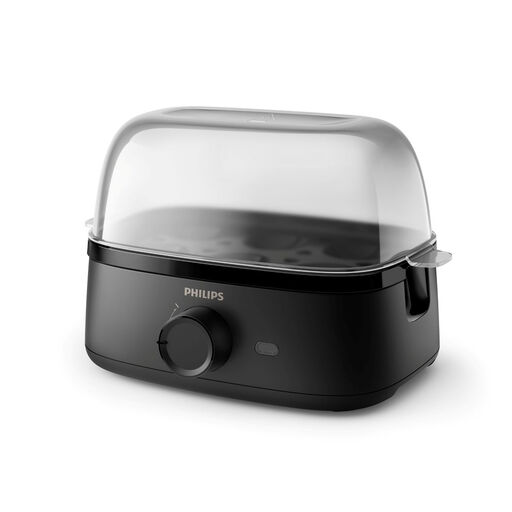
This egg cooker is worth considering if you usually prepare a smaller salad batch and want to compare a compact appliance with the space available in your shared kitchen.
 No image available
Consider this egg cooker for smaller salad-preparation batches, and compare the capacity shown for this exact model with the number of eggs your household usually cooks together.
Before ordering, check the plug configuration for your kitchen. Allow the appliance to cool before handling or cleaning it.
Choose by the number of eggs normally prepared in one session, not by the largest capacity available. Salter lists six-egg models, while Lakeland and Quest list seven-egg options; a larger batch is useful when it avoids a routine second cycle and you have space to cook, clean and chill it.
Cool the cooked food and put it in the fridge within one to two hours, in line with GOV.UK guidance. Prepare containers and fridge space before cooking so a shared worktop does not become the batch’s waiting place.
Let the cooker cool and follow the cleaning instructions for the exact model, particularly for its electrical base and removable parts. Salter’s instructions also say not to move its cooker while it is in use.
Check the electrical-equipment collection or take-back options offered by your local authority or retailer. GOV.UK explains that UK waste electrical and electronic equipment rules aim to reduce electrical waste sent to landfill or incineration; the collection route available to you depends on the local service.