For soft-boiled eggs in a shared kitchen, start with a cooker that has a supplied, model-specific water measure, then check its completion alert or automatic shut-off, storage needs and cleaning instructions. A larger cooker makes sense when several people regularly prepare eggs together; otherwise, its extra capacity also means more appliance and accessories to store.
Who is an egg cooker for?
Consumers seeking a soft, runny yolk
If soft-boiled eggs are your main reason for buying, look for a clearly marked soft setting on the cooker’s own measuring cup. Tower advises that egg size and starting temperature can change the result, so a stated cooking time is a starting point rather than a promise.
People with limited shared-kitchen space
Measure the cupboard and the worktop area where the cooker may be used. Allow room to put away the lid, cup and any trays as well as the main unit; a ready alert or automatic shut-off is useful, but does not replace safe setup.
People preparing eggs for a group
If several people routinely cook together, consider batch capacity and whether poaching or omelette accessories will actually be used. Those extra parts also need cleaning and somewhere to go between uses.
What matters when choosing?
Choose the soft-egg setting for the result you want, check that the cooker fits the permitted space, then decide whether shared batches justify a larger model.
| Concern |
What to check |
Who this matters to |
| Soft-egg consistency |
Look for a soft setting on the supplied measuring cup and follow that model’s instructions; egg size and starting temperature may affect the result. |
If I mainly want a runny yolk, I need a setting I can use consistently rather than borrowing another cooker’s water markings. Around 50% of consumers might put soft-egg consistency first. |
| Shared space and supervision |
Compare stated dimensions with the available space, and check for a ready alert or automatic shut-off. |
When the worktop and cupboards are shared, I want to use the cooker and put it away without crowding other people. For around 30% of consumers, fitting into that routine might be the main concern. |
| Capacity and extra functions |
Check egg capacity, the included cooking accessories and how many parts need washing and storing. |
If several of us regularly prepare eggs together, I would value a useful batch size more than the smallest footprint. That shared-use need might come first for around 20% of consumers. |
Mistakes to avoid
-
Using another cooker’s water markings
Tower says the supplied cup is designed for its T19023 and that egg size and temperature can alter cooking time. A soft setting or timing from another model may not give the result you expect.
Begin with the instructions and cup for the exact cooker you own, then adjust your approach for the eggs you normally use.
-
Choosing capacity without measuring the space
Salter lists the EK2783 at 15.1 × 15.7 × 15.7 cm, while VonShef lists its 16-egg cooker at 21 × 21 × 16.5 cm. A larger batch capacity does not make the base easier to store after breakfast.
Measure the space where the cooker is allowed to operate and be stored. Choose the larger capacity when cooking together is a regular need, not just an occasional possibility.
-
Relying on automatic shut-off for safety
A completion feature does not make a damaged appliance or an unsuitable setup safe. Electrical Safety First warns that faulty appliances can pose shock, burn and fire risks.
Check the shared kitchen’s appliance rules, use a dry, stable surface and a suitable socket, and do not use a cooker with a damaged cable, plug or body, or one that leaks.
-
Leaving cleaning until the next use
Salter’s egg-cooker manual warns that limescale or scorch marks around the heating plate can affect performance and lifespan.
Unplug the cooker and let it cool before cleaning. Follow the instructions for its heating plate and removable parts, then dry accessories before putting them into shared storage.
Brands to consider
These examples show how particular egg-cooker models differ; the features and limitations belong to the named models, not every product from each brand.
Tower
The T19023 suits someone who wants soft-, medium- and hard-boiled settings alongside other ways to prepare eggs.
- Tower specifies capacity for up to seven eggs, poaching and omelette trays, an indicator light, a beep and automatic shut-off.
- Tower gives approximately 6½ minutes for soft eggs, but says egg size and temperature affect timing. Use the supplied cup rather than treating that time as universal.
Salter
The EK2783 is a six-egg option to consider when storage space matters but occasional poaching would be useful.
- Salter specifies six boiled eggs or two poached eggs and lists dimensions of 15.1 × 15.7 × 15.7 cm.
- Compare those dimensions with the actual storage space, and check the exact model’s instructions for its water measure and cleaning requirements.
VonShef
The listed 16-egg cooker is worth considering when a group regularly needs a larger batch.
- VonShef specifies two removable eight-egg shelves; removing one provides an eight-egg arrangement.
- Its stated 21 × 21 × 16.5 cm dimensions require more storage planning than the smaller Salter example, even when one shelf is removed.
Joybuy product choices
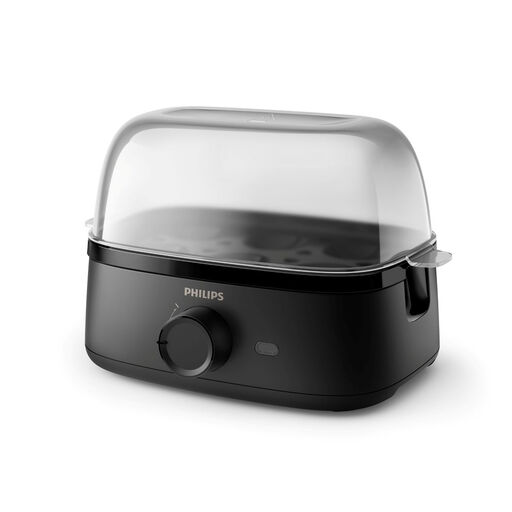
This compact egg-cooker option is relevant if soft-boiled eggs are the priority and the appliance needs to fit into a shared kitchen. Confirm the permitted storage space, plug suitability and local appliance rules before buying.
 No image available
Philips 3000 series Egg Cooker HD9137/91
Consider this model if you want an egg cooker for soft-boiled eggs in a shared kitchen. Check its own water-setting instructions, dimensions, plug suitability and cleaning requirements against how and where you will use it.
View on Joybuy
Frequently asked questions
How do I make soft-boiled rather than hard-boiled eggs in a cooker?
Use the soft-egg marking on the measuring cup supplied with your exact cooker and follow its instructions. Tower says its T19023 takes approximately 6½ minutes for soft eggs, but egg size and starting temperature can change the result; do not copy another model’s water level or timing.
Can I leave an egg cooker unattended if it switches off automatically?
Automatic shut-off is a completion feature, not a substitute for setting up the cooker safely. Follow the maker’s instructions, use a dry, stable surface and do not use an appliance that is damaged or leaking.
How should we clean an egg cooker that several people use?
Unplug the cooker and allow it to cool before cleaning it according to its own manual. Salter’s egg-cooker instructions call for cleaning after each use and regular descaling; check the exact model before putting any removable part in a dishwasher.
What should I check before bringing an egg cooker into a shared kitchen?
Confirm that the kitchen’s rules allow the appliance and that you have a suitable socket, safe place to use it and space to store it. Check the plug, cable and cooker for damage before use; Electrical Safety First warns that faulty appliances can pose shock, burn and fire risks.


