Family-bathroom cleaners
If you regularly clean tile faces and residue around a bath used by several people, a cordless tool lets you work without a trailing mains lead. Decide whether broad coverage or awkward edges take more of your time.


Choose a compact cordless scrubber if grout lines, taps, corners and the bath edge are the difficult parts; choose a telescopic model if reaching high tiles or low panels without bending matters more. Whichever format you choose, check the supplied heads against your tile finish, follow the model’s wet-use instructions and charge the tool outside the bathroom.
If you regularly clean tile faces and residue around a bath used by several people, a cordless tool lets you work without a trailing mains lead. Decide whether broad coverage or awkward edges take more of your time.
If upper wall tiles, low bath panels or the outer bath edge make you stretch or kneel, consider a telescopic handle and an adjustable head.
If narrow grout lines, tap surrounds, corners and the bath rim are your main concern, look for a smaller head you can control around fittings.
Start with the part of the bath surround that is hardest for you to clean. Then check whether the attachments suit its surfaces and whether the power arrangement works for your household.
| Concern | What to check | Who this matters to |
|---|---|---|
| Reach and bending | Compare extended handle length, storage length and whether the head pivots. | If upper tiles or low panels make me stretch or kneel, easier access is my priority. Around 33% of consumers put reach and reduced bending first. |
| Tile-finish care | Identify the tile finish; check for a suitable soft head and test it in an inconspicuous area. | When I clean tile faces as well as grout, I want to avoid scratching a sensitive finish. Surface suitability comes first for around 27% of consumers. |
| Grout and corners | Check whether a small detail or corner head is supplied or available. | If the bath rim and tap bases are harder to clean than open tiles, I need control in tight spaces. Around 20% of consumers prioritise that precision. |
| Power and wet-area use | Check what powers the tool, what is supplied and the model’s wet-use and charging instructions. | I want to be able to use the tool without arranging missing power accessories or charging near the bath. Around 20% of consumers put straightforward ownership and wet-area precautions first. |
A scrubber’s water-resistance rating describes the tool under its stated conditions; it does not make a charging cable or extension lead safe near a bath.
Follow the model’s wet-use instructions and charge it outside the bathroom. Electrical Safety First advises against using extension leads to power appliances within bathrooms.
A wide head can reach open tile faces yet be awkward around joints, corners and taps. Bosch describes its compact UniversalBrush for small-to-medium tasks, while the Ryobi R18TPS-0 uses a 15 cm head for its long-reach format.
Choose for the hardest part of your bath surround, or check that a long-reach tool accepts a suitable detail attachment.
Tiles360 warns that wire brushes and scouring pads can scratch tiles, and that harsh chemicals can damage sensitive surfaces such as natural stone.
Identify the tile material, choose an appropriate cleaner and soft attachment, and test both in an inconspicuous area.
Ryobi Tools UK lists the R18TPS-0 as a bare tool; The Kleeneze Deep Clean Power Scrubber needs four AA batteries that are not included.
Before choosing, check the supplied battery, charger or cable, as applicable, alongside the included heads.
Without a compatible Ryobi ONE+ battery and charger, the R18TPS-0 cannot be used as supplied; the Kleeneze tool needs separate AA batteries before first use.
Bosch positions the cordless UniversalBrush for small-to-medium cleaning tasks, including tiles, joints and narrow areas around bathroom fittings.
The ONE+ R18TPS-0 is a telescopic scrubber to consider when reaching across a bath surround matters more than cleaning tight details.
The rechargeable Scrub Buddi is a compact option for small bathroom surfaces and corners.
The Deep Clean Power Scrubber is a compact, AA-powered option for tiles and smaller household cleaning jobs.
These cordless scrubbers offer either an extendable handle for awkward bath-surround areas or multiple heads for tile and grout cleaning. Check the actual attachments and wet-use instructions against your surfaces before choosing.
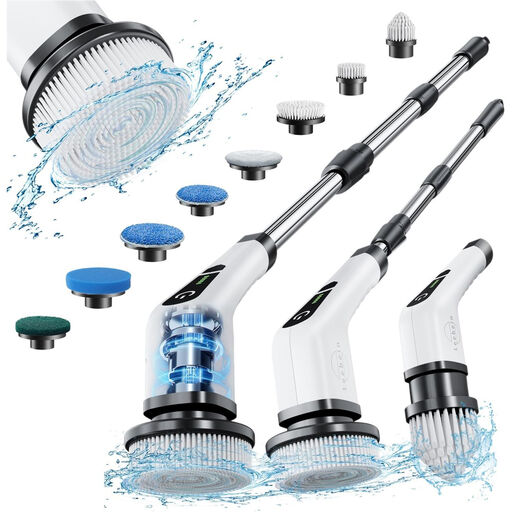 No image available
Consider this cordless model if reaching across the bath surround is your main difficulty. Its title specifies a 137 cm adjustable handle and eight interchangeable heads; check that the supplied shapes and materials suit your grout and tile finish. Follow its wet-use instructions and charge it outside the bathroom.
 No image available
Its extendable handle makes this a format to consider for awkward areas around a tiled bath. The product name specifies two speeds, seven heads and an IPX7 rating; check the head shapes and tile suitability, and follow the model’s instructions for wet use and charging.
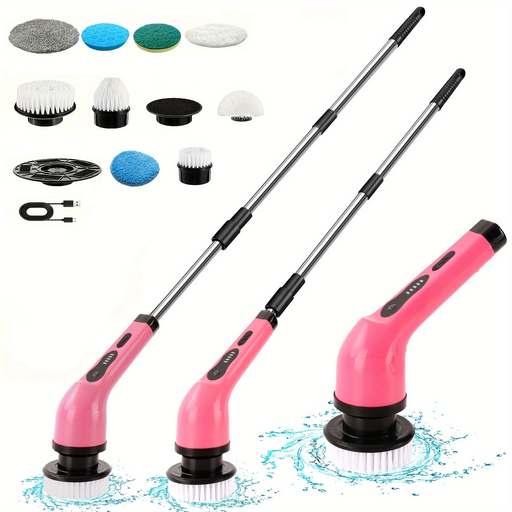 No image available
This rechargeable model is presented for bathroom tile and grout cleaning. Its product name specifies two speeds and nine replacement heads; check the attachment shapes, handle reach and wet-use instructions if you need to clean high tiles or narrow joints.
Choose telescopic reach if high tiles, low panels or the outer bath edge are your main difficulty. If grout, tap bases and tight corners take priority, a compact tool with a suitable detail head may be easier to control.
Charge it outside the bathroom rather than treating cordless or USB operation as an exception to electrical precautions. Electrical Safety First advises against using extension leads to power appliances within bathrooms.
No: follow the instructions for the exact model rather than applying one wet-use rule to every scrubber. Bosch DIY describes the IPX5 UniversalBrush as splash-water protected, while Ryobi Tools UK gives different water-resistance conditions for its IPX7 R18TPS-0.
Not with every attachment or cleaner. Tiles360 advises avoiding wire brushes and scouring pads that can scratch tiles, and warns that harsh chemicals can damage natural stone; identify your finish and test a suitable soft head and cleaner in an inconspicuous area.