Occasional cottage cooks making dressings
If you mainly squeeze lemons, limes or oranges for vinaigrettes, marinades and sauces, consider a small citrus model with a jug you can read easily. Capacity for a large batch need not drive the choice.


For occasional lemon or lime juice for dressings, start with a dedicated citrus juicer that fits your cupboard and is straightforward to clean; a large jug is not necessary for one dressing. Choose adjustable pulp control if recipes vary, and assess how much pressure the operating mechanism requires if hand effort is a concern. More power alone does not establish easier handling or greater juice yield.
If you mainly squeeze lemons, limes or oranges for vinaigrettes, marinades and sauces, consider a small citrus model with a jug you can read easily. Capacity for a large batch need not drive the choice.
Guests need to be able to use, clean and put away the appliance without guesswork. Check how its parts come apart and follow the cleaning instructions for the exact model rather than assuming removable parts are dishwasher-safe.
Compare how each machine is operated, including whether you must hold fruit down on a cone. Duronic markets its electric press to people who struggle with grip or wrist movement, but that is not an independent assessment of how easy it will be for any particular person to use.
For cottage dressings, settle the practical questions of storage and cleaning before choosing extra jug capacity or pulp settings. If squeezing by hand is difficult, assess the operating mechanism separately from the motor rating.
| Concern | What to check | Who this matters to |
|---|---|---|
| Small batches and storage | Check the appliance dimensions against the cupboard and look for a suitable small-fruit cone; a marked jug helps if you measure juice for a recipe. | If I only squeeze a lemon or lime for a dressing, I want a machine that is easy to take out and put away. Around 30% of consumers would put small-batch preparation and storage first. |
| Cleaning and drips | Check which parts detach, whether the exact model permits dishwasher cleaning and how its motor base must be wiped. | When guests use the juicer, I need the clean-up to be clear and manageable. For around 30% of consumers, easy cleaning and low-mess use would be the primary concern. |
| Pulp and citrus sizes | Check the included cone sizes and whether pulp can be adjusted if your recipes call for different textures. | I might strain juice for one dressing but leave pulp in another, or switch between limes and oranges. Around 20% of consumers would prioritise that recipe flexibility. |
| Hand effort | Check how the fruit is held and pressed; wattage does not tell you how much downward force you will need. | If repeated squeezing tires my hands, I need to judge whether I can comfortably operate the machine. Reducing hand effort would come first for around 20% of consumers. |
A dedicated citrus juicer squeezes halved citrus fruit; it is a different tool from a juicer chosen for whole fruit or vegetables.
Choose the citrus category for lemons, limes, oranges and grapefruit. Consider another type only if other produce is part of what you intend to juice.
A larger general-purpose appliance may also mean more equipment to store and clean for this narrow task.
Cleaning rules differ by model: Smeg lists dishwasher-safe parts for its citrus juicer, while Salter’s EK5025 manual says that model is not dishwasher-safe. The EK5025 instruction must not be applied to Salter’s EK5878.
Read the instructions for the model you buy. Unplug it before cleaning, and do not immerse the motor base.
Braun lists the CJ3000 at 20 W and Duronic lists the JE6SR at 100 W. Those ratings alone cannot establish how much juice either extracts or how much pressure a user must apply.
Compare the way each model operates and, if handling is particularly important, check whether you can assess it before committing to a purchase.
The Health and Safety Executive says electrical equipment must be maintained to prevent danger and does not prescribe automatic annual portable appliance testing. An appliance guests share still needs attention to its condition.
Check the plug, lead, housing and attachments for visible damage, remove damaged equipment from use, and arrange competent inspection or testing when the risks indicate it is needed.
The CitrusQuick 1 CJ3000 is a small citrus-juicer option for people interested in press-to-start operation and pulp adjustment.
Lakeland’s 600 ml jug-style model is relevant when a stated working capacity and a choice of cones and filters matter.
The EK5878 combines a 500 ml jug, two cone sizes and variable pulp control for different citrus recipes.
The JE6SR is a 100 W electric citrus press with two interchangeable cones.
Smeg’s citrus juicer is a design-focused option with a stainless-steel reamer and an anti-drip spout.
This Kenwood citrus juicer is relevant to squeezing citrus for cottage dressings. Consider its jug capacity and cupboard dimensions in light of the small amounts you normally prepare.
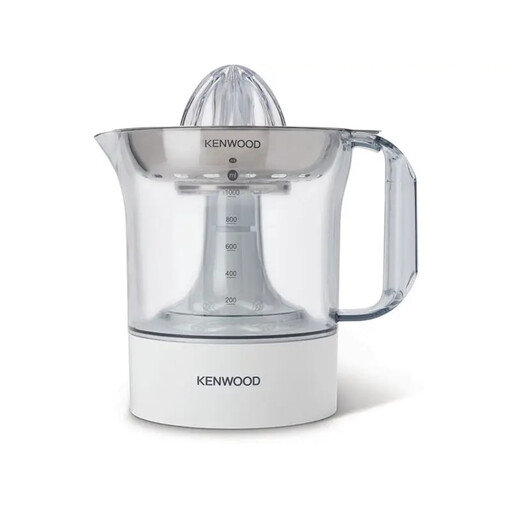 Image unavailable
A dedicated citrus juicer to consider when making juice for dressings. Its stated 1 L jug offers more capacity than one dressing generally needs; check that its listed 21.2 × 16 × 21.9 cm dimensions fit your storage space.
Confirm the plug arrangement before buying, and check for jug measurement markings if you want to measure recipe quantities directly in it.
No: a large capacity is chiefly useful if you make several batches, not a requirement for one dressing. Lakeland lists a 600 ml working capacity and Salter lists a 500 ml jug for their respective models; for a small recipe, check the measuring scale and small-fruit cone as well as capacity.
No, a dedicated citrus juicer is intended to squeeze halved citrus fruit. If apples, carrots or other produce are part of your plans, assess a different juicer type instead.
Only if the instructions for your exact model allow it. Smeg lists dishwasher-safe parts for its citrus juicer, whereas Salter’s EK5025 manual says that model is not dishwasher-safe; unplug the appliance before cleaning and keep its motor base out of water.
Annual portable appliance testing is not an automatic requirement: the Health and Safety Executive says the law does not prescribe a fixed testing frequency. Maintain the appliance to prevent danger, remove damaged equipment from use and arrange competent inspection or testing when its condition and use indicate a need.