
24/7 Customer Support

Free returns

Same-day & Next-day Delivery

Quality Guaranteed

Unlock Your Welcome Offers: FREE Delivery | Up to 80% OFF | Free 30-day JoyPlus trial
Download the APP
Freshly ground beans can improve the practical side of home coffee preparation, but choosing an electric coffee grinder is not simply a matter of selecting the model with the largest wattage or the most grind settings. UK buyers need to consider burr design, adjustment control, cleaning, electrical safety and how often the machine will be used.
A suitable grinder should match your brewing method and daily routine. The wrong choice may produce inconsistent grounds, create unnecessary mess or struggle with repeated grinding sessions.
A grinder advertising dozens of settings may still offer limited control if the adjustment steps are widely spaced or poorly defined. Espresso preparation often benefits from small changes, while pour-over coffee generally needs a broader range of medium-to-coarse options.
Look for a clearly described adjustable coffee grinder with either indexed steps or stepless grind adjustment. Stepless control allows finer manual changes, although it may take longer to learn because there are no fixed clicks to record.
A high wattage figure does not, by itself, confirm grind consistency, heat management or durability. Burr size, alignment, construction and the recommended duty cycle are also important.
For home use, a grinder should be operated according to its manual and allowed to cool if the manufacturer specifies rest periods. A model suitable for light café use may still require pauses between extended grinding sessions.
Fine coffee particles can cling to the chute or container, particularly in dry indoor conditions. This can cause mess and leave old grounds in the next dose. An anti-static coffee grinder or one with a system for clearing residual powder may reduce this problem, but it does not remove the need for regular cleaning.
Do not immerse an electric grinder base, plug or power cord in water. Always unplug the appliance before cleaning or removing a blockage, and keep fingers and utensils away from the burr chamber.
A burr coffee grinder crushes beans between two burrs rather than chopping them with a blade. This design is generally more appropriate when you want control over grind size for espresso, filter coffee or pour-over brewing.
A conical burr grinder is commonly used in domestic machines because it can provide a compact design and a broad adjustment range. Burr size should be considered alongside the rest of the construction. For example, the Starseeker E55 Pro models use 55mm titanium alloy conical burrs, while the HiBREW G3 uses a 48mm conical burr.
Titanium alloy burrs may appeal to buyers prioritising a stated wear-resistant material, but the product specification should still be checked for cleaning instructions, replacement parts and intended usage.
Espresso requires a fine grind, whereas cafetière, filter and pour-over methods usually need coarser settings. If one household uses several brewing methods, select a grinder that states it supports the required range.
A pour-over coffee grinder should offer repeatable medium settings, while an espresso coffee grinder needs fine control without making the dial difficult to use. If you switch between methods often, note whether the hopper and adjustment mechanism can be reset consistently.
A large hopper is useful for households or small cafés that prepare several drinks, but it may be unnecessary for a single daily cup. Check both bean capacity and ground-coffee container capacity.
The HiBREW G3 lists a 210g bean container, a 100g powder tank and single- or double-cup quantitative discharge. These features may suit users who prefer preset dosing. By contrast, a smaller, more direct workflow may be preferable if you weigh each dose manually.
Also confirm the appliance’s electrical specifications. The HiBREW G3 lists 220–240V, 50Hz, which corresponds with standard UK domestic voltage requirements. Check the product listing, plug type, markings and supplied instructions before purchase.
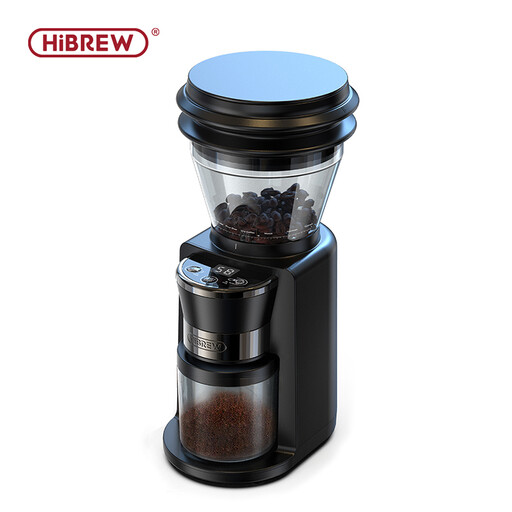
Why This Fits Their Persona: Its 34 grind settings, manual/automatic modes and quantitative button provide a straightforward starting point for UK home users preparing different cup sizes.
The stated settings and capacities are clearly specified, while the built-in air blower and anti-static function address residual powder and mess.
48mm conical burr; 210g bean container; 100g powder tank; 220–240V specification.
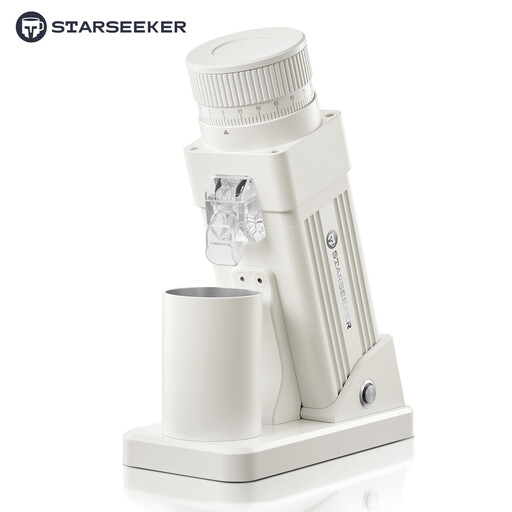
Why This Fits Their Persona: Home baristas focusing on espresso may value its stated 55mm titanium alloy conical burrs and stepless adjustment for manual fine-tuning.
Its product description identifies the burr size, burr material and stepless control rather than relying only on a broad “professional” label.
55mm titanium alloy conical burrs; stepless adjustment; anti-powder-flying technology; 72W AC motor.
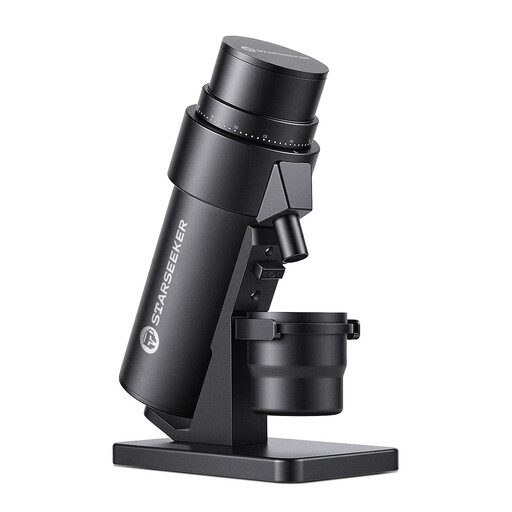
Why This Fits Their Persona: Users switching between espresso and pour-over can consider the stated 63mm burr format and suitability for both brewing styles.
The listing provides a defined burr measurement and explicitly identifies espresso and pour-over use, helping buyers compare it with vague all-purpose claims.
63mm burrs; listed for espresso and pour-over; outlet pricing may suit buyers comparing value.
Place the grinder on a stable, dry surface with ventilation openings unobstructed. Check beans for stones or other hard foreign objects before grinding. Use the supplied settings and avoid forcing beans through the burrs.
For routine care:
These steps are relevant whether you choose a home coffee grinder or a model listed for café use. A grinder’s service life depends on bean condition, cleaning, operating frequency and adherence to its duty cycle.
We have compiled a complete, real-time list of products that fully satisfy these strict selection criteria and UK safety regulations.
Many burr grinders cover both fine and coarse settings, but the usable range and adjustment control differ between models. Check the product description for espresso and pour-over compatibility, then confirm whether the adjustment is stepped or stepless.
Remove loose grounds regularly and follow the manufacturer’s cleaning instructions. Light users may need a deeper clean less frequently, while daily espresso preparation can leave more fine residue around the burrs and chute.
Running cost depends on motor power and operating time. Coffee grinding normally takes a short period, so usage time is often limited; however, do not select a grinder solely by wattage. Burr design, dose control, adjustment range and the stated duty cycle are more useful comparison points.