
24/7 Customer Support

Free returns

Same-day & Next-day Delivery

Quality Guaranteed

Unlock Your Welcome Offers: FREE Delivery | Up to 80% OFF | Free 30-day JoyPlus trial
Download the APP
An electric contact grill can make toasted sandwiches, burgers, vegetables and steaks with less preparation than a conventional oven or frying pan. However, product listings often focus on wattage or phrases such as “health grill” without explaining the practical details that affect everyday use.
Before buying a panini press or sandwich maker, watch for these common traps:
Plate size determines how much food you can cook at once. A compact appliance may suit one or two people, while larger plates reduce the need to cook in batches.
For comparison:
A standard contact grill presses food between upper and lower plates. A 180° contact grill opens flat, converting into a tabletop grill and allowing more flexible positioning of meat and vegetables. Check whether the upper plate has a floating or adjustable height if you regularly cook thicker burgers, steaks or filled sandwiches.
Wattage indicates the electrical input, but it does not by itself guarantee cooking results. Higher power can help an appliance heat up quickly and recover temperature after food is added. It may also increase energy use while heating.
An adjustable temperature grill is useful when cooking different foods. Sandwiches generally need a different setting from vegetables or steak, so a single fixed temperature can limit control. Simple dial controls are usually straightforward for everyday use.
For running-cost estimates, multiply the appliance’s kilowatt rating by the number of hours used, then multiply by your electricity tariff. For example, a 2,000W grill uses up to 2kW while actively heating; actual consumption depends on thermostat cycling and cooking time. Check the product instructions and your household tariff rather than relying on wattage alone.
A non-stick grill can reduce the need for added oil, but it still requires careful handling. Use silicone, nylon or wooden utensils, and avoid knives or metal tools that may scratch the coating.
Prioritise:
Never immerse the main electrical unit, cord or plug in water. Always unplug the appliance and allow it to cool fully before cleaning.

Why This Fits Their Persona: A compact choice for students, couples and smaller UK kitchens where worktop and storage space are limited. It combines a grill, sandwich maker and panini press in one appliance.
Its stated 22.5 × 14cm plates make the available cooking area clear, rather than relying only on general versatility claims.
800W output, double-sided heating and food-grade non-stick plates in a smaller format.
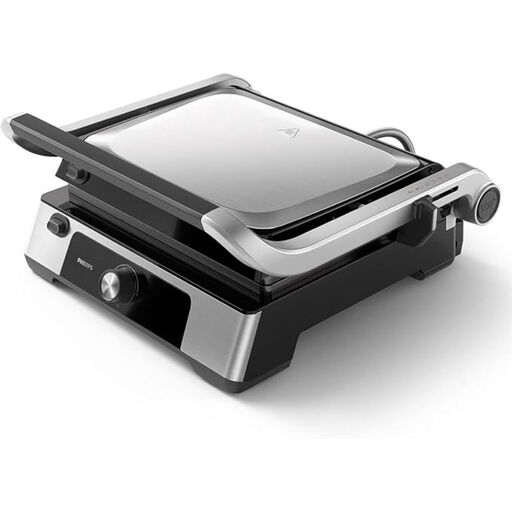
Why This Fits Their Persona: Suits regular home cooks wanting temperature adjustment, a larger format and features that support repeated indoor use.
The specification lists adjustable temperature, removable plates, a removable grease tray and a 180° opening.
Up to 2200W maximum power, adjustable-height top plate and 2-year manufacturer’s warranty.
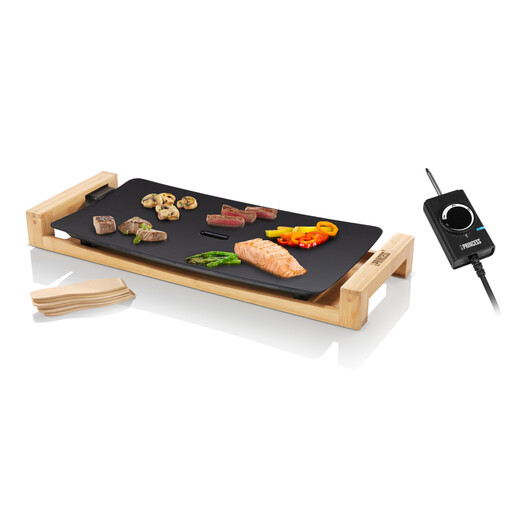
Why This Fits Their Persona: Designed for families, hosts and diners who want to cook several ingredients together at the table rather than pressing individual sandwiches.
Its 50 × 25cm surface is specified for shared cooking, while the integrated grease tray addresses drips and cooking juices.
2500W output, 50 × 25cm baking surface and a grease collection tray.
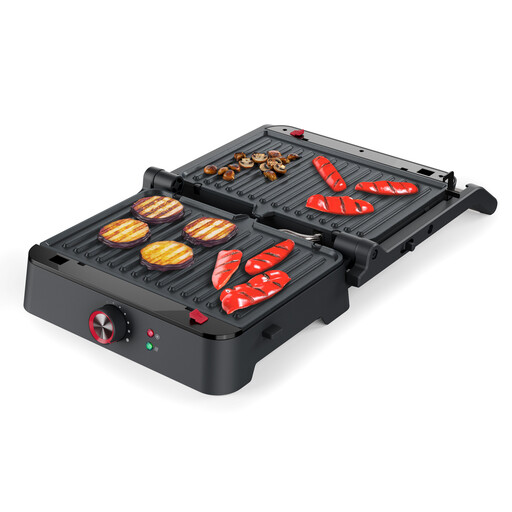
Why This Fits Their Persona: A practical match for cooks who want a panini press during the week and a flat indoor grill for vegetables or meat at weekends.
The 180° hinge is paired with an adjustable thermostat and detachable plates, so the extra functionality is supported by useful controls.
1800W power, 27.5 × 18cm cooking area and 2-year manufacturer’s warranty.
We have compiled a complete, real-time list of products that fully satisfy these strict selection criteria and UK safety regulations.
Place the appliance on a stable, dry, heat-resistant surface away from curtains, paper and other flammable materials. Preheat according to the supplied instructions, avoid overcrowding the plates and monitor food while cooking.
The plates and surrounding surfaces become hot. Use the handle and designated controls, keep children away and take care when opening the lid because steam or hot grease may escape. Unplug the grill after use and wait until it is completely cool before cleaning or storing it.
Yes, it is designed for indoor worktop cooking, provided you have a suitable mains connection and follow the supplied instructions. Check the appliance rating, plug arrangement and required clearance before use. Ventilation is also sensible, particularly when cooking fatty foods.
Not necessarily. Higher wattage can support faster heating, but plate size, heat distribution, temperature control and the way food is placed on the grill also matter. Compare the complete specification rather than choosing on wattage alone.
Lifespan depends on frequency of use, storage, cleaning and how carefully the non-stick surface is treated. Avoid metal utensils, abrasive cleaners and immersing electrical parts. Inspect the cord, plug, plates and housing regularly, and stop using the appliance if any component is damaged.