
24/7 Customer Support

Free returns

Same-day & Next-day Delivery

Quality Guaranteed

Unlock Your Welcome Offers: FREE Delivery | Up to 80% OFF | Free 30-day JoyPlus trial
Download the APP
Choosing among electric cooking appliances can be surprisingly difficult. A compact portable hob may suit a rented flat, while a built-in model could be more appropriate for a kitchen renovation. Electric grills also look convenient, but plate size, cleaning and heat distribution can affect how useful they are in everyday cooking.
Before buying, look beyond power ratings and glossy feature lists. The most suitable appliance depends on your cookware, available worktop or cabinet space, household size and installation requirements.
A 2000W induction cooker can heat quickly, but wattage alone does not tell you how precisely the appliance controls heat. Check the number of power or temperature settings, whether heat is distributed consistently and whether the appliance includes a timer or automatic switch-off.
For built-in hobs, total power can be considerably higher. A 4-zone induction hob may offer more flexibility, but it can also require a suitable electrical connection. Always check the product specifications and installation instructions before purchase.
Induction hobs heat magnetic cookware, not the cooking surface directly. Aluminium, glass and some stainless steel pans may not work unless they have a ferromagnetic base. A simple magnet test on the underside of a pan can help, but the cookware should also have a reasonably flat base and match the recommended diameter.
Ceramic hobs use radiant heating and generally accept a wider range of cookware. However, their glass surface can remain hot after cooking, so a residual-heat indicator and child lock are useful household safety features.
A portable appliance needs enough clearance around its ventilation openings and a stable, heat-resistant surface. A built-in induction hob or ceramic hob also requires a precise worktop cut-out, suitable cabinet ventilation and an appropriate electrical supply.
For example, a 60cm built-in induction hob may measure approximately 590 × 520mm while requiring a cut-out around 560 × 490mm. Always compare the product dimensions and cut-in dimensions with your kitchen plan rather than relying on the advertised width alone.
A 2-zone induction hob can work well for one- or two-person households, compact kitchens and occasional cooking. A 4-zone model is more suitable for families or anyone preparing several pans at once. Check the recommended pan diameter for each zone, as an oversized or undersized pan may heat less effectively.
A touch-control hob is easy to wipe clean because it has fewer raised controls. Look for practical features such as:
These functions support safer everyday use but do not remove the need for supervision. Hot surfaces should not be touched, and children should be kept away from appliances while they are operating or cooling.

Why This Fits Their Persona: Its slim portable format suits students, renters and small UK kitchens where a permanent installation is not practical.
The specifications state 10 power settings, a safety lock and boil-dry protection rather than relying on wattage alone. It also clearly requires ferromagnetic cookware.
2000W output, touch controls, six preset functions and a smooth glass panel for straightforward cleaning.
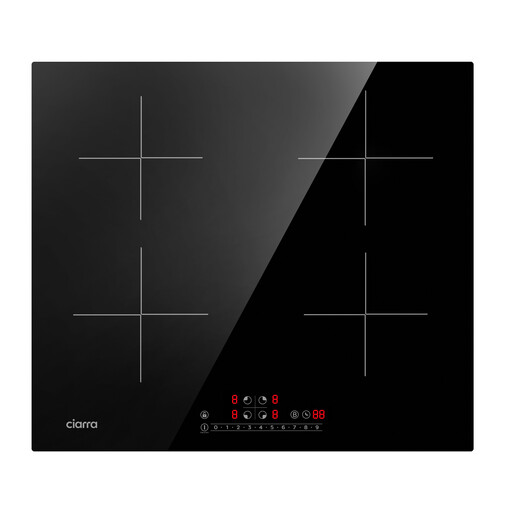
Why This Fits Their Persona: Homeowners upgrading a family kitchen can use four independent zones for simultaneous cooking.
The product details specify 9 power levels, zone dimensions, safety functions and a 32A rated fuse, helping buyers assess installation needs before ordering.
Four zones, booster function, touch control and a 590 × 520mm appliance size.

Why This Fits Their Persona: Frequent sandwich makers and households wanting a dedicated grill can prepare several types of food without using a full oven.
Its stated 28 × 22cm plates provide a measurable cooking area, while double-sided heating explains how food is heated from both sides.
2000W power, non-stick food-contact plates and a design suitable for steaks, burgers, toasted sandwiches and vegetables.
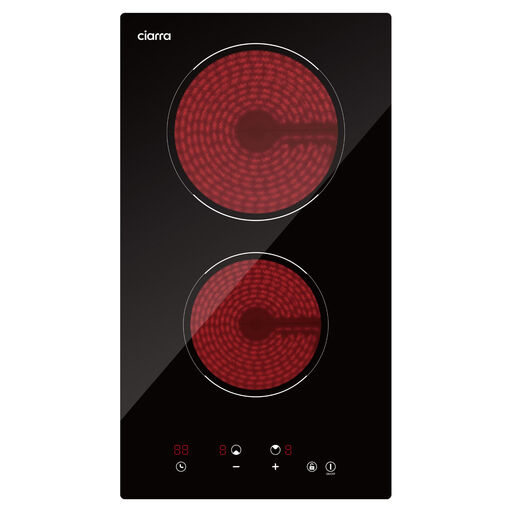
Why This Fits Their Persona: It suits compact homes and cooks who want a built-in electric cooktop without changing to induction-compatible pans.
Unlike induction-only models, it is specified for stainless steel, cast iron, ceramic, glass and aluminium cookware. The 29cm width and 260 × 490mm cut-out are clearly stated.
Two zones, 9 power levels, touch controls, a 99-minute timer and child lock.
We have compiled a complete, real-time list of products that fully satisfy these strict selection criteria and UK safety regulations.
Portable appliances usually connect to a standard socket, but you should follow the supplied instructions and avoid overloading an extension lead. Keep ventilation openings clear and place the unit away from water and flammable materials.
Built-in models should be installed by a suitably qualified professional electrician, particularly where the specification lists a 16A or 32A rated fuse. Confirm the required voltage, cabinet clearance and ventilation before cutting a worktop.
Electricity use depends on the appliance’s power, cooking duration and energy tariff. A simple estimate is:
Power in kilowatts × hours used × your tariff per kilowatt-hour = electricity cost
For example, a 2000W appliance uses 2kW when operating at full rated power. Actual consumption may be lower when thermostatic or power-level controls cycle the heating element, so published wattage should be treated as a maximum operating figure rather than a fixed daily cost.
Running cost depends on the appliance’s efficiency, cooking time and your electricity or gas tariff. Induction transfers heat directly to compatible cookware, while ceramic and traditional electric elements heat the cooking surface first. Compare your tariff and expected usage rather than assuming one technology will always cost less.
No. Induction requires cookware with a magnetic, ferromagnetic base. Cast iron and many magnetic stainless steel pans are suitable, but aluminium, glass and ceramic pans may not work unless they include a compatible base. Check the appliance’s stated diameter range as well as the material.
Measure both the hob and the worktop cut-out. Then check the electrical rating, cable requirements, ventilation clearance and cabinet layout in the instruction manual. Built-in appliances should be installed by an appropriately qualified electrician, and a cracked glass surface should not be used.