For a short drive in moderate weather, a thermoelectric cool box can suit food that has already been chilled, provided its cooling claim is adequate for the conditions and its capacity fits your containers. For a hotter or longer journey, possible delays, or food that needs more dependable temperature control, consider a compressor box with a settable temperature; check the actual food temperature during use rather than relying on the box’s setting alone.
Who is this for?
People carrying temperature-sensitive food
If you are bringing chilled ready-to-eat dishes, dairy or food with a use-by date, prioritise temperature control. A compressor box is worth considering when heat, journey length or delays make an ambient-relative cooling claim difficult to rely on.
Families making a short drive
For pre-chilled food and drinks going to a nearby gathering, a thermoelectric box may suit the trip. Check its cooling claim against expected conditions, make sure your containers fit and confirm the power connections you plan to use.
People carrying a larger load
If several dishes and bottles must travel from the car to the venue, check internal space, external dimensions and how you will lift the loaded box. Wheels and a pull handle can help with the walk, but not with lifting it into the car.
What matters when choosing?
Thermoelectric cool box
Consider it: For a shorter trip in moderate conditions, with food chilled before loading.
Trade-off: Cooling is generally quoted as a drop below the surrounding temperature, not a fixed internal temperature. Dometic advises pre-chilling food for its thermoelectric boxes.
Compressor cool box
Consider it: When heat, delays or a longer journey make settable temperature control important, or when you also need a freezing setting.
Trade-off: Check its size and loaded carrying arrangements. A temperature setting does not, by itself, confirm the temperature of the food inside.
| Concern | What to check | Who this matters to |
|---|
| Chilled-food temperature |
Compare an ambient-relative cooling claim with expected conditions, or check the compressor model’s settable range. Use a thermometer when temperature assurance matters. |
If I am carrying chilled dishes through heat or possible delays, I need confidence that the food stays cold throughout the journey. Dependable chilling would be the primary concern for around 42% of consumers. |
| Space and carrying |
Measure your dishes and bottles against the internal space; check external dimensions, empty weight and lifting or wheeling arrangements. |
Several containers and drinks need to fit without making the loaded box awkward to move from the car. For roughly 33% of consumers, fitting and carrying the load would come first. |
| Power at both ends |
Confirm the vehicle input, mains input, supplied leads and plug. If using vehicle power while parked, check the exact model’s instructions and battery-protection features. |
I want the box powered during the drive and may need to keep it running at the destination. Around 25% of consumers would make that car-to-mains flexibility their main concern. |
Buying pitfalls
-
Reading “18°C below ambient” as a fixed fridge temperature
A thermoelectric box’s internal temperature depends on its surroundings. Dometic also advises putting pre-chilled contents in its thermoelectric boxes rather than expecting them to chill warm food.
Compare the stated temperature drop with likely travel conditions. If dependable low-temperature control is essential, consider a compressor model and check the food temperature during use.
-
Choosing by capacity in litres alone
A quoted capacity does not show whether wide dishes or upright bottles will fit. A larger box can also be harder to lift once loaded.
Measure your largest containers, check internal and external dimensions, and plan how you will move the box from the car to the gathering.
-
Assuming an electric box includes a mains connection
Power arrangements vary by model: Koolatron says the 230V adapter for its cited 34L box is sold separately.
Check the exact model’s input voltages, supplied leads, plug and any adapter needed at your destination.
-
Packing raw food beside ready-to-eat dishes
Cooling does not prevent cross-contamination if raw food can touch food that will be eaten without further cooking.
Pack food in sealed, food-safe containers. Keep raw and ready-to-eat food separate where possible, and place raw food below ready-to-eat items if they must share the box.
Brands to consider
Dometic
Its electric-cooler range includes thermoelectric and compressor models. The CFX5 compressor line is relevant if settable temperatures and vehicle use are priorities.
- Dometic lists a +20°C to -22°C settable range, AC/DC input and three-stage battery protection for the CFX5 25.
- Those features are specific to that model; check the size and connections of the one you intend to buy.
Outwell
Its ECOcool Slate Grey 24 is a 24L thermoelectric cool/warm box intended for vehicle and mains use.
- Outwell specifies 12V and 230V operation, space for a 2L bottle and an icepack divider.
- Its stated cooling of 18–25°C below ambient is not a guaranteed internal setpoint; assess it against expected conditions.
Mobicool
The MQ40W is a larger thermoelectric option for a load that needs to be moved between vehicle and venue.
- Mobicool specifies a 39L capacity, wheels, a pull-out handle and side lifting handles for the MQ40W.
- Its cooling is quoted at up to 18°C below ambient. Confirm the exact UK-market model, plug and warranty before buying.
Koolatron
Its cited 34L thermoelectric cooler/warmer offers a 12V option for vehicle travel.
- Koolatron specifies 34L capacity and cooling up to 22°C below ambient for this model.
- Koolatron says its 230V adapter is sold separately and advises using its 12V connection only while the engine is on.
Compressor cool boxes on Joybuy
These two compressor boxes are options to consider when adjustable cooling matters for the journey. Compare their stated capacities with your actual dishes and drinks; neither product’s setting alone confirms the temperature of packed food.
 No image available
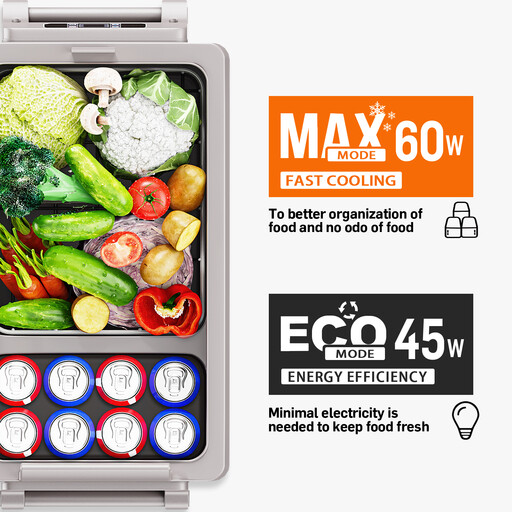
EUHOMY 49.4L Compressor Cooler Box
Consider its stated 49.4L capacity if you are taking a larger food-and-drink load and want a compressor box for the journey.
The product name specifies 12/24V DC and 240V AC connections. Check container fit, the space needed in your vehicle, how you will lift it and whether the supplied mains connection suits your outlet.
View on Joybuy
 No image available
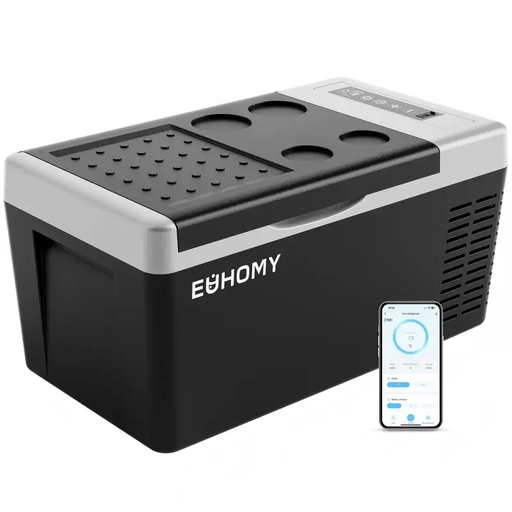
EUHOMY 18L Compressor Cooler Box
Consider the stated 18L capacity if your chilled dishes and drinks fit a smaller box and you want a settable compressor temperature.
The product name specifies a -20°C to +20°C range, 12/24V DC and 100–240V AC connections. Check the internal fit and the supplied mains plug, and measure the food temperature during use if assurance is important.
View on Joybuy
Common questions
Will a thermoelectric box keep chilled food at a fixed fridge temperature?
Not necessarily: its cooling claim is usually expressed relative to the surrounding temperature. Load food that is already chilled and assess the claim against likely conditions; if temperature assurance matters, check the food with a thermometer or consider a compressor box with a settable temperature.
How should I pack raw and ready-to-eat food together?
Keep them separate where possible, using sealed, food-safe containers. If they must share a box, place raw food below ready-to-eat dishes to reduce the risk of contamination.
Can I leave a 12V cool box running while the car is parked?
Check the instructions for the exact model before doing so. Koolatron advises using its cited 12V box only while the engine is on to avoid draining the vehicle battery; do not assume another model has battery protection.
What should I check if I need mains power at the gathering?
Confirm that the exact box accepts the available mains supply and that a suitable plug, lead or adapter is included. A 12V connection does not by itself mean the box is ready to use from a household outlet.


