What to check before buying
Start with the incoming water and the way you will fill your bottle, then decide whether you will use a hot-water function. If repeated feed-tank refills would be inconvenient and you can accommodate plumbing, an under-sink RO system with a separate tap is a different route, as illustrated by Aquaphor's UK range.
| Concern |
Buying checks |
Who this matters to |
| Treatment fit |
Check reduction documentation for the exact model and whether the incoming water is microbiologically safe and of known quality, the input-water scope described by NSF/ANSI 58. |
I need the model's treatment claim to match my water concern, especially if my supply needs testing. Around 36% of consumers would put treatment fit first. |
| Bottle-refill routine |
Check bottle clearance or pitcher dimensions, and how you will refill the feed tank. Confirm that the counter position has a suitable socket. |
If I refill my bottle daily, I want a dispensing arrangement that works without plumbing. For around 29% of consumers, refill convenience would be the primary concern. |
| Water and filter upkeep |
Compare the stated pure-to-drain ratio and reject-water instructions. Identify the exact replacement cartridge and its stated change interval. |
I would need to handle reject water and obtain new cartridges over time, so upkeep matters beyond the initial setup. Around 21% of consumers would make this their first concern. |
| Hot water and electrical safety |
For a plugged-in hot-water dispenser, check the UK 3-pin plug and fuse specified by Electrical Safety First, plus the model's heating protections. |
I also make hot drinks, but want a heating function I can use safely in my kitchen. Hot-water function and electrical safety would come first for around 14% of consumers. |
Joybuy countertop RO options
These countertop RO purifiers offer pitcher-based ways to handle purified water for bottle refills, alongside selectable-temperature dispensing. Check the pitcher arrangement against your own bottle and decide whether you would use the additional hot-water functions.
 No image available
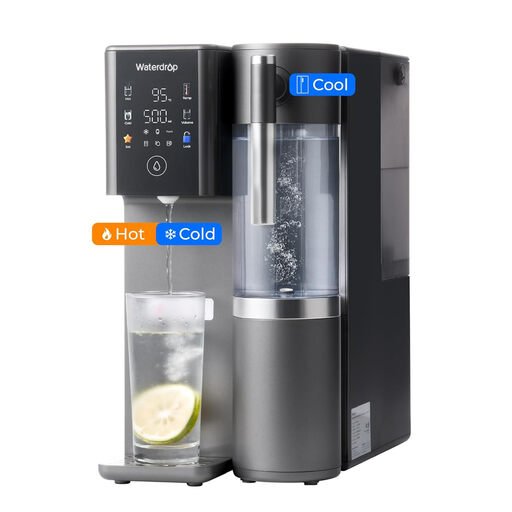
Waterdrop WD-A2 countertop RO system, 6 temperature settings
For bottle refills without plumbing, Joybuy describes plug-in countertop use and a detachable 1.1 L purified-water pitcher. The listing states a 3:1 pure-to-drain ratio; check the manual for reject-water handling and whether the pitcher works with your bottle. Before relying on a particular reduction claim, check treatment documentation for the WD-A2 and identify its replacement cartridge and change interval.
Joybuy
 No image available
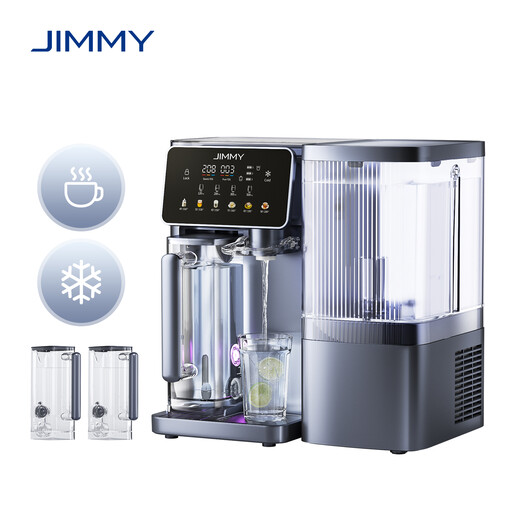
JIMMY R9 Pro countertop RO purifier, 5.5 L tank and two 1 L pitchers
For households considering both bottle refills and hot or cold dispensing, Joybuy describes a no-plumbing countertop system with a 5.5 L tank and two 1 L pitchers. Check how the pitchers fit your bottle routine, the model's electrical connection and hot-water protections, and its reject-water instructions. Confirm exact-model treatment documentation, the replacement-filter interval and cartridge availability before relying on specific reduction claims.
Joybuy
Frequently asked questions
Can a countertop RO purifier make any water source safe to drink?
No: do not assume a countertop RO purifier makes an unknown or unsafe supply safe. NSF/ANSI 58 describes point-of-use RO systems intended for water considered microbiologically safe and of known quality. If you use a private supply in England or Wales, the Drinking Water Inspectorate identifies the local authority as the first point of contact for testing and identified risks; choose treatment in response to the water-quality results.
What should I check on an instant-hot countertop purifier?
Check the appliance's plug, heating safeguards, instructions and intended placement before choosing the hot-water function. Electrical Safety First says a plugged-in hot-water dispenser must have a UK 3-pin plug and fuse, and warns against overloading extension leads. If purchasing for Northern Ireland, do not assume product-marking guidance for Great Britain applies unchanged.
How often do countertop RO filters need replacing?
Follow the replacement interval and any earlier-change instructions for your exact model, rather than using one interval for every countertop RO system. Waterdrop states a 12-month filter life for its C1H, while Joybuy lists a recommended 12-month replacement cycle for the compatible WD-C1RF cartridge.
Does a 3:1 pure-to-drain ratio mean there is no wastewater?
No. A stated 3:1 ratio describes three parts purified water for each part reject water under the product's stated conditions; it does not mean zero reject water. Check your chosen model's manual for its ratio, collection method and permitted non-drinking uses for collected water.


