
24/7 Customer Support

Free returns

Same-day & Next-day Delivery

Quality Guaranteed

Unlock Your Welcome Offers: FREE Delivery | Up to 80% OFF | Free 30-day JoyPlus trial
Download the APP
An electric food chopper can save considerable preparation time, but choosing one based only on wattage or bowl size may lead to disappointment. A large container does not always mean efficient chopping, while a high advertised power figure may refer to maximum rather than rated output.
For UK kitchens, the most useful appliance is one that matches your batch sizes, ingredients, storage space and cleaning routine. Before buying, watch for these common pitfalls.
Some listings promote a high maximum wattage that the motor may only reach briefly. For everyday chopping, the rated power, operating cycle and rest time are more useful indicators.
A 350W food chopper can be suitable for vegetables, meat and cooked ingredients when used in short pulse cycles. However, it should not be treated like a full-size food processor for prolonged heavy-duty work. Always check whether the instructions specify a maximum run time, such as 30 or 40 seconds, followed by a cooling interval.
A 2.5L food processor may appear suitable for family cooking, but the usable capacity depends on the ingredient type and blade design. Overfilling can produce uneven pieces, strain the motor and make cleaning more difficult.
Also consider whether the bowl is made from stainless steel, glass or plastic. Stainless steel is resistant to staining and does not retain food odours as readily as some plastics, while glass allows you to see the ingredients during processing but can be heavier.
A single bowl may be inconvenient if you regularly prepare raw meat, vegetables, sauces and baby food. Flavour transfer and cross-contact can become avoidable cleaning concerns.
Removable bowls and blades are easier to wash, but “dishwasher-safe” must be checked for each component. Motor housings should not be immersed in water. Blades also require careful handling, whether cleaning by hand or placing approved parts in a dishwasher.
Look for a clear rated wattage and an appropriate control system. A two-speed food processor or pulse-operated chopper gives more control than a single-speed design:
Power should be considered alongside the blade shape, bowl capacity and recommended operating cycle. A 350W food chopper with a multi-level blade may be more practical for short household tasks than a larger appliance with limited control.
A stainless steel food chopper is a practical option for raw meat and strongly coloured ingredients. Food-grade 304 stainless steel is commonly used for food-contact components and is resistant to corrosion when maintained correctly.
Choose capacity according to your household:
Nesting bowls can be particularly helpful in smaller UK kitchens where cupboard and worktop space are limited.
A vegetable chopper should create reasonably even pieces without requiring repeated scraping. Curved or multi-level stainless steel blades can help move ingredients through different parts of the bowl, although results still depend on cutting ingredients into suitable pieces and avoiding overfilling.
If you need an electric meat grinder or meat mincer, check whether the product uses a dedicated grinding plate and feed tube. A general chopper is not automatically suitable for bones, frozen food or large pieces of meat. Follow the supplied instructions and use the correct pusher rather than fingers or utensils.

Why This Fits Their Persona: Its 350ml bowl suits small portions, herbs, onions, garlic, sauces and dips without taking up much cupboard space.
The listing states a 300W motor, two speeds and pulse control, rather than relying only on an inflated maximum-power figure.
Dishwasher-safe bowl and blade; compact dimensions; non-slip feet and a 30-second operating warning.
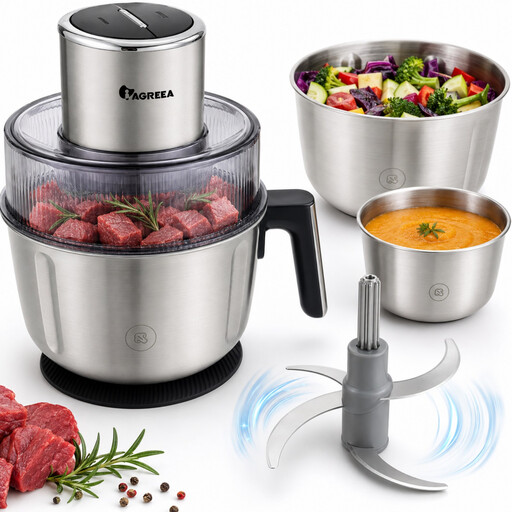
Why This Fits Their Persona: Three nesting stainless steel bowls offer flexible preparation and more organised storage for regular family cooking.
The 2.5L, 2.2L and 1.8L bowls reduce the need to use one container for every ingredient, while the stated 30-second pulse cycle sets a practical limit.
304 stainless steel bowls; two-speed pulse control; triple-curved detachable blade assembly.
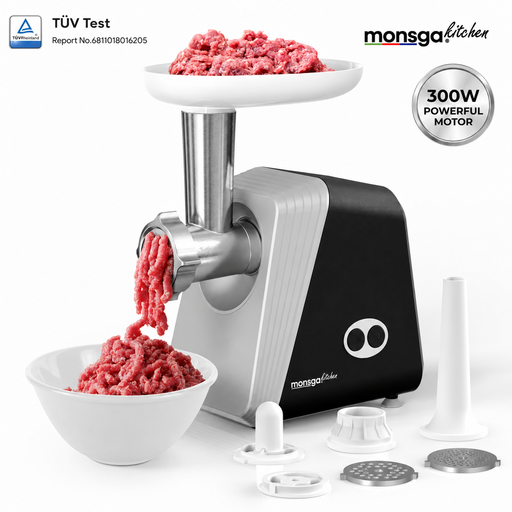
Why This Fits Their Persona: Suits cooks who specifically prepare homemade mince, burgers, sausages or kibbeh rather than only chopping vegetables.
Three cutting discs provide fine, medium and coarse textures, while the instructions specify small boneless pieces, a meat pusher and cooling breaks.
Includes sausage, kibbeh and biscuit-making accessories; reverse function and overload and overheat protection are listed.
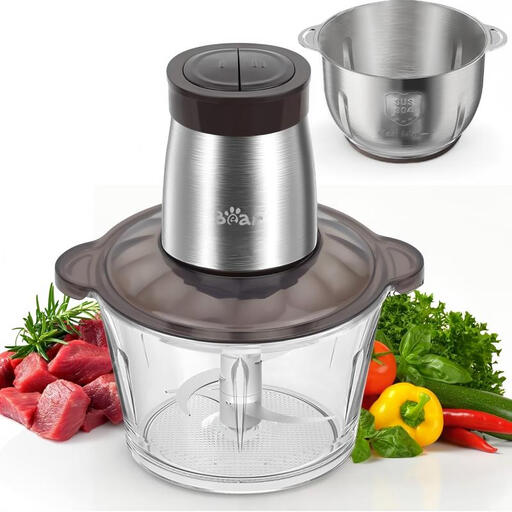
Why This Fits Their Persona: Separate glass and stainless steel containers can help organise preparation for cooked foods, vegetables and family meals.
The dual-bowl design reduces reliance on one container, and the stated 40-second cycle with a two-minute rest discourages prolonged operation.
Includes a 2L glass bowl and 1.8L 304 stainless steel bowl; two speeds; detachable bowls and blades are listed as dishwasher-safe.
We have compiled a complete, real-time list of products that fully satisfy these strict selection criteria and UK safety regulations.
Some models are designed for mincing or chopping raw meat, but suitability varies. Remove bones, skin and tough sinew, cut meat into small pieces and use the supplied pusher. A dedicated electric meat grinder with cutting discs is generally more appropriate for repeated mince preparation.
Lifespan depends on motor load, cleaning, storage and adherence to operating cycles. Avoid overfilling, do not process prohibited ingredients and allow the motor to cool as instructed. Dry removable metal components thoroughly and keep the motor housing away from water.
Most household choppers operate for short periods, so their electricity use is usually linked more to the appliance’s wattage and total operating time than bowl capacity. Pulse operation and preparing ingredients in suitable batches can help avoid unnecessary run time.