
24/7 Customer Support

Free returns

Same-day & Next-day Delivery

Quality Guaranteed

Unlock Your Welcome Offers: FREE Delivery | Up to 80% OFF | Free 30-day JoyPlus trial
Download the APP
Preparing onions, herbs, vegetables, meat or baby food can be time-consuming when done by hand. An electric food chopper can shorten preparation work, but choosing the right model requires more than comparing wattage or bowl size. A compact appliance may be convenient for occasional chopping, while a larger food processor and chopper may suit family cooking and meal preparation.
This guide from the Joybuy Product Recommendation Officer focuses on practical specifications, common buying traps and suitable options for different UK households.
Motor power is useful, but it does not tell the whole story. Blade arrangement, bowl shape and recommended operating time also affect performance. A 750W food processor may offer more functions, while a 300W kitchen chopper may be sufficient for onions, herbs and softer vegetables.
For tougher ingredients such as meat, carrots or nuts, check whether the product description specifically lists them as suitable. Do not assume that every electric vegetable chopper can handle ice, frozen food, bones or dry grains.
Plastic bowls are generally light and easy to store, but they may show scratches or retain strong food odours over time. A food chopper with glass bowl can be more suitable for shoppers who prefer a substantial, odour-resistant container. Glass is heavier, so check whether the base has an anti-slip feature.
Also confirm which parts are dishwasher safe. Some products allow the bowl and blades to go in the dishwasher, while the motor unit must only be wiped with a damp cloth.
A stated 2-litre capacity does not mean the bowl should be filled to the rim. Overfilling can produce uneven chopping and increase strain on the motor. Look for instructions covering maximum fill levels and continuous operating time.
Several compact models use short cycles, such as 30 or 40 seconds, followed by a cooling interval. This is important for batch cooking: a smaller bowl may require several pauses when preparing large quantities.
For basic chopping, a lower-powered appliance may be adequate. If you regularly prepare meat, firm vegetables, nuts or cheese, compare the motor rating and blade configuration. A 2-speed food chopper offers more control than a single-speed design: a lower setting can help with softer ingredients, while a higher setting may be more suitable for firmer foods.
Pulse-style controls are useful when you want to stop and check texture frequently, particularly for fillings, sauces or purées.
Look for stainless steel blades, as this material is commonly used for food preparation and is easier to rinse after use. Multiple blades positioned at different heights may help process ingredients throughout the bowl rather than only at the bottom.
A vegetable chopper designed for slicing and dicing may use interchangeable cutting grids or discs, whereas a meat chopper generally relies on rotating blades. These are different functions, so check whether the appliance is a simple chopper or a multifunctional food processor.
A small bowl works well for garlic, herbs, onions and individual portions. Families and meal-prep users may prefer approximately 1.8 to 2 litres, provided the kitchen has sufficient storage space.
A stainless steel food chopper bowl is durable and less likely to retain food odours. Some dual-bowl models combine glass and stainless steel, allowing users to separate raw meat from vegetables or cooked ingredients. Nesting bowls can also reduce cupboard space.
For UK kitchens, check the stated 220–240V, 50/60Hz compatibility and read the supplied instructions before use. Keep the motor base, plug and cable away from water, and unplug the appliance before assembling, cleaning or changing blades.

Why This Fits Their Persona: A straightforward option for smaller UK households that need a visible 2-litre glass bowl for everyday vegetables, fruit, garlic and meat preparation.
The listing states a 40-second maximum continuous operating time and a two-minute rest interval, helping buyers plan around its intended short-cycle use.
2-litre glass bowl, two speeds and 304 stainless steel blades in a compact format.
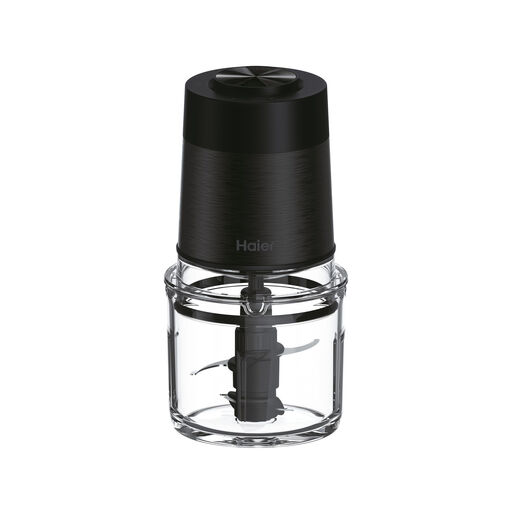
Why This Fits Their Persona: Suitable for cooks who prefer a glass container, stronger stated motor power and simple top-press operation for regular chopping and puréeing.
The 550W motor is paired with four double-stacked blades, while the product information clearly lists two speed settings rather than relying on wattage alone.
Glass bowl and blades are listed as dishwasher safe; anti-slip base supports stable operation.
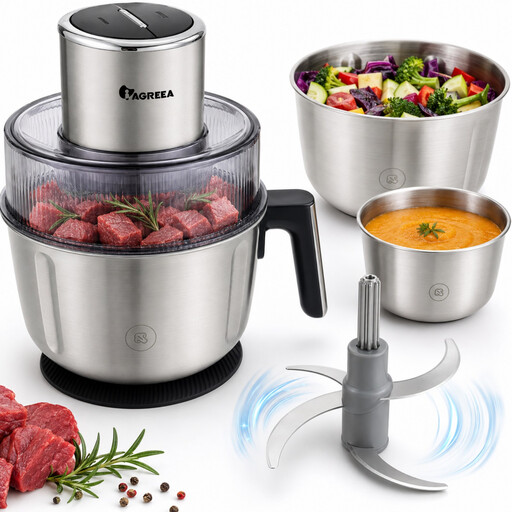
Why This Fits Their Persona: Its three nesting bowls suit meal-prep households, cooks handling different ingredients and parents preparing purées or cooked baby food.
The three bowls separate ingredients and the listing states a pulse operating limit of up to 30 seconds per cycle, making the usage boundary clear.
2.5L, 2.2L and 1.8L 304 stainless steel bowls; triple-curved blades and two-speed pulse control.
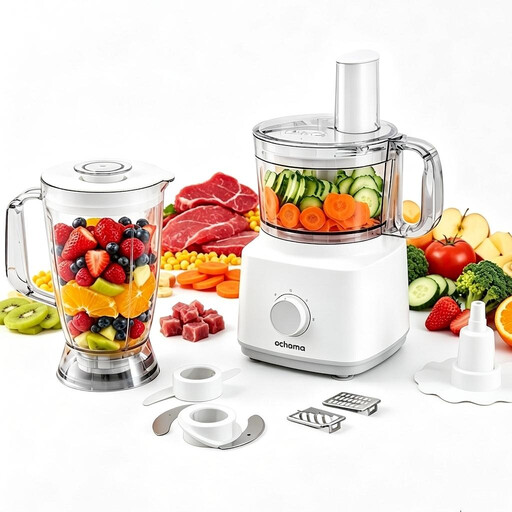
Why This Fits Their Persona: A practical match for families wanting one appliance for chopping, slicing, grating, shredding and puréeing rather than a single-purpose vegetable chopper.
Its stated functions and 1.8-litre capacity make the intended versatility clear, while the instructions warn users not to exceed the bowl limit.
750W motor, 1.8-litre bowl and detachable parts for chopping, slicing, grating and puréeing.
We have compiled a complete, real-time list of products that fully satisfy these strict selection criteria and UK safety regulations.
Sometimes, but not always. A basic chopper is suitable for mincing, chopping and puréeing. A full food processor usually includes slicing, shredding, grating or julienne attachments. Choose according to the tasks you perform most often rather than the number of advertised accessories.
Follow the individual manual. The products above specify operating limits ranging from 30 to 40 seconds per cycle, with rest periods between uses. Short pulses can also provide better texture control and help prevent over-processing.
A glass bowl may suit shoppers who value resistance to odours, flavours and scratches, and it allows the contents to remain visible during preparation. It is heavier than plastic, however, so stainless steel or plastic may be more convenient if frequent lifting and storage are priorities.