
24/7 Customer Support

Free returns

Same-day & Next-day Delivery

Quality Guaranteed

Unlock Your Welcome Offers: FREE Delivery | Up to 80% OFF | Free 30-day JoyPlus trial
Download the APP
An electric food chopper can speed up meal preparation, but the wrong model may create more work than it saves. Small bowls, unclear operating limits and difficult-to-wash blade assemblies are common reasons an apparently affordable kitchen chopper ends up unused in a cupboard.
Before comparing motor wattage or promotional claims, look closely at the details that affect everyday use. A suitable appliance should match your batch size, ingredients, available storage space and cleaning routine.
Motor power is useful, but it does not tell the whole story. Blade design, bowl shape and recommended operating time also influence performance. A 750W food processor may be more suitable for larger batches, while a 300W food chopper can be practical for onions, herbs, vegetables and smaller portions.
Avoid choosing solely by wattage. Check whether the manufacturer specifies suitable ingredients and whether the appliance can run continuously for the amount of preparation you expect to do.
A stated 2L bowl does not necessarily mean you can fill it completely. Ingredients need room to move, and some appliances include a maximum fill line below the bowl’s total volume. Overfilling can produce uneven chopping, spills and unnecessary strain on the motor.
For a couple or small household, a mini food chopper may be more convenient. Families and meal-prep users may prefer a larger bowl or a model supplied with more than one container.
A blade that is difficult to remove can make routine preparation inconvenient. Raw meat, garlic, herbs and sauces may also leave strong flavours behind if the same bowl is used without thorough cleaning.
Look for detachable parts, dishwasher-safe components and separate bowls where appropriate. A glass bowl food chopper can also be useful if you prefer a transparent, non-plastic container, although glass adds weight and should be handled carefully.
For everyday chopping, 250W to 400W can be sufficient for softer ingredients and moderate portions. Models with higher power may offer more capacity and versatility, but always follow the supplied instructions.
Some electric food processors have strict duty cycles. For example, the Bear QSJ-D03W5 models specify short operating periods followed by rest intervals. One version states a maximum continuous working time of 40 seconds, a two-minute rest and a longer cooling period after three consecutive cycles. These instructions matter more than a headline wattage figure.
Consider the ingredients you usually prepare:
A dual-bowl design can help separate raw meat from vegetables or keep strong flavours apart.
A stainless steel chopping blade is suitable for many everyday tasks, but attachments determine whether an appliance can also slice, shred, grate, blend or emulsify. A meat mincer function should not be interpreted as permission to process bones, ice or frozen food unless the instructions specifically allow it.
Also check for:

Why This Fits Their Persona: Its compact 350ml bowl suits small kitchens, students, couples and cooks preparing modest quantities of herbs, onions, nuts or sauces.
The bowl size makes its intended use clear, while the 30-second continuous-use warning helps prevent unrealistic expectations about batch processing.
300W motor, two speeds plus pulse function, and dishwasher-safe bowl and blade.
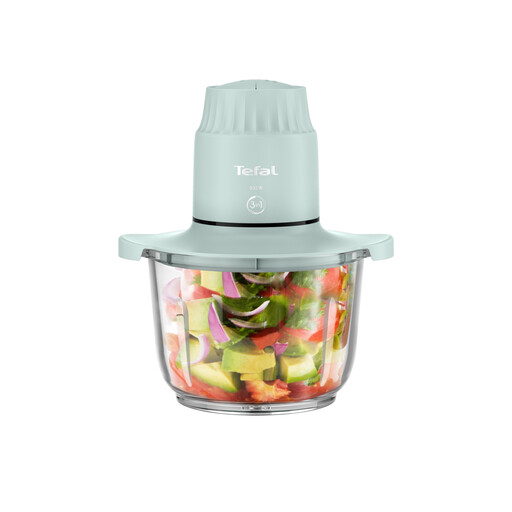
Why This Fits Their Persona: A borosilicate glass bowl and storage lid suit households that value visible processing, straightforward storage and a more substantial countertop appliance.
The stated 1L useful capacity is clearer than relying only on the 2L bowl headline, helping buyers plan realistic portions.
500W motor, four-blade stainless steel assembly and dishwasher-safe removable parts.
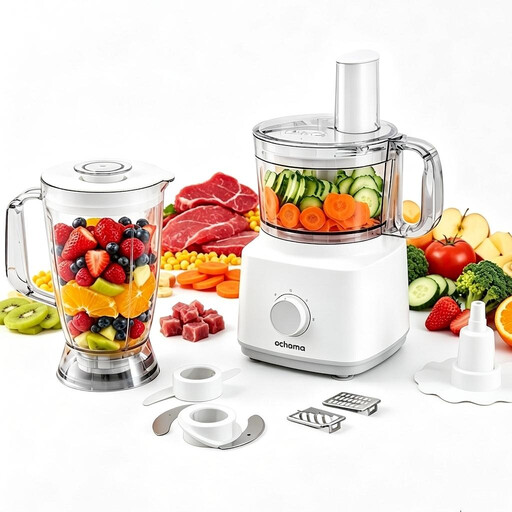
Why This Fits Their Persona: Meal-prep enthusiasts and larger households may prefer its 1.8L bowl and range of chopping, slicing, grating and puréeing functions.
Its functions and capacity are stated separately, making it easier to compare genuine versatility with a simple mini food chopper.
750W motor and 1.8L bowl with detachable parts for cleaning.

Why This Fits Their Persona: The two-bowl arrangement works for households that alternate between small ingredient preparation and larger family portions.
The 0.6L and 2L bowls provide more practical flexibility than buying one oversized container for every task.
300W power, two speeds, two glass bowls and separate stainless steel blade sets.
We have compiled a complete, real-time list of products that fully satisfy these strict selection criteria and UK safety regulations.
A 300W food chopper can be suitable for modest quantities of prepared meat, vegetables, herbs and fruit, depending on the model’s instructions and blade design. It is not automatically suitable for bones, ice or frozen ingredients. For frequent large batches, consider a higher-powered electric food processor with a larger bowl.
A glass bowl offers clear visibility and can be dishwasher-safe on selected models. It may also feel more substantial than a lightweight plastic bowl. However, glass is heavier and can break if dropped or handled roughly. Check the useful capacity, maximum fill line and cleaning guidance rather than selecting by material alone.
Running cost depends on the appliance’s wattage, electricity tariff and operating time. A 300W appliance operating for one minute uses approximately 0.005 kWh, while a 750W model operating for the same period uses approximately 0.0125 kWh. Actual preparation may involve pauses and multiple cycles, so these figures are illustrative rather than a fixed bill estimate. For most households, the more important comparison is whether the appliance completes the intended task without repeated batches or excessive processing time.