
24/7 Customer Support

Free returns

Same-day & Next-day Delivery

Quality Guaranteed

Unlock Your Welcome Offers: FREE Delivery | Up to 80% OFF | Free 30-day JoyPlus trial
Download the APP
Meal preparation can often feel like the most time-consuming part of cooking. The endless dicing of onions, mincing of garlic and chopping of vegetables can turn a quick weeknight dinner into a lengthy chore. An electric food chopper promises to reclaim that time, but navigating the market can be tricky. Many models look similar, yet their performance can vary dramatically.
As a Joybuy Product Recommendation Officer, my role is to help you see past the marketing clutter and focus on what truly matters. Before you buy, it's crucial to understand a few common pitfalls that lead to disappointment and wasted money.
food processor for baby food.vegetable chopper to a fine meat grinder electric.To avoid these issues, focus on three key specifications. These non-negotiable features are the difference between a helpful kitchen assistant and a cupboard-cluttering gadget.
The motor is the heart of any electric food chopper. A power rating of around 300W is generally sufficient for most household tasks, including mincing meat and chopping hard vegetables. However, power is only half the story. Look for the continuous operating time in the product specifications. A typical guideline for a well-made consumer model is around 40 seconds of operation followed by a 2-minute rest period. This prevents the motor from overheating and extends the appliance's lifespan.
Capacity is measured in litres, and a 2L food processor is a versatile size for most families, allowing you to prepare substantial quantities in one go. For materials, you have three main options:
stainless steel food chopper is ideal for preparing raw meat and is often the preferred choice for a baby food maker due to its non-reactive and easy-to-sterilise surface.An effective chopper will feature multiple blades—often four—arranged at different heights to ensure all ingredients are drawn into the vortex and chopped evenly. Look for blades made from 304 stainless steel, which is food-grade and resistant to rust and corrosion. Furthermore, having at least two speed settings provides crucial control. A lower speed is perfect for a coarse chop on soft items like onions and herbs, while a higher speed is necessary for pureeing or grinding tougher ingredients like nuts and meat.
Based on these practical criteria, here are a few recommendations matched to different household needs.
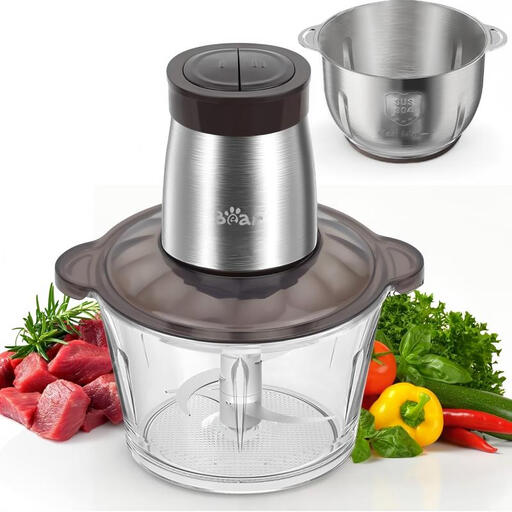
Why This Fits Their Persona: This model is ideal for parents who need a versatile tool for family meals and a dedicated, hygienic option for making baby food. The separate bowls prevent cross-contamination between raw meat and baby purees.
It directly solves the "Material Mismatch" pitfall by providing two bowls: a large 2L plastic bowl for general use and a separate 1.8L 304 stainless steel container for hygienic tasks like preparing baby food or mincing meat.
The dual-bowl system offers unmatched versatility and hygiene. Its 300W motor and four stainless steel blades provide ample power for various ingredients.

Why This Fits Their Persona: This is a straightforward, reliable workhorse for the home cook who regularly prepares meals. The large glass bowl is perfect for chopping a week's worth of vegetables or mincing meat for bolognese without staining or retaining odours.
It avoids the "Blade Illusion" with its three-dimensional, 304 stainless steel blades and two-speed control, giving the user power over the final texture. The 300W motor and specified duty cycle also guard against the overheating trap.
The 2L high-quality glass bowl is non-porous, easy to clean and allows for clear visibility during chopping. Its simple, robust design focuses on performing its core function effectively.
We have compiled a complete, real-time list of products that fully satisfy these strict selection criteria and UK safety regulations.
Most household electric choppers are not designed for prolonged, continuous use. A common and safe operational cycle is 40 seconds of processing followed by a 2-minute rest period. Adhering to this prevents the motor from overheating, which is a primary cause of premature failure. Always refer to the manufacturer's specific instructions for your model.
This depends entirely on the bowl material. A glass or stainless steel bowl can typically handle warm or hot ingredients without issue. However, you should exercise caution with plastic bowls, as high temperatures can cause them to warp, degrade or release chemicals. It is always safest to let very hot foods, like boiled vegetables for a soup, cool down slightly before processing.
The terms are often used interchangeably, and many products function as both. Generally, an electric food chopper or vegetable chopper is designed primarily for dicing, mincing and coarse chopping. A mini food processor may imply a broader range of functions, including pureeing, emulsifying and mixing, often with different blade attachments. For most home cooks, a high-quality chopper with variable speeds can perform all these tasks effectively.