Guests unsure about the hob
If the cottage hob is unavailable, occupied or unsuitable for your cookware, a plug-in pan gives you a separate surface for breakfast. You still need somewhere safe to place and power it.


If the cottage has a working hob that suits your pan, a small conventional frying pan may be enough for a couple of eggs. A plug-in pan is more useful when the hob is unavailable or occupied, but it needs a suitable socket and stable worktop space. For fried eggs, look for controllable heat and check the appliance’s cleaning instructions rather than choosing by maximum temperature alone.
If the cottage hob is unavailable, occupied or unsuitable for your cookware, a plug-in pan gives you a separate surface for breakfast. You still need somewhere safe to place and power it.
Heat control and a surface you can care for properly may matter more than room for a larger meal. The Judge JEA23 manual, for example, gives a model-specific setting for eggs over easy.
An electric pan can add capacity while the main hob is in use. Plan its position, socket access and guest-facing care instructions before leaving it in the kitchen.
Choose when: The cottage hob cannot be relied on, or you need a separate breakfast surface.
Trade-off: It takes worktop and packing space and needs a suitable mains socket.
Choose when: A working, compatible hob is confirmed and you only need to fry a small number of eggs.
Trade-off: It cannot provide an independent cooking surface if that hob is occupied or unsuitable.
| Concern | What to check | Who this matters to |
|---|---|---|
| Cooking without the hob | Confirm plug-in operation and measure both the cooking surface and the appliance’s overall footprint. | If I cannot count on the cottage hob, I need a separate surface that fits the available worktop; roughly 27% of consumers put hob-independent cooking first. |
| Control for fried eggs | Look for adjustable heat, a suitable cooking surface and egg guidance for the exact model. | I want to set the heat for eggs without relying on the highest setting; around 33% of consumers prioritise heat control and easy release. |
| Cleaning and transport | Check the permitted cleaning method and the overall size you would need to carry and store. | With limited washing-up space and a journey home afterwards, I need a pan I can clean and pack; roughly 20% of consumers put this need first. |
| Electrical setup | Check the socket and lead condition, the appliance’s rated wattage and any extension lead’s marked rating. | Before adding another appliance to the kitchen, I need to know where it can be used safely; around 20% of consumers prioritise the electrical setup. |
The space needed around a 30 cm cooking surface can be larger than the surface itself. The Quest 35410 listing gives an overall footprint of 34.5 × 35 cm.
Measure the intended worktop position and the space available for carrying and storing the appliance.
A high maximum thermostat setting is not an egg-cooking instruction. The Judge JEA23 manual specifies dial 3, up to 145°C, for eggs over easy on that model.
Start with the guidance for your exact pan and adjust cooking to the result you want.
A non-stick surface or detachable cord does not establish that an electrical appliance can be immersed. The Judge JEA23 manual explicitly says not to immerse its skillet.
Check the model’s cleaning instructions against the cottage’s washing-up arrangements.
The Quest, VonShef and Judge examples are rated at 1500 W. Electrical Safety First warns that exceeding an extension lead’s or cable reel’s maximum current rating can cause overheating and fire.
Use a suitable wall socket where possible. If an extension is necessary, check its marked rating and the combined load; fully unwind a cable reel and do not leave cooking unattended.
The Quest 35410 is a 30 cm electric cooker pan to consider where worktop space is limited.
The 30 cm square electric pan offers a deeper cooking area for meals beyond eggs.
The JEA23 electric skillet has a product-specific manual with instructions for eggs and surface care.
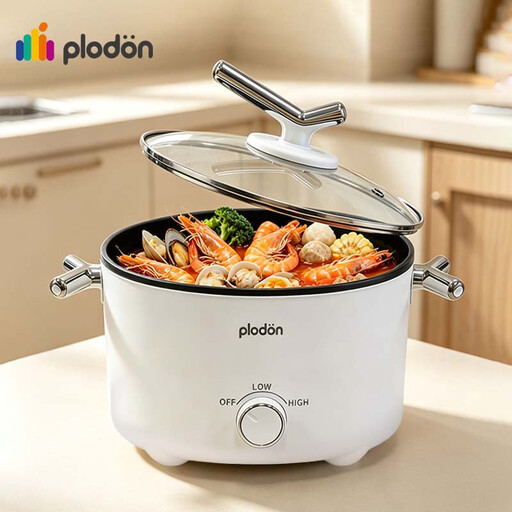
This plug-in cooker is a hot-pot-style option described for frying eggs when you need a cooking surface separate from the cottage hob. Check its pan shape and worktop fit if you specifically want a conventional frying-pan layout.
 No image available
Consider this plug-in cooker if the cottage hob is unavailable and a hot-pot-style surface suits the eggs you plan to cook.
Its listed features include LOW/HIGH power levels and a non-stick skillet. Check the cooking-surface dimensions and model-specific egg instructions before buying.
Start with the instructions for your exact pan. The Judge JEA23 manual lists eggs over easy at dial 3, up to 145°C, for about 1½ minutes per side; that setting should not be assumed to apply to other models.
Use one only if necessary and if its marked rating accommodates the combined appliance load. Electrical Safety First advises against overloading or daisy-chaining extensions and says cable reels should be fully unwound.
Let it cool and follow its own cleaning instructions rather than assuming the whole appliance can be washed in the sink. For the Judge JEA23, the manual calls for a cloth or kitchen paper dampened with warm soapy water and says never to immerse the skillet.
No. The pan still needs a stable, suitable worktop and safe socket access while cooking. Electrical Safety First advises against touching electrical equipment with wet hands or leaving kitchen appliances on and unattended.