Weekly batch cooks
If you cook several fillets for later meals, plate area and stated capacity help you judge whether your usual batch will fit without crowding.


For several chicken fillets in one session, compare cooking area and stated portion capacity before choosing cooking presets. Tefal UK lists an 800 cm² surface and 6–8 portion capacity for the OptiGrill+ XL GC722D40, while Philips Home lists a 748 cm² surface for its HD6301 and HD6307 models; the space you can use will also depend on fillet size and spacing. Thickness sensing may help with timing, but check the centre of the thickest fillet with a clean food thermometer, and consider removable parts if you will grill frequently.
If you cook several fillets for later meals, plate area and stated capacity help you judge whether your usual batch will fit without crowding.
Thickness sensing and cooking indicators may help you manage fillets of different sizes. You will still need to check that the thickest piece is cooked through with a clean food thermometer.
If chicken is a regular part of meal preparation, check whether the exact grill has removable plates and a drip tray, and which parts can go in the dishwasher.
Start with the number and size of fillets you normally cook, then decide how much cooking guidance and cleaning convenience you want. A grill that opens flat also needs enough worktop clearance in that position.
| Concern | What to check | Who this matters to |
|---|---|---|
| Room for a batch | Compare the stated cooking area or portion capacity with your fillet sizes, allowing space between pieces. Tefal UK lists 800 cm² and 6–8 portions for GC722D40; Philips Home lists 748 cm² for HD6301 and HD6307. | I want my usual batch to fit without crowding the plates or cooking several small loads; around 42% of consumers put batch capacity first. |
| Chicken doneness | Treat poultry presets and thickness sensing as timing aids. Check the centre of the thickest fillet with a clean probe; GOV.UK gives cooking combinations of 70°C for 2 minutes or 75°C for 30 seconds. | When my fillets differ in thickness, I want a dependable way to check the thickest one rather than relying on surface colour; around 33% of consumers put doneness checks first. |
| Repeated clean-up | For the exact model, confirm whether the plates and drip tray are removable and dishwasher-safe, and check what still needs washing by hand. | If I grill chicken regularly, cleaning the appliance after each session needs to be manageable; around 25% of consumers put clean-up first. |
Fillets can differ in thickness, and an indicator or browned surface does not establish the temperature at the centre of the thickest piece.
Use the programme to help manage cooking, then check the thickest fillet with a clean food thermometer and cook it through.
Wattage alone does not tell you how many of your fillets will fit in one batch. A stated portion capacity is a guide, not an exact fillet count.
Compare cooking area with the size of the fillets you usually prepare, leaving room between pieces.
Cleaning differs by model: removable parts and dishwasher suitability are separate questions, and the grill body may still need attention.
Check the exact model’s plate and drip-tray cleaning instructions before choosing it for frequent use.
An open-flat layout can give you a different cooking arrangement, but it takes up more worktop room and calls for more active management of the food.
Check the appliance’s open dimensions against your available worktop space.
These model-specific examples offer different ways to handle batch size and cooking guidance; they do not describe every grill made by either brand.
Tefal UK lists guided contact grills ranging from the 4–6 portion OptiGrill+ GC713D40 to the 6–8 portion OptiGrill+ XL GC722D40.
Philips Home lists HD6301 and HD6307 contact grills with a 748 cm² surface and a 180° open-flat option.
These choices include contact grills and flat cooking surfaces for different batch sizes. Compare the area stated for each model with your usual fillets; none removes the need to check chicken doneness independently.
 No image available
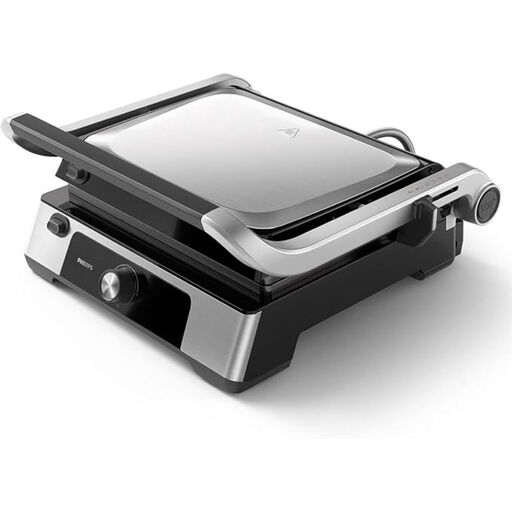
Consider this contact grill if plate space is a priority for your usual batch. Check the room needed for your chosen cooking layout and the cleaning instructions for this exact variant; use a clean probe for the thickest fillet.
 No image available
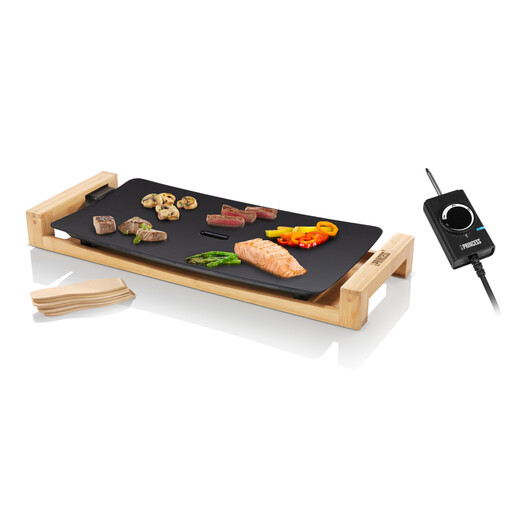
The stated 50 × 25 cm baking surface gives you an area to compare with your usual batch of fillets. Allow tabletop space for the grill and check how its cooking surface should be cleaned.
 No image available
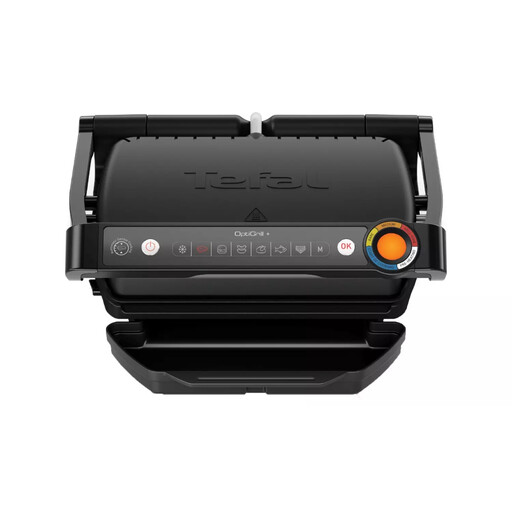
The automatic programmes may suit cooks who want guidance through a batch. Check that the grill’s capacity fits your usual number of fillets, and use a clean thermometer rather than treating a programme indicator as a doneness check.
 No image available
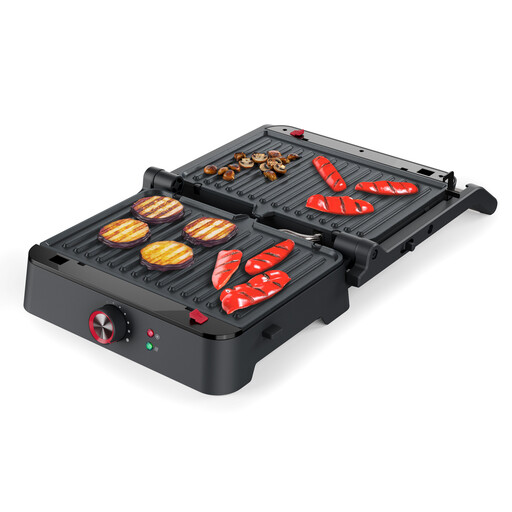
Compare its stated 27.5 × 18 cm cooking area with the fillets you normally prepare. It has detachable plates and a 180° opening; check plate-washing instructions and worktop clearance before buying.
 No image available
The stated 28 × 22 cm plates give you a defined area to compare with a smaller batch. Its product name specifies double-sided heating and a non-stick coating; check the plate-cleaning instructions and the thickest fillet’s centre temperature.
Insert a clean food thermometer into the centre of the thickest fillet and make sure the chicken is cooked through. GOV.UK gives safe cooking combinations of 70°C for 2 minutes or 75°C for 30 seconds; Food Standards Scotland advises checking the thickest part and reaching at least 75°C.
No. A programme, thickness sensor or progress indicator can help you manage cooking, but it does not establish the condition at the centre of every fillet. Check the thickest piece with a clean probe.
Choose by the number and size of fillets you actually cook, allowing room between pieces rather than treating a portion claim as an exact count. For comparison, Tefal UK states an 800 cm² surface and 6–8 portion capacity for the OptiGrill+ XL GC722D40, while Philips Home states a 748 cm² surface for its HD6301 and HD6307 models.