Choose a compact fan heater for quick, directed warmth during short, attended sessions. If you will occupy the room for several hours, a radiator-style heater with a thermostat and timer may suit steadier heating, provided you can accept a slower warm-up. Whichever type you choose, check its power settings and keep it safely clear of people, furnishings and blocked vents.
Who is this for?
Short-session desk and home-office users
If you mainly want warmth near your seat, a compact fan heater is worth considering. Electrical Safety First notes that fan heaters provide rapid heat but can be noisy, so think about whether fan sound will interrupt your work and where you can place the heater safely.
People spending several hours in one room
For reading, working or relaxing over a longer period, an adjustable thermostat and timer may matter more than immediate directed heat. A radiator-style heater is an option if you can wait for it to warm up.
Households where placement needs extra care
Children, pets, soft furnishings or a busy walkway make stability and clear space especially important. Check for suitable protective features, but do not rely on them instead of following the placement and electrical-safety advice from Electrical Safety First and the UK Home Office.
What matters when choosing?
Start with how long you will use the occupied room and whether you want heat directed towards your seat or more gradual room heating. Then compare controls, electricity use and the space available for safe placement.
| Concern |
What to check |
Who this matters to |
| Fast warmth at your seat |
Look at the heat settings and stated noise level, and allow clear space for the airflow. |
If I sit at a desk for a short session, I want warmth directed towards me without waiting for the whole room to heat; around 33% of consumers put that immediate warmth first. |
| Steady heat over several hours |
Check for an adjustable thermostat and timer, while allowing for slower warm-up with a radiator-style heater. |
When I spend an afternoon in one room, I would rather control the heat over time than have an immediate blast. Roughly 25% of consumers make steady, longer-session comfort their primary concern. |
| Electricity use |
Compare rated power, lower heat settings and thermostat control; actual use depends on the setting and time switched on. |
If I expect to use the heater regularly, I want a setting that fits the warmth I need rather than running at full power throughout; around 25% of consumers prioritise control over electricity use. |
| Safe household placement |
Check stability, tip-over and overheat protection, and whether you can keep vents and nearby fabrics clear. |
With people or pets moving through the room, I need a spot where the heater is unlikely to be knocked or obstructed; roughly 17% of consumers place that safety concern first. |
Mistakes to avoid
-
Choosing by maximum wattage alone
A higher power rating indicates greater electricity draw at full power, not that the heater is automatically a better fit for a small room. Thermostat cycling and lower settings also affect use.
Compare the available settings and controls with the length of your usual heating session, rather than selecting the highest figure on the label.
-
Relying on protective features instead of clear space
Tip-over and overheat protection do not remove the risk posed by curtains, bedding, clothes or blocked vents near a portable heater.
Follow the heater’s placement instructions, use a stable position and never use it to dry clothes. Electrical Safety First provides guidance on keeping portable heaters clear of furnishings.
-
Overloading a socket or extension lead
Portable heaters draw substantial power, and an overloaded connection is unsafe.
Use a suitable wall socket and avoid overloading socket strips or extension leads, as Electrical Safety First advises. Stop using the heater if a plug, cable or socket is damaged or becomes hot.
-
Applying one model’s efficiency claim to every heater
A manufacturer’s comparison can depend on the particular models and test conditions used; it does not establish how every radiator-style heater will perform in your room.
Read the stated comparison basis and choose controls that suit when you will actually occupy the room.
Brands to consider for these heater types
De'Longhi
De'Longhi’s UK portable-heater range includes fan heaters, oil-filled radiators and convectors, giving you several ways to match heating style to the time spent in a room.
- De'Longhi describes its fan heaters as providing immediate, directed warmth. The Capsule Fit HFS70B24.GY lists 1,000 W and 2,400 W settings.
- For the Capsule Fit HFS70B24.GY, check whether its stated noise and maximum power suit a quiet workspace and your intended hours of use.
Dimplex
Dimplex is relevant if you are considering radiator-style heat with scheduled, thermostat-led control.
- The Evo2BTA EvoRad lists a thermostat adjustable in 1°C increments, a timer, a tilt switch and overheat protection.
- Dimplex’s energy-saving claim concerns its own specified comparison with an equivalent 2 kW oil-filled column radiator; it is not a general result for other rooms or heaters.
Dyson
The Dyson Hot+Cool AM09 is a heat-and-cool option for someone who also wants fan airflow in warmer weather.
- Dyson lists focused and diffuse airflow modes for the AM09.
- Dyson says the AM09 is suitable only for well-insulated spaces or occasional use. Consider that condition before choosing it for regular room heating.
Joybuy products for this room
These two heaters offer different approaches to warming an occupied room: a fan heater for directed warmth and a convector with controls for room heating. Check the placement and product details that matter in your household before choosing either one.
 No image available
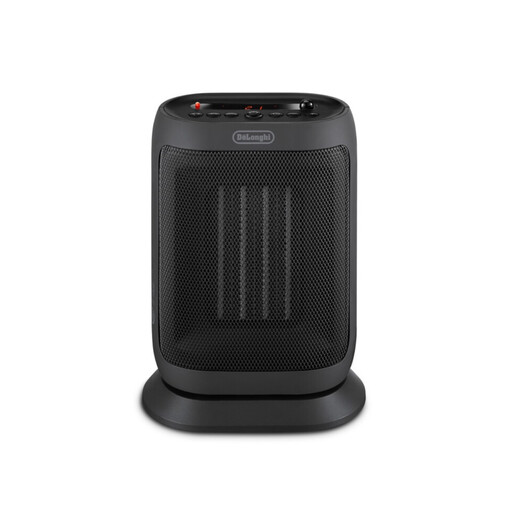
De'Longhi Capsule You & Me ceramic fan heater, dark grey
Consider this fan-heater format when you want directed warmth during a short, attended session.
The stated variant has a 2,000 W maximum rating, an oscillating base, remote control, 24-hour timer and ECO mode.
If quiet work or plug compatibility is important, confirm the noise level and plug supplied before ordering.
View on Joybuy
 No image available
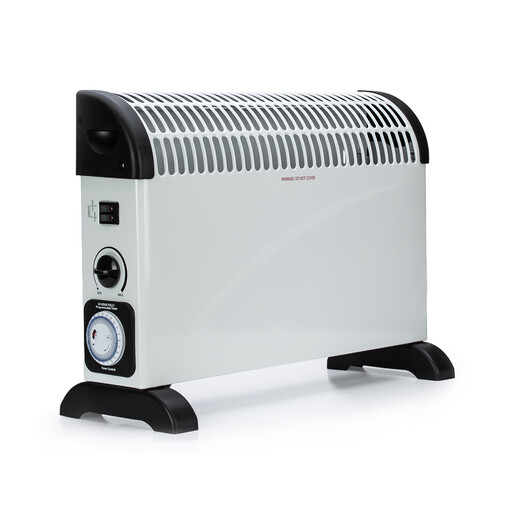
Status 2,000 W convector heater, white
Consider this convector if you want adjustable room heating rather than heat directed towards one seat.
Its stated variant has three heat settings, an adjustable thermostat and a timer.
If tip-over protection matters for your placement, confirm that feature and the plug supplied before ordering.
View on Joybuy
Common questions
What heater suits a short session at my desk?
A compact fan heater is worth considering if you want quick, directed warmth while you are present. Electrical Safety First notes that fan heaters can be noisy; check the stated sound level if you need a quiet workspace, and keep the heater’s vents and surrounding space clear.
What if I spend several hours in the room?
A radiator-style heater with an adjustable thermostat and timer may suit a longer session if you prefer more gradual heat. Oil-filled radiators take longer to warm than fan heaters and can continue giving out heat after switch-off, so consider both the warm-up time and where you will place the unit.
How can I compare electricity use?
Multiply a heater’s rated power in kW by the hours it operates at that setting to estimate electricity use in kWh. A 2 kW heater running continuously at full power for one hour uses 2 kWh; lower settings and thermostat cycling change the amount used.
What should I check before using a heater in a UK home?
Confirm the supplied plug and the manufacturer’s electrical instructions, then choose a stable position with adequate clearance from furnishings. Electrical Safety First also advises buying from a reputable retailer and registering the heater so you can be contacted about a safety recall.
Can I leave a portable heater on overnight or use it to dry clothes?
Do not use a portable heater to dry clothes or leave it running while you sleep. The UK Home Office advises unplugging electric heaters when you go to bed or go out; keep the heater away from curtains and furniture while it is in use.


