Desk-side quick-warmth users
If you sit down to work in a small, chilly office and want warmth promptly, a fan heater is worth considering. Electrical Safety First notes that fan heaters provide quick heat but can be noisy.


Choose a ceramic fan heater for quick warmth near your desk, a convector for quieter background heat, or an oil-filled radiator if sustained, fan-free warmth matters more than a fast warm-up. Whichever type you choose, check its stated room suitability and controls, then make sure it can stand clear of furnishings without overloading your desk-area electrics.
If you sit down to work in a small, chilly office and want warmth promptly, a fan heater is worth considering. Electrical Safety First notes that fan heaters provide quick heat but can be noisy.
If calls or concentrated work make fan noise disruptive, consider a fan-free oil-filled radiator or a convector. Dimplex describes its ML2T convector as near-silent, though the exact model and its placement still matter.
If you work in the room for sustained periods, compare thermostats and heat settings rather than choosing by maximum output alone. The De'Longhi TRRS0920 and Dimplex ML2T are examples with room thermostats.
Choose when: You want quick warmth around a cold desk rather than gradual room heating.
Accept: Fan noise may interrupt calls or focused work, and air vents need to remain clear.
Choose when: Low-noise background warmth across the room matters more than immediate desk-side heat.
Accept: Allow space around the grilles; Dimplex says its ML2T is suitable only for well-insulated spaces or occasional use.
Choose when: You work for longer stretches and prefer steady warmth without a fan.
Accept: Warm-up takes longer, and the fins can remain hot after switch-off.
| Concern | What to check | Who this matters to |
|---|---|---|
| Fast warmth at the desk | Check the stated room suitability and whether the footprint leaves safe clearance around papers and furniture. | I want to feel warmer soon after starting work, even if a fan makes some noise; roughly 28% of consumers put rapid desk-side warmth first. |
| Quiet background heat | Check whether the model has a fan and what noise information its maker provides. | Calls and focused work are harder for me with a fan running; around 22% of consumers prioritise low-noise warmth. |
| Temperature and electricity use | Compare input power, heat settings and thermostat controls; use your own electricity unit rate to assess consumption. | I spend long periods at my desk and want control over when the heater runs at full output; roughly 22% of consumers make temperature and electricity use their main concern. |
| Safe desk-area placement | Check plug and socket arrangements, the load on any extension lead, and clearance from fabrics and furniture. | My desk has equipment and cables nearby, so I need a safe place and suitable electrical connection for a heater; around 28% of consumers put that first. |
Maximum power alone does not tell you how quickly warmth reaches your desk, whether a fan will be audible or whether heat persists after switch-off. Electrical Safety First notes the quick warmth and potential noise of fan heaters.
Decide which heating pattern fits your workday before comparing controls and room suitability.
A heater alongside a computer, monitor and chargers can exceed an extension lead’s marked rating. Electrical Safety First warns against overloading or daisy-chaining extension leads.
Use a wall socket where practical. If an extension lead is necessary and the heater’s instructions permit it, check its marked rating against the total connected load and fully unwind any cable reel.
A 2 kW heater running continuously at full output uses 2 kWh in one hour; a thermostat may change how long it runs at that output. Actual use also depends on the room and selected setting.
Compare the available heat settings and thermostat, then assess likely use against your own electricity unit rate rather than assuming continuous full-power operation.
Tip-over and overheat protection do not make it safe to cover a heater or place it against curtains, furniture or papers.
Keep the heater and its vents clear, never use it to dry clothes, and follow GOV.UK advice to unplug electric heaters when you go out or go to bed.
The Radia S TRRS0920 illustrates the oil-filled radiator route for sustained, fan-free warmth.
The ML2T convector is an example for home-office users seeking low-noise background heating.
Its compact ceramic fan-heater range illustrates the quick-warmth route for a small work area.
These models cover quick desk-side heat from a ceramic fan heater and steadier warmth from oil-filled radiators. Choose the heating type and a safe position in your office before comparing individual models.
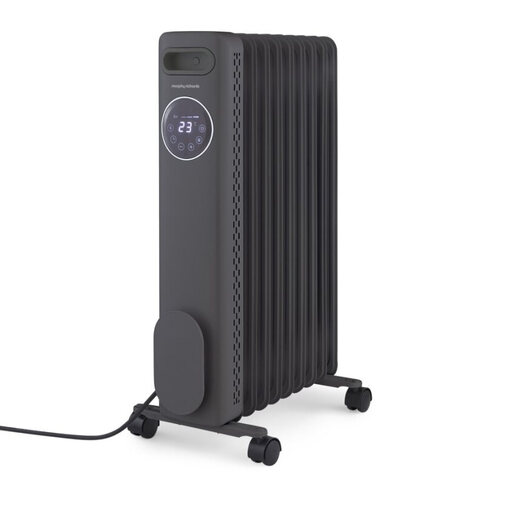 No image available
Consider this oil-filled model for longer desk sessions if you can accept a slower warm-up and hot surfaces after use.
2 kW model with remote control; grey finish. Check its stated room suitability and plug before buying.
 No image available
Consider a ceramic fan heater when quick warmth near the desk takes priority over quiet operation.
1.5 kW model with remote control; grey finish. Check the stated room suitability, noise information and plug, and leave its airflow clear.
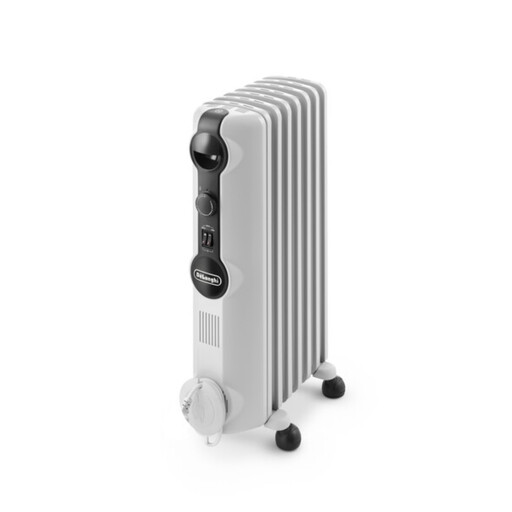 No image available
This fan-free radiator may suit focused work when gradual warmth is acceptable; its fins can remain hot after use.
Mechanical controls and white finish distinguish this TRRS0715 variant. Check its stated room suitability and plug before buying.
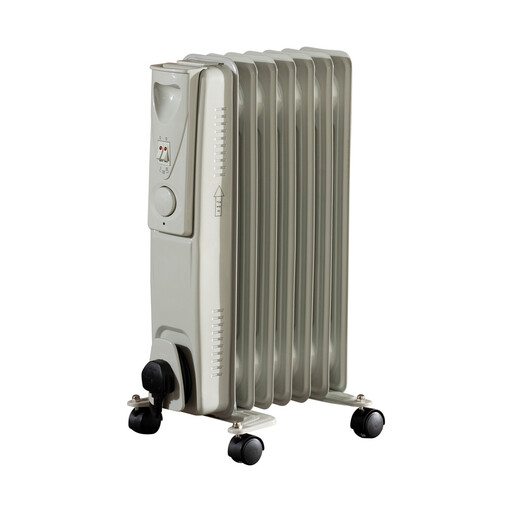 No image available
Consider this radiator for adjustable background warmth if slower warm-up and hot fins fit your work area.
Its title specifies an adjustable thermostat, tip-over shut-off, wheeled base and carry handle. Its instructions call for a direct wall-socket connection; check room suitability and the plug before buying.
 No image available
Consider this oil-filled model if its stated room suitability and a safe position in your office fit your needs; higher maximum power alone does not establish a better fit.
Black, 2500W, eleven-fin variant. Check its plug and allow for slower warm-up and hot surfaces after use.
A fan-free oil-filled radiator or a low-noise convector is generally a more suitable starting point than a fan heater when call noise is the priority. Electrical Safety First notes that fan heaters can be noisy, while Dimplex describes its ML2T convector as near-silent; check the exact model’s information.
No: it uses 2 kWh in an hour if it operates at its full 2 kW output throughout that hour. Lower settings or thermostat cycling can change consumption, so consider how you intend to use it as well as its maximum rating.
No. GOV.UK fire-safety guidance says to unplug electric heaters when you go out or go to bed, even if the model has safety shut-offs.
Only if the heater’s instructions permit it and the total connected load stays within the extension lead’s marked rating. Electrical Safety First warns against overloading and daisy-chaining leads; a direct wall socket is preferable where practical, and some models specifically require one.
Check the heater’s stated room suitability, plug, instructions and space requirements before choosing a model. Electrical Safety First advises buying from a reputable retailer and checking for a UK three-pin plug; register the product so recall notices can reach you.