Quick warm-up users
If you use the bedroom briefly while awake, such as when dressing or reading, you may want warmth soon after switching on. Dimplex describes fan heaters as circulating warmed air rapidly.


For a quick top-up while you are awake, consider a fan heater; for warmth spread more evenly through an enclosed bedroom, consider a convector. A radiant heater concentrates warmth on a person or spot, while a radiator-style model may suit a longer occupied period if its room guidance and footprint fit. Whichever type you choose, make sure it can stand clear of bedding and curtains, reach a wall socket directly and be switched off before bed.
If you use the bedroom briefly while awake, such as when dressing or reading, you may want warmth soon after switching on. Dimplex describes fan heaters as circulating warmed air rapidly.
If you stay in an enclosed bedroom for longer, you may prefer warmth spread through the room rather than concentrated directly in front of the heater. Dimplex describes convection as an approach for more even room warmth.
If bedding, curtains, furniture or limited floor space make placement difficult, check where the heater can stand before choosing one. Electrical Safety First and London Fire Brigade advise keeping portable heaters away from bedroom fabrics and furniture.
Decide whether your occupied-room use calls for a quick burst, warmth spread through the room or a longer period of radiator-style heating. A radiant heater is another option when you want warmth directed at a particular seat rather than even warmth throughout the bedroom.
| Concern | What to check | Who this matters to |
|---|---|---|
| Quick warmth | Consider fan-assisted heat for a short, awake stay; check the exact model’s heat settings and thermostat. | If I only need to take the chill off while dressing or reading, I want warmth soon after switching on. Around 40% of consumers put quick top-up warmth first. |
| Even room warmth | Compare convection and radiator-style models using the maker’s room-use guidance, thermostat and footprint. | When I remain in the bedroom, I care more about warmth across the enclosed room than a burst of heat beside the heater. For around 30% of consumers, even room warmth is the primary need. |
| Safe placement and control | Check for a clear, stable position away from fabrics, a direct route to a wall socket and controls you can switch off before bed. | If bedding and furniture leave little clear floor space, I need a heater I can position safely and remember to switch off. Safe placement and control come first for around 30% of consumers. |
Electrical Safety First and London Fire Brigade warn against placing portable heaters close to bedding, curtains and furniture. A small footprint does not remove the need for clearance.
Work out where the heater could stand before buying, follow its placement instructions and never use it to dry clothes.
Protective controls do not replace switching a portable heater off before sleep. Warwickshire County Council advises turning it off and unplugging it when going to bed.
Plan to use the heater while awake and occupied, and make switching it off part of your bedtime routine.
A higher power rating alone does not tell you how much electricity a heating session will use; the duration and whether a thermostat cycles the heater also matter.
Compare the stated wattage, heat settings and thermostat against the time you expect to use the heater while awake.
Electrical Safety First warns that high-powered appliances can overload extension leads and socket outlets. A cable stretched across a bedroom can also create a trip risk.
Choose a position where the supplied cable reaches a wall socket directly without crossing a walkway. Warwickshire County Council advises against using an extension lead or power strip for a portable heater.
Dimplex offers portable fan, convection and radiator-style heating approaches.
De'Longhi’s portable-heating range includes convectors and oil-filled radiators.
Dyson’s Purifier Hot+Cool range combines a fan heater with cooling and air-treatment functions.
These oil-filled radiators are options to consider if you prefer radiator-style warmth while using the bedroom. Check each model’s room guidance and whether you can give it enough clear floor space; the wider choice between fan, convection, radiant and radiator-style heat still depends on how you use the room.
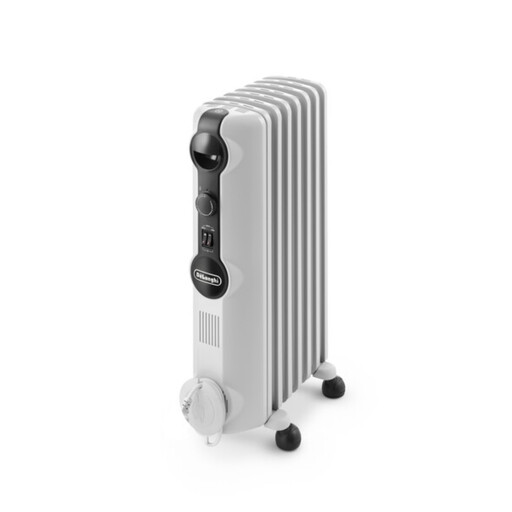 Image unavailable
Consider this model for an occupied period when you prefer radiator-style heating, subject to its room-use guidance. Its name specifies mechanical controls and a 1500 W rating. The listing calls for at least 50 cm of clear space around the unit, so check that its position works away from bedding, curtains and furniture; switch it off before bed.
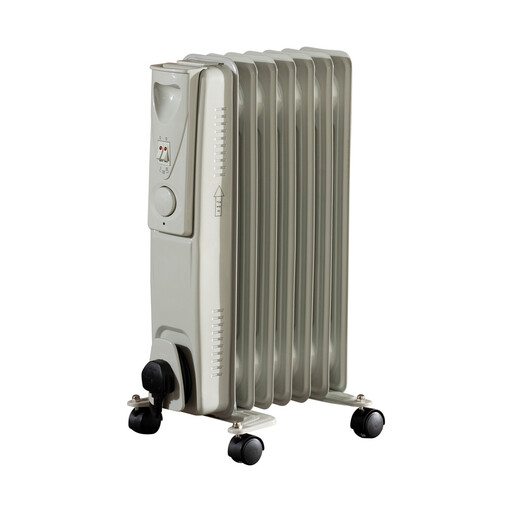 Image unavailable
Consider this model for radiator-style warmth during an occupied period, after checking its room-use guidance for your small bedroom. Its name specifies an adjustable thermostat, a tip-over shut-off, wheels and a carry handle. Check the dimensions and cable reach for a clear position near a wall socket, and switch it off before sleep.
Yes, if you can follow the heater’s instructions and position it safely while you are awake. Electrical Safety First advises keeping it away from curtains and furniture and never using it to dry clothes; leave clear space from bedding too.
No: switch it off before bed. Warwickshire County Council also advises unplugging a portable heater when going to bed; a timer or protective cut-out is not a substitute for that routine.
No: Warwickshire County Council advises plugging a portable heater directly into a wall socket rather than using an extension lead or power strip. Before buying, check that the cable can reach without crossing a walkway.