One-pan cooks short on space
If you usually make one saucepan of compote and need the worktop back for preparing food, a portable hob you can store between uses is worth considering. You will still need a safe place to set it up while cooking.


For one saucepan of apple compote, choose a portable induction hob if you need to put the appliance away afterwards and your pan is induction-compatible. A compact built-in two-zone hob makes more sense if you want a permanent second cooking zone and can accommodate the installation; consider ceramic if keeping existing non-induction cookware is the deciding factor, but check the exact hob’s cookware instructions before buying.
The space available after cooking matters as much as the space available while the compote is on the hob.
If you usually make one saucepan of compote and need the worktop back for preparing food, a portable hob you can store between uses is worth considering. You will still need a safe place to set it up while cooking.
If compote often cooks alongside another dish, a compact built-in two-zone hob offers a permanent second zone. Check that the worktop and electrical installation can accommodate the particular model.
If a built-in hob is the plan but induction compatibility would rule out pans you want to keep, compare ceramic models. Check the chosen hob’s cookware instructions rather than assuming every pan will suit it.
Decide whether the hob must be removable or permanently fitted, then check the pan and controls you would use for compote. A second cooking zone is useful only if you have a regular task for it.
Choose when: One compatible saucepan is usually enough and putting the hob away frees valuable worktop space.
Trade-off: The hob occupies counter space during cooking and gives you only one zone.
Choose when: You want a permanent place for a compote pan and another cooking task at the same time.
Trade-off: Installation needs checking, and both pans must suit induction.
Choose when: A fitted hob suits the kitchen, but retaining cookware that is not induction-compatible takes priority.
Trade-off: The cooking surface can remain hot after use; check its residual-heat indication and the model’s cookware instructions.
| Concern | What to check | Who this matters to |
|---|---|---|
| Worktop and storage space | For a portable hob, check its stored dimensions, a stable place to use it and the permitted pan-base size. | I need room to peel and chop apples once the hob is put away, even if that means cooking with one pan at a time. Around 40% of consumers put reclaiming worktop space first. |
| Simmering control | Compare the exact model’s lowest stated setting, manual steps and timer; do not assume a preset will suit your recipe. | When the fruit has released liquid, I want to adjust the heat and keep an eye on the simmer. For around 30% of consumers, controllable cooking is the primary need. |
| A permanent second zone | Check the installation diagram, cut-out, ventilation space and electrical requirements for the particular hob. | I regularly need another pan on the go while the compote cooks, so a fixed two-zone layout is worth the installation. A permanent second zone comes first for around 30% of consumers. |
A saucepan that is not induction-compatible, or whose base falls outside the hob’s stated size range, may not heat as intended. Tefal’s portable Everyday models specify cookware requirements that must be checked for the particular model.
Check induction suitability and measure the pan’s base, not its rim, before comparing it with the hob instructions.
Keeping an incompatible or undersized saucepan may mean needing another pan for compote.
A portable hob still brings a cable and electrical connection into a kitchen where heat and water are present. Electrical Safety First warns against overloaded sockets and damaged leads.
Set the hob on a stable, dry surface, keep the lead clear of heat and water, inspect the plug and cable, and follow the appliance instructions for connecting and supervising it.
An appliance’s outside dimensions do not establish whether it fits an existing cut-out or has enough space for ventilation and connection.
Get the exact installation diagram and check the cut-out, space below the worktop, ventilation and electrical requirements before ordering. Consult a qualified installer where needed.
An unsuitable opening or electrical supply may require worktop alteration or electrical-installation work.
Bosch describes ceramic hobs as heating through radiant elements and induction hobs as using magnetic fields. That distinction affects pan choice, while a ceramic surface can retain heat after cooking.
Check cookware guidance for the exact model and, for ceramic, look at its residual-heat indication and controls.
These brands provide examples of the formats and specifications to compare; a brand’s range does not establish what is suitable for your particular kitchen.
Tefal’s Everyday IH201840 and Everyday Slim IH210840 are portable single-zone induction examples for a one-pan setup.
AEG describes built-in induction ranges that include compact two-zone layouts as well as larger layouts.
Bosch provides induction and ceramic electric format information, including documentation for a compact two-zone induction hob.
These options cover a portable hob for one-pan cooking and compact built-in induction and ceramic alternatives. Choose the format first, then check the particular model against your saucepan and kitchen.
 No image available
Consider this one-zone portable format if you cook one pan of compote and want to store the hob afterwards.
The product name states 2000 W, 10 power settings, six functions, touch control and a safety lock. Check its lowest setting and compatible pan-base range against your saucepan; keep its ventilation openings clear during use.
 No image available
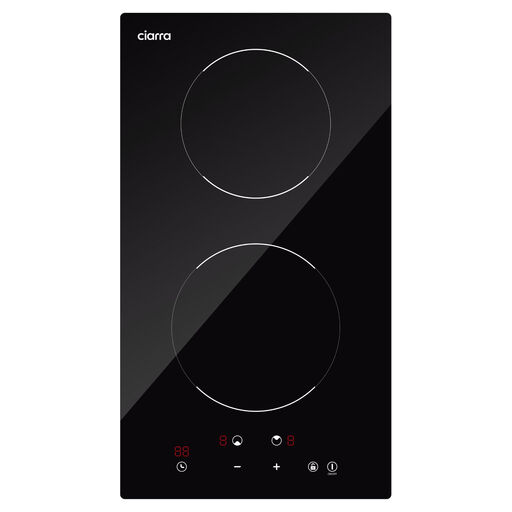
Consider this fixed two-zone format if a second pan is useful while the compote cooks and the kitchen can accommodate a built-in hob.
The product name states 2900 W, nine power levels, a timer and touch control. Induction requires suitable cookware. Check the exact cut-out, ventilation, electrical connection and pan-size requirements before buying.
 No image available
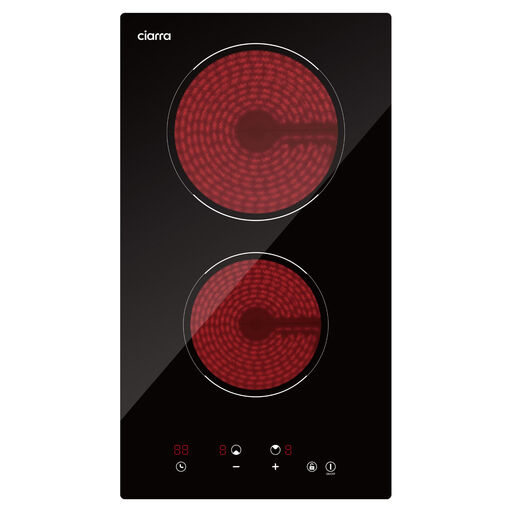
Consider this fixed ceramic format if you want two zones without making induction compatibility the deciding factor for your pans.
The product name states 2900 W, nine power levels, a timer and touch control. Check the product instructions for cookware suitability: its cookware guidance needs clarification. Confirm installation requirements and allow for a surface that can remain hot after use.
It will work only if it is induction-compatible and its base falls within the chosen hob’s stated size range. Measure the flat base rather than the rim and check the particular model’s instructions; Tefal’s Everyday portable models specify cookware requirements.
It can suit a one-pan compote routine if the saucepan is compatible and the controls give you a usable simmer. Compare manual low-power settings and timers, but keep stirring and supervising the fruit as your recipe requires; a preset does not guarantee the result.
Do not assume an extension lead is suitable for a high-power hob. Electrical Safety First warns against overloaded sockets; follow the appliance instructions and check the ratings and condition of the socket and any lead before use.
Check the exact model’s cut-out, clearances, ventilation and electrical connection requirements before committing to a fixed installation. In England, GOV.UK’s Approved Document P provides electrical-safety guidance for dwellings; confirm the requirements applicable to your installation and location, particularly elsewhere in the UK.
A ceramic radiant hob is worth considering if you need a built-in model and want to keep pans that are not suitable for induction. Bosch distinguishes radiant ceramic heating from magnetic induction, but cookware guidance still needs checking for the exact hob; take account of heat remaining at the ceramic surface after use.