Shared-kitchen batch cook
You make compote in one pan and need to set up, supervise and put away a hob without taking over the communal worktop.


For one saucepan of plum compote, a portable induction hob is a practical starting point if your pan is induction-compatible and your accommodation permits a personal appliance. Compare its lower heat settings and controls for a supervised simmer; choose two zones only if you regularly need another pan. A built-in ceramic hob is a separate installation decision, not a portable alternative.
You make compote in one pan and need to set up, supervise and put away a hob without taking over the communal worktop.
You want settings for bringing fruit to the boil and then monitoring a gentler simmer, but need to check that your saucepan has a magnetic base.
You need to confirm the accommodation rules and find a suitable worktop and electrical connection before using a personal cooking appliance.
Decide whether you need one portable zone, two portable zones or a permanent installation before comparing individual controls.
Consider it: For one saucepan when a personal hob is permitted and storage space is limited.
Trade-off: It requires induction-compatible cookware; lower heat settings vary by model.
Consider it: When you regularly use a second pan alongside the compote.
Trade-off: It takes more worktop space. IKEA's TILLREDA manual also describes power management between its two zones, so do not assume both can run at their highest settings together.
Consider it: Only if the kitchen owner is fitting or replacing a permanent hob.
Trade-off: Installation and electrical requirements must be checked for the exact model; a built-in hob is not a moveable countertop appliance.
| Concern | What to check | Who this matters to |
|---|---|---|
| Permission and safe setup | Confirm the accommodation rules, the manual's placement and ventilation instructions, and a suitable socket and lead position. | I need a permitted place to cook without putting the hob beside water or routing its lead across the worktop; around 42% of consumers put permission and safe setup first. |
| Simmer control and pan fit | Check that the saucepan has an induction-compatible base, meets the model's pan-size requirements and can be used with its lower settings. | Once the fruit has boiled, I want to monitor a gentler heat without discovering that my pan will not work; roughly 33% of consumers prioritise simmer control and cookware compatibility. |
| Storage and worktop space | Compare the hob's dimensions, number of zones and storage position; follow its instructions for cleaning after cooking. | I need to clear the communal worktop when the compote is finished; about 25% of consumers put compact storage and clean-up first. |
An induction hob needs a suitable magnetic pan base; otherwise the saucepan may not heat.
Try a fridge magnet on the base and check the hob manual's pan-size requirements before ordering.
If your current pan is unsuitable, you will need access to a compatible saucepan.
A second zone uses more shared worktop space, while a built-in ceramic hob involves a separate installation decision.
If you normally make compote in one pan, compare portable single-zone models first. Consider two zones for regular parallel cooking.
Electrical Safety First highlights the combination of water, hot surfaces, trailing cables and high-power appliances as a kitchen hazard.
Use a dry, stable worktop, keep the lead away from water and hot cookware, and check the plug, lead and socket before use.
Compote may need stirring or attention if it bubbles over. Greater Manchester Fire and Rescue Service advises against leaving cooking unattended.
Use a timer as a prompt to check the pan, not as a reason to leave the hob operating.
IKEA's TILLREDA two-zone model is relevant when a second pan is useful and there is room to operate and store the hob.
The Everyday Slim IH210840 is a single-zone option to compare for a compact cooking setup.
VonShef's single induction hob is relevant if you want to compare stated power and temperature settings for one pan.
These portable induction hobs are options to assess for countertop compote cooking. Check their pan requirements, available controls and placement instructions against your shared kitchen.
 No image available
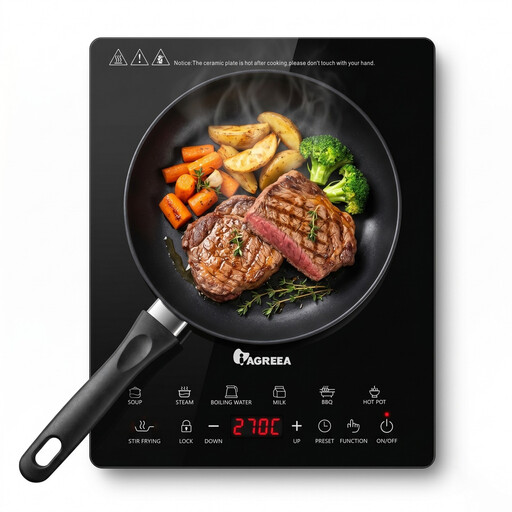
Consider its stated controls for bringing fruit to the boil and then supervising a gentler setting. The product name specifies eight power levels, 60–270°C temperature control and a timer of up to three hours.
It specifies flat-based magnetic cookware measuring 12–26 cm. Confirm the electrical connection and the manual's placement and ventilation requirements for your kitchen; a timer does not replace attendance.
 No image available
Consider this portable model if you can use an induction-compatible saucepan and need to put the hob away after cooking. Its product name specifies ten power settings and six functions.
Before choosing it for compote, check the lowest setting and whether its controls suit a supervised simmer. Also confirm pan-size requirements, dimensions, electrical connection and the instructions for keeping ventilation openings clear.
No. Greater Manchester Fire and Rescue Service advises against leaving cooking unattended. If you need to leave, take the pan off the heat and turn off the hob; use a timer as a reminder to check it, not as a substitute for staying nearby.
It will work only if its base is induction-compatible and its size meets the exact hob's requirements. Judge advises using a fridge magnet to check whether the pan base is magnetic; also consult the pan and hob instructions.
Turn off the hob and follow its own instructions on when and how to clean the surface. IKEA's TILLREDA guidance specifies a cloth dampened with warm water and mild detergent, followed by drying with a soft cloth; check the care method before applying it to another model.