Who this is for

Frequent large-pot batch cooks

If you make several portions of polenta at once, compare your pot’s base with the hob’s cooking-zone dimensions and check that the controls remain accessible when the pot is in place. AEG UK and Neff Home Appliances GB describe bridge and flex arrangements on specific models for larger cookware.

Induction-ready cookware owners

If your flat-bottomed pot has a magnetic base, induction is an option. AEG UK Support recommends checking the base with a magnet; you still need to check the cookware dimensions allowed by the particular hob.

Kitchen-replacement planners

If you are replacing a built-in hob, compare the new model’s cut-out, external dimensions and electrical connection with your kitchen before ordering. The installation specifications published by AEG UK and Electrolux UK apply to their respective models, not every hob of the same nominal width.

What matters when choosing

Standard induction

Choose it when: A large circular zone accommodates your round polenta pot’s magnetic base.

Bear in mind: Induction requires compatible cookware, and the model’s stated pan-size limits still apply.

Bridge or flex induction

Choose it when: Your cookware is broad or elongated enough to benefit from linked zones or more flexible placement.

Bear in mind: A flexible layout does not remove induction’s magnetic-base requirement; check the exact model’s supported pan dimensions.

Ceramic radiant

Choose it when: You want to keep a suitable non-magnetic pot rather than switch to induction-compatible cookware.

Bear in mind: Do not assume it offers bridge or flex induction features; Electrolux UK lists no flexible cooking zones for its LRR6436 ceramic model.

Concern What to check Who this matters to
Pot footprint Measure the pot’s base, not its rim, against the model’s zone dimensions and permitted cookware sizes. Check whether a standard zone fits before considering bridge or flex. I use one substantial pot and need its base to fit the heated area without awkward placement. Around 36% of consumers put large-pot layout first.
Heat adjustment Look for controls that let you select a lower setting after heating the liquid; treat boost as a heat-up feature, not a substitute for stirring. Once polenta thickens, I want to turn the heat down readily while I stir. For around 29% of consumers, controllable finishing is the primary need.
Pot compatibility For induction, test the base with a magnet and check its flatness and size against the exact hob manual. I would rather keep my current pot than discover it cannot be used on the new hob. Keeping cookware compatible comes first for around 21% of consumers.
Installation fit Compare the worktop cut-out, appliance dimensions, connection type and electrical load with your kitchen and the model’s installation instructions. I am replacing a built-in hob and need the new appliance to suit the space and electrical arrangement. Around 14% of consumers make installation fit their first concern.

Buying pitfalls

  • Choosing induction without checking the pot

    AEG UK Support states that induction needs a magnetic base. The pot’s rim diameter alone tells you neither whether it will work nor whether its base fits the chosen zone.

    Test the base with a magnet, measure it and check the exact hob manual’s cookware limits.

    If the existing pot is not compatible, using an induction hob for it would mean changing cookware.

  • Assuming every 60 cm hob fits the same opening

    A nominal width does not establish the required worktop cut-out or connection. AEG UK and Electrolux UK list hardwired installation for their cited 60 cm models.

    Check the chosen model’s cut-out, depth, electrical load and connection instructions against your kitchen before ordering.

    A mismatch may require electrical work or changes to the worktop.

  • Relying on boost throughout cooking

    A boost feature is useful during initial heating, but thickening polenta still calls for a lower setting and stirring. Bosch GB describes PowerBoost on its PUE611BB5B as a faster-heating feature.

    Choose controls you can adjust readily with the pot in place, and consider boost a convenience for the heat-up stage.

  • Choosing bridge or flex without measuring the base

    Linked or flexible zones can help with broad or long cookware, but a round pot that fits a standard large zone may not need that layout. AEG UK and Neff Home Appliances GB describe these features on specific induction models.

    Measure the pot base first, then compare it with both standard-zone and flexible-zone dimensions for the models you are considering.

Relevant brands to compare

AEG

Worth looking at if a documented bridge layout could help accommodate your cookware.

  • AEG UK states that the Bridge function on its TO64IB00FB combines two cooking zones.
  • That model requires hardwired installation; its layout and connection details should not be assumed for other AEG hobs.

Bosch

A reference for comparing a conventional four-zone induction layout with direct touch selection.

  • Bosch GB lists TouchSelect and PowerBoost for the PUE611BB5B.
  • If linked zones matter for your pot, check a model that explicitly lists CombiZone or FlexInduction rather than assuming the PUE611BB5B has them.

Neff

Relevant when flexible pan placement is a specific requirement.

  • Neff Home Appliances GB lists two flex induction zones and automatic cookware detection for the T56TT60N0.
  • Check that model’s supported pan sizes, cut-out and connection requirements before treating its layout as suitable for your kitchen.

Electrolux

A ceramic radiant option to consider when retaining non-magnetic cookware matters.

  • Electrolux UK lists four zones, including an oval zone, for the LRR6436 ceramic hob.
  • The LRR6436 lists no flexible cooking zones and requires hardwired installation; an oval ceramic zone is not a bridge induction zone.

Hisense

Another brand to check if you want an induction hob with a bridge function.

  • A bridge function and four induction zones are listed for the HI6421BSC.
  • Those retailer-listed details concern the HI6421BSC; check the exact model documentation rather than applying them to other Hisense variants.

Joybuy induction hobs

These two induction hobs offer flexible-zone layouts to consider if your batch-cooking pot needs more placement space. Compare the pot’s magnetic base and the installation requirements with each exact model; the ceramic alternative discussed above remains a separate choice.

Belling IHL773 BLK induction hob

Belling IHL773 BLK 77 cm induction hob

Consider its flexible bridge layout if a standard circular zone does not suit your pot base.

Four cooking zones, touch controls and boost mode are listed for this variant. Check that your pot has a suitable magnetic base and that this model’s cookware limits, worktop opening and electrical connection suit your kitchen.

View on Joybuy
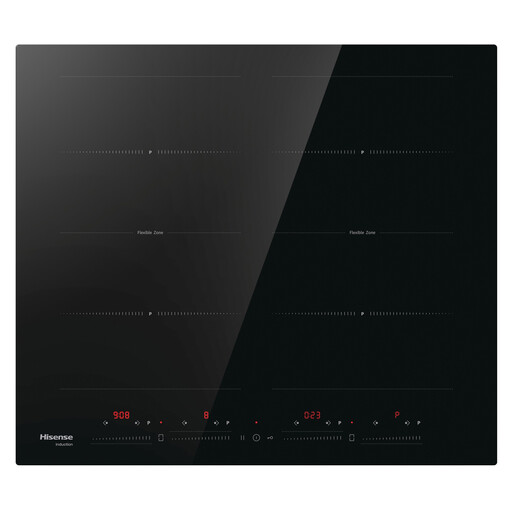
Hisense HI6442BSCE induction hob with Area Flex

Hisense HI6442BSCE 60 cm induction hob with Area Flex

Consider the Area Flex layout if your pot base would benefit from flexible placement.

Before ordering, check the model’s permitted cookware dimensions, worktop cut-out, electrical load and connection type against your pot and kitchen. Induction requires a suitable magnetic-base pot.

View on Joybuy

Frequently asked questions

Should I choose induction or ceramic for a large pot of polenta?

Choose induction if the pot has a suitable magnetic, flat base and the hob has a zone that fits it; choose ceramic radiant if keeping a suitable non-magnetic pot is more important. Check the base against the exact model’s zone dimensions either way.

Do I need a bridge zone to batch-cook polenta?

Not if a standard large zone accommodates your round pot’s base. Consider bridge or flex induction for a broader or elongated base, checking the model’s supported cookware dimensions before buying.

How can I check whether my pot works on induction?

Test whether a magnet sticks to the base, then check that the base is flat and falls within the chosen hob’s cookware-size limits. AEG UK Support states that induction requires a magnetic base; the exact model manual sets its permitted dimensions.

What should I check before replacing a built-in hob?

Measure the existing worktop opening and available surface space, then compare them with the new model’s installation sheet and electrical requirements. Do not assume that two hobs with the same nominal width need the same connection or opening.

Should an electrician install my new hob?

Electrical Safety First recommends using a registered electrician for electrical installation work. Ask one to assess the work required for your kitchen and location, particularly if the selected hob specifies a hardwired connection; follow that model’s installation instructions.