One-pan cooks without an installation space
If you usually make soup in one saucepan and need to put the appliance away afterwards, a portable hob is the format to examine. Check its actual footprint and connection before choosing it.


For one soup pan and no worktop alteration, consider a portable induction hob; if you want a permanent hob in a narrow space, consider a built-in two-zone model. A 60 cm hob makes more sense when you regularly use several pans, while ceramic is worth comparing if keeping your existing cookware is the priority. Check the chosen model’s dimensions, installation and electrical requirements, and pan compatibility before ordering.
If you usually make soup in one saucepan and need to put the appliance away afterwards, a portable hob is the format to examine. Check its actual footprint and connection before choosing it.
A built-in two-zone hob may suit a permanent cooking space that cannot accommodate a standard-width model. The worktop cut-out, space below and ventilation must match the particular hob.
If replacing the soup saucepan would be inconvenient, compare ceramic with induction rather than choosing by hob size alone. Induction requires suitable cookware; Hotpoint says its ceramic and solid-plate electric hobs can be used with any pot or pan.
Decide whether the hob must be portable or built in, then consider how many pans you actually use and whether your soup saucepan is suitable for induction.
Choose when: You normally cook soup in one pan and want to store the hob after use.
Trade-off: The cited electriQ single-zone model uses a 13-amp plug, but one zone cannot heat another pan at the same time; check your chosen hob’s connection and pan requirements.
Choose when: You want a permanent two-zone hob without giving over the worktop width of a standard-size model.
Trade-off: It needs a matching cut-out and model-specific clearance and ventilation; a nominal 29–30 cm width does not establish that it will fit.
Choose when: You have room for a wider built-in hob and regularly cook soup alongside other pans.
Trade-off: NEFF says its Plug&Play hobs share power between active zones once the total-output limit is reached, which can lengthen cooking time.
Choose when: Keeping your current cookware matters more than switching to induction.
Trade-off: Which? explains that ceramic elements heat the glass surface, unlike induction’s pan-directed heating; allow for residual heat after cooking.
| Concern | What to check | Who this matters to |
|---|---|---|
| Space and installation | Measure the space the hob will occupy. For a built-in model, match its installation drawing to the cut-out, space below and ventilation available. | I need somewhere to cook soup without losing worktop space I rely on, or I need the appliance to go away afterwards. Around 36% of consumers put fitting or storing the hob first. |
| Simmering and cookware | Check the chosen model’s heat controls and whether your soup saucepan is suitable for induction; compare ceramic if you need to keep that pan. | When soup needs a gentler heat, I want controls I can use with the pan I already own. For around 29% of consumers, cooking control and cookware suitability are the primary concern. |
| Cooking zones | Count the pans you use together. On a plug-and-play multi-zone model, check how its total power is shared between active zones. | I often have soup on while preparing another dish, so one zone would restrict that routine. Around 21% of consumers place room for additional pans first. |
| Cleaning and residual heat | Look for residual-heat indication and follow the exact model’s cleaning instructions; check for a lock or timer if you need one. | Soup can splatter, and I want to know when the surface can be cleaned without treating a switched-off hob as cool. Surface care and residual-heat safeguards come first for around 14% of consumers. |
NEFF says its Plug&Play hobs share power across active zones after reaching their total-output limit. Cooking soup alongside another dish may therefore take longer.
If you routinely use several pans, check the chosen 13-amp model’s total-output and power-sharing instructions.
The visible width does not establish whether the hob fits the opening or has enough airflow beneath it. Bosch says induction-hob installation measurements vary by model.
Compare the manufacturer’s installation drawing with your measured worktop, cupboard space and ventilation arrangement before ordering.
Induction requires suitable cookware. Hotpoint says its ceramic and solid-plate electric hobs can be used with any pot or pan.
Check your saucepan against the chosen induction hob’s instructions, or compare ceramic if you need to retain it.
If the saucepan is unsuitable for your chosen induction hob, you will need a compatible pan to use it.
A ceramic hob heats its glass surface, while an induction surface can retain heat transferred from the pan. Switching either off does not mean it is immediately safe to touch.
Follow the model’s residual-heat indication and cleaning instructions before wiping the surface or storing a portable unit.
Relevant if you want to examine a built-in, standard-width induction hob designed for a 13-amp supply.
Relevant for comparing a standard-width plug-in induction model with the space available in your kitchen.
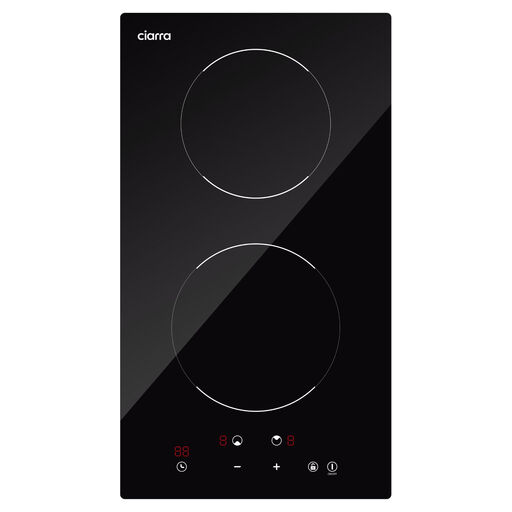
Relevant if you are comparing compact two-zone induction layouts with larger built-in options.
Relevant if retaining existing saucepans makes ceramic or solid-plate electric hobs worth comparing with induction.
These two induction options address different small-kitchen needs: a narrow permanent two-zone hob and a portable cooker that can be put away. Check the installation or connection details of the particular option you prefer.
 No image available
Consider this for a permanent narrow hob when you want a second zone alongside the soup pan. Its title specifies 2900 W, nine power levels, a timer and a child safety lock. Check the installation drawing, ventilation, electrical connection and saucepan compatibility for this model before buying.
 No image available
Consider this if you need an induction cooker that can be moved or stored after making soup. Its title specifies ten power settings, six functions, touch controls and a safety lock. Confirm its footprint, electrical connection and suitability for your saucepan before buying.
No. AEG says most induction hobs need hard-wiring by a qualified electrician unless they are Plug and Play models. For a 13-amp multi-zone model, also check how power is shared: NEFF says its Plug&Play hobs share output between active zones once the total limit is reached.
It will work only if it meets the chosen induction hob’s cookware requirements, so check both the pan and the appliance instructions. If keeping the pan is essential, compare ceramic: Hotpoint says its ceramic and solid-plate electric hobs can be used with any pot or pan.
Check the specified worktop cut-out, worktop thickness, clearance beneath the hob and ventilation arrangement against the chosen model’s installation drawing. Bosch says induction installation measurements vary by model, so the advertised surface width alone cannot confirm a fit.
Check the exact model’s installation and connection instructions before arranging fitting. AEG says built-in induction hobs that require hard-wiring need a qualified electrician; do not assume a hob can be plugged in merely because another model is sold as Plug and Play.
The Office for Product Safety and Standards says the Electrical Equipment (Safety) Regulations 2016 set requirements before electrical equipment is placed on the Great Britain market. That does not establish the compliance of an individual hob; for delivery or use in Northern Ireland, check the applicable local arrangements rather than applying a Great Britain-only conclusion.