Large-pan batch cooks
If you caramelise onions in a wide sauté pan or cook other components at the same time, usable zone space matters more to you than a compact hob footprint.


For regular large batches, choose an induction hob with a zone that suits the base of your onion pan. A wider bridge or flex-zone model is worth considering if you use an oversized pan or cook other dishes alongside it; a frying-temperature sensor may appeal if scorching is your main concern, but you will still need to manage the heat, moisture and stirring. Check pan compatibility, worktop dimensions and the exact model’s electrical connection before buying.
If you caramelise onions in a wide sauté pan or cook other components at the same time, usable zone space matters more to you than a compact hob footprint.
If your main worry is onions catching during a long cook, you may value readily adjustable controls or a model-specific temperature-assistance feature. Pan choice and stirring still matter.
If you are replacing a hob, the new appliance must suit your worktop opening, electrical connection and onion pan. Those checks can narrow the choice before extra cooking features do.
Consider it when: your pan base fits one zone and retaining a standard-width hob is the priority.
Trade-off: a conventional ring-zone layout does not join zones for an unusually wide pan.
Consider it when: a wide pan needs joined cooking zones, or you want room to use other pans alongside it.
Trade-off: a wider built-in model may require worktop changes; AEG UK specifies a 750 × 490 mm cut-out and hardwired connection for its IKX84443CB.
Consider it when: flexible pan placement and temperature assistance are priorities during multi-pan cooking.
Trade-off: NEFF UK describes these features on its T68FUV4L0, but they do not establish how it will caramelise onions in your pan or remove the need to stir.
| Concern | What to check | Who this matters to |
|---|---|---|
| Avoiding scorching | Look for controls you can adjust readily during a long cook. If you want temperature assistance, confirm that the exact model has a frying sensor. | If onions tend to catch while I am managing a large batch, I want to adjust the heat without relying on boost power; around 40% of consumers put avoiding scorching first. |
| Usable pan area | Measure the pan base and check the zone layout. For a wide or rectangular base, confirm whether the model can join zones or offers a suitable flex area. | When my onion pan takes up substantial space, I need a layout that also accommodates the other pans I use; roughly 30% of consumers prioritise large-pan or multi-pan space. |
| Kitchen and pan fit | Compare the specified cut-out and connection with your kitchen, then check that the pan has a suitable induction-compatible base. | Before replacing my hob, I need to know that it can be installed and will work with my main pan; about 30% of consumers put installation and cookware fit first. |
The usable cooking area depends on the zones and the pan base, not just the overall hob width. Induction also requires suitable cookware.
Measure the base rather than the rim, check whether a magnet is attracted to it and compare it with the exact model’s zone guidance. For a particularly wide pan, verify that the model has the bridge, combi or flex feature you need.
You may need a different pan if your existing one is unsuitable for the chosen induction hob.
A wider hob cannot be assumed to fit a worktop opening made for a 60 cm model. AEG UK specifies a 750 × 490 mm cut-out and hardwired connection for the IKX84443CB.
Compare the appliance and cut-out dimensions with your kitchen, check the connection instructions for the exact model and seek installation advice appropriate to where it will be fitted.
Changing the worktop opening or arranging electrical installation may add work to the replacement.
Boost is a rapid-heating feature, not a substitute for controlling heat as onions cook over time.
Use rapid heating only when it suits the pan and ingredients, then move to a controllable setting and stir regularly. If temperature assistance matters to you, check for it on the exact model.
AEG UK warns that abrasive cleaners and scouring pads can scratch an induction hob’s surface.
Allow the zones to cool and follow the model’s cleaning instructions, using a suitable hob-cleaning method and scraper where appropriate.
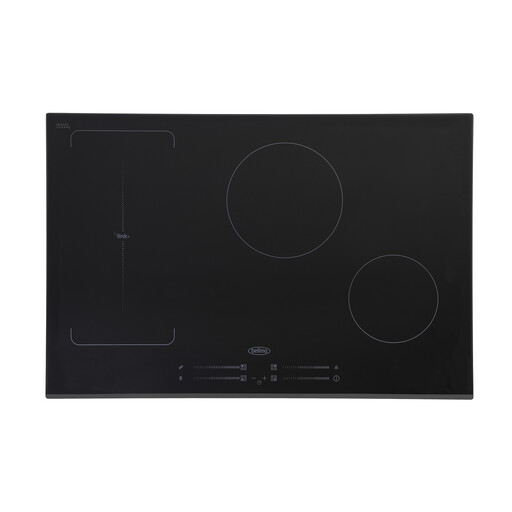
AEG UK’s 80 cm IKX84443CB illustrates a built-in bridge-zone option for a wide pan.
NEFF UK’s 80 cm T68FUV4L0 illustrates a five-zone model for buyers interested in flexible pan placement and temperature assistance.
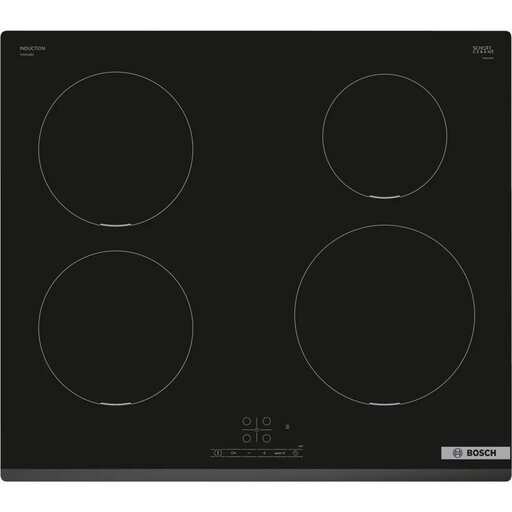
Bosch UK’s 60 cm PIE631BB5E illustrates a conventional four-ring-zone layout; its PWP611BB5B is a separate 60 cm CombiZone option.
These induction hobs cover two relevant approaches: a 77 cm model with a bridge zone for wider-pan use and a 60 cm ring-zone model for a pan that fits a single zone. Check the pan and installation requirements of whichever layout you choose.
 No image available
Consider this model if a wider pan or cooking alongside other pans makes a bridge zone useful. Its stated configuration has four cooking zones, a flexible bridge, touch controls and boost mode. Check the zone dimensions against your pan base and confirm the connection and installation instructions before ordering.
 No image available
Consider this conventional four-zone layout if your onion pan fits a single ring zone and a 60 cm hob suits your kitchen. Bosch UK lists PowerBoost for this model, but controllable heat matters more during the long cooking stage. The listed variant is hardwired; check the cut-out and zone dimensions and arrange installation advice before purchase.
It can work if its base is attracted by a magnet and is flat and appropriately sized for the intended zone. NEFF UK advises that cookware quality affects heating results, so compare your pan base with the guidance for the exact hob.
No: a standard ring zone can be sufficient when the pan base fits it. A bridge or flex zone is worth considering for a wider or unusually shaped pan, or when you need more flexible space for other batch-cooking pans; AEG UK describes joined zones on the IKX84443CB, while NEFF UK describes flexible cookware placement on the T68FUV4L0.
PowerBoost is intended for faster initial heating, not for maintaining the gentle, controlled cook needed over time. Bosch UK describes it as a faster-heating feature on the PIE631BB5E; during caramelising, adjust the heat to suit the pan and stir the onions regularly.
Allow the cooking zones to cool, then follow your model’s instructions for removing residue with a suitable scraper or non-abrasive cleaning method. AEG UK advises against abrasive cleaners and scouring pads because they can scratch the surface.