Small-kitchen custard makers
If you usually heat one saucepan, a stowable single-zone hob lets you keep the worktop clear between uses. Check how you can reduce the heat as the custard begins to thicken.


For one saucepan in a small kitchen, consider a portable induction hob if your pan is compatible and you want stated settings for adjusting the heat as custard thickens. A portable ceramic hotplate is the more accommodating route for ordinary aluminium or copper pans. Choose two zones only if you regularly cook with another pan at the same time and have room for the larger unit; neither settings nor hob type guarantee that custard will not curdle.
If you usually heat one saucepan, a stowable single-zone hob lets you keep the worktop clear between uses. Check how you can reduce the heat as the custard begins to thicken.
If you want to keep using non-magnetic saucepans, consider a ceramic hotplate. Induction requires a compatible pan base, as Judge explains in its JEA90 manual.
If custard often shares cooking time with another dish, a second zone may be useful. Measure the counter and storage space before choosing a larger unit.
Decide whether your saucepan works with induction, then weigh heat adjustment against the space needed for one or two zones. A stated low setting gives you a control option, not a tested custard result.
| Concern | What to check | Who this matters to |
|---|---|---|
| Low-heat control | Check the exact model’s lowest stated power or temperature setting and how you adjust it manually. Tefal UK specifies seven manual levels from 300W to 2100W for the Everyday Slim IH210840. | When custard starts to thicken, I want to turn the heat down promptly rather than rely on a preset. Roughly 42% of consumers put controllability first. |
| Saucepan compatibility | For induction, check the pan base and the model’s supported diameter. For ceramic, check that the saucepan sits flat and fits the heated zone. | If my usual saucepan is aluminium or copper, I would rather keep using it than change pans for a new hob. Around 33% of consumers make cookware compatibility their primary concern. |
| Space and second-pan capacity | Measure the appliance’s full footprint, storage space and cable route. Judge specifies its two-zone JEA92 as 55cm long. | When another dish needs a pan alongside the custard, I have to decide whether a second zone earns its place on the worktop. About 25% of consumers prioritise that space-and-capacity decision. |
A flat base alone is not enough: Judge’s induction manual says ordinary glass, ceramic, aluminium and copper pans need a specially constructed induction base.
Try a magnet on the saucepan base, then check the pan and hob instructions for compatibility and supported diameter.
Keeping an incompatible saucepan may mean obtaining another suitable pan.
Judge specifies the two-zone JEA92 as 55cm long, while its single-zone JEA90 measures 31cm by 27cm. The extra zone may leave too little usable worktop.
Measure the counter and storage location with the saucepan and a safe cable route in mind before deciding that two zones are necessary.
Electrical Safety First warns that exceeding an extension lead’s or cable reel’s current rating can cause overheating and fire.
Use a suitable wall socket where possible. If an extension is unavoidable, check its marked rating and the combined appliance load, avoid daisy-chaining and fully unwind a cable reel.
A fitted hob also needs a suitable cut-out, ventilation space and electrical supply. Built-in induction and ceramic hobs need hardwiring by a qualified electrician.
Check the exact model’s installation instructions and arrange qualified help for hardwired work before ordering.
Tefal UK lists the Everyday Slim IH210840 as a portable, single-zone induction option for a kitchen where storage depth matters.
Judge has a portable single-zone induction model, JEA90, and a larger two-zone option, JEA92.
The Cooks Professional K962 is a single-zone ceramic hotplate for buyers who want to use a wider range of existing saucepans.
These induction options serve different kitchen layouts: a built-in two-zone hob for a planned fitted space, and a portable hob that can be moved when it is not in use. Check cookware compatibility and the exact low setting before choosing either for custard.
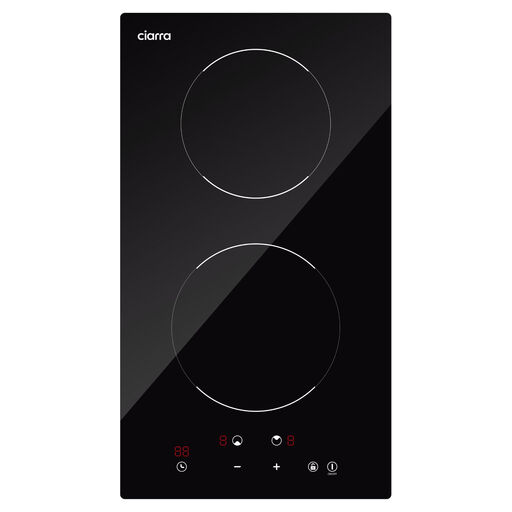 No image available
Consider this built-in model if you need two pans in a compact fitted layout rather than a portable ring.
Its title specifies 2900W, touch control, nine power levels, a timer and a child safety lock. Check the lowest setting for custard, confirm that your saucepan is induction-compatible, and follow the exact model’s fitting and electrical instructions. Built-in induction hobs need hardwiring by a qualified electrician.
 No image available
Consider this portable option if you want a hob that can be moved off the worktop and already have induction-compatible cookware.
Its title specifies ten power settings and six functions. Check the lowest setting for custard and measure the hob against your counter and storage space before buying. Avoid touching the panel during use, as the product information warns that it becomes very hot.
It will work only if its base is magnetic or specifically made for induction. Judge’s JEA90 manual lists enamelled steel, cast iron and suitably designed stainless steel as suitable, but says ordinary glass, ceramic, aluminium and copper need a special induction base. Check the saucepan as well as the hob’s pan-size guidance.
Cooks Professional lists both materials as compatible with its K962 ceramic hob. Check that your saucepan has a flat, stable base and fits the model’s pan-size guidance; the K962 is stated to work best with pans up to 22cm.
Use a suitable wall socket where possible; if an extension is needed, keep the combined appliance load within its marked current rating. Electrical Safety First also advises against daisy-chaining extensions and says cable reels should be fully unwound.
Built-in induction and ceramic hobs need hardwiring by a qualified electrician. A plug-in portable hob is a different appliance; for a built-in model, check its own fitting, ventilation and electrical instructions before ordering.
Place it where the pan sits securely, the lead can be routed safely and the appliance’s ventilation is unobstructed. Keep the hob and electrical connections away from water, follow its clearance instructions and do not leave it unattended while cooking.