Short-stay cooks using one pan
If you plan to fry the vegetables and spices before simmering everything in the same pan, a compact hob that is easy to set up and store may be enough. Check that you can bring a suitable pan.


For a short stay, a portable hob is the practical route: choose single-zone induction if you have a compatible pan and can cook the curry in sequence, or two independently controlled electric plates if you need to fry and simmer at the same time. A fitted hob is a separate choice for an owner replacing the cottage kitchen appliance, subject to worktop, electrical and installation checks.
If you plan to fry the vegetables and spices before simmering everything in the same pan, a compact hob that is easy to set up and store may be enough. Check that you can bring a suitable pan.
If one pan needs to simmer while you fry ingredients in another, two independently controlled plates matter more than minimising the hob’s footprint.
A permanent replacement calls for measurements of the existing worktop opening and checks against the new hob’s installation instructions and electrical requirements. It is a different purchase from a temporary countertop appliance.
Choose it when: You can cook in one pan and have an induction-compatible pan for the stay.
Trade-off: One zone cannot fry ingredients in a second pan while the curry simmers.
Choose it when: Frying and simmering need to happen in separate pans at the same time.
Trade-off: Check the rating of each plate rather than assuming both offer the same power, and allow for residual heat after cooking.
Choose it when: You own or manage the cottage and are replacing its fitted kitchen hob.
Trade-off: The worktop opening and installation requirements must suit the exact model; it is not a portable option for a short stay.
For vegetable curry, decide whether the cooking stages need separate pans before comparing controls, cookware and the space available.
| Concern | What to check | Who this matters to |
|---|---|---|
| One pan or two | Count the cooking zones and check whether two plates have independent controls and individual power ratings. | If I want to fry vegetables while the sauce simmers, I need both pans running together; around 36% of consumers put this two-pan workflow first. |
| Compact cooking control | Compare the hob’s dimensions and its adjustable settings for frying followed by simmering. | When I have little room to set up or store a hob, I want to make the curry in one pan without losing control as it simmers. Compact one-pan cooking comes first for around 29% of consumers. |
| Pans and worktop | For induction, confirm pan compatibility and the model’s supported pan diameter; check for a stable, heat-resistant position. | I need to know my existing pan will work and that I have a suitable place to use the hob. Around 21% of consumers make cookware and worktop compatibility their primary concern. |
| Fitted replacement | Measure the existing opening and check the exact model’s installation and electrical instructions. | If I am replacing the cottage’s fitted hob, it must suit the kitchen rather than just the curry recipe; for around 14% of consumers, the permanent installation is the deciding need. |
An induction-ready pan is essential. Tefal specifies a 12 cm to 26 cm induction-pan range for its IH210840; that range should not be assumed for other models.
Check the pan you intend to use against the exact hob’s cookware and size instructions before ordering.
A single cooking zone means frying and simmering in separate pans must happen one after the other.
If your usual curry preparation needs both pans in use together, look for two independently controlled plates and check each plate’s rating.
Even a built-in model with a plug connection has product dimensions and installation requirements that must suit the kitchen.
For a permanent replacement, measure the worktop opening and follow the exact model’s installation documents. For a short stay, consider a countertop hob instead.
Electrical Safety First warns that appliances used together must not exceed an extension device’s maximum current rating.
Use a suitable wall socket where possible. If extension equipment is necessary, check its marked rating, avoid connecting extension leads together and fully unwind a cable reel before use.
Its portable single-zone induction range includes the IH210840 and IH201840, relevant to compact, one-pan cooking.
The portable 15199 mini hob is a two-plate option for cooking curry components in separate pans.
The built-in PUG61RAA5B is relevant to owners replacing a fitted cottage-kitchen hob, not to guests seeking a portable appliance.
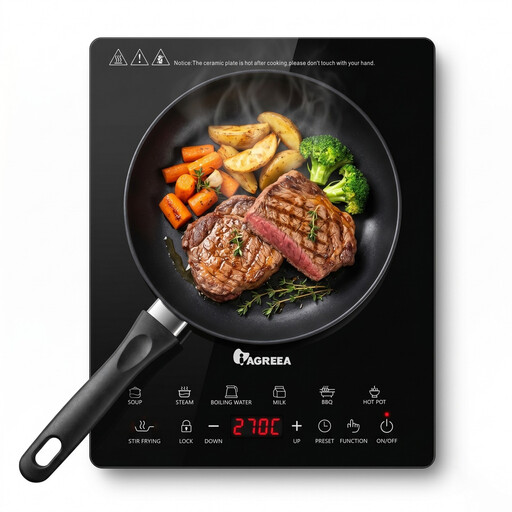
This portable induction option is for a temporary curry-cooking setup where you can use a compatible pan. If your recipe requires two pans at once, check the number of cooking zones before choosing it.
 No image available
Consider this model for a temporary setup if you have an induction-compatible pan and want adjustable cooking settings.
The product name specifies eight power levels, a 60–270°C temperature-control range, seven preset functions, a three-hour timer and suitable cookware measuring 12–26 cm.
If you need to use two pans together, confirm the number of cooking zones. Check the plug and electrical-supply requirements for the cottage before buying.
A portable hob may suit a temporary setup if the accommodation permits its use and you follow the appliance instructions. Place it on a stable, heat-resistant surface, keep it away from water and flammable materials, leave ventilation openings clear and stay with it while cooking.
It will work only if it is induction-compatible and meets the particular hob’s pan-size requirements. Tefal specifies induction pans measuring 12 cm to 26 cm for the IH210840; check the instructions for any other model rather than applying that range to every hob.
Choose two independently controlled plates if you want one pan to simmer while you fry ingredients in another. If you can cook those stages in sequence and storage space matters more, a single-zone portable hob may suit the recipe instead.
Do not assume an extension lead is suitable for a cooking appliance. Electrical Safety First advises checking its maximum current rating, avoiding connected extension leads and fully unwinding cable reels; use a suitable wall socket where possible and follow the hob’s electrical instructions.