
24/7 Customer Support

Free returns

Same-day & Next-day Delivery

Quality Guaranteed

Unlock Your Welcome Offers: FREE Delivery | Up to 80% OFF | Free 30-day JoyPlus trial
Download the APP
An electric hot pot cooker can handle much more than shared hot pot meals. Depending on the design, it may also cook noodles, soups, stews, stir-fries, rice and steamed dishes. However, choosing by appearance or wattage alone can lead to an appliance that is difficult to clean, too small for your household or unsuitable for your kitchen setup.
This guide from the Joybuy Product Recommendation Officer explains the practical details worth checking before you buy.
A listed capacity such as 5L electric hot pot or 7L electric hot pot describes the pot’s volume, but you should not fill it to the rim. Ingredients and boiling liquid need room to circulate safely, particularly when cooking noodles or soup.
As a general guide:
A deep, wide cooking surface can also be more convenient than a narrow pot with the same stated capacity.
Some products described as a multifunctional electric hot pot have only low and high power controls. That can still be useful for boiling and simmering, but it is not equivalent to a digital multi-cooker pot with dedicated programmes.
Before ordering, check whether the appliance offers:
For occasional hot pot meals, simple controls may be sufficient. For unattended slow cooking, a timer and temperature management can be more convenient.
A non-stick hot pot can reduce food residue and make wiping easier, but the coating still needs sensible care. Metal utensils, abrasive scourers and overheating an empty pot may shorten its service life.
Look for clear information about the coating, cleaning method and whether the cooking vessel is removable. Stainless steel alternatives avoid non-stick coating altogether, although food may require more attention during frying and cleaning.
Power is measured in watts. A 600W electric cooking pot is generally suited to smaller portions, while models around 1,200–2,000W are more appropriate for larger volumes or faster boiling.
Higher wattage does not automatically mean better cooking. Check whether the appliance has:
Do not use an appliance with a damaged lead, loose plug or unsuitable extension arrangement. Keep the electrical base and connector dry, and follow the supplied instructions.
Coated aluminium-style cooking surfaces are often light and convenient, but they should be cleaned with a soft sponge. Stainless-steel cookware is generally resistant to scratches from normal use, though water marks and heat discolouration can occur.
If you are considering a steamer pot, check whether the steaming basket is removable and whether it takes up useful cooking space. A detachable pot can make serving and cleaning easier, but the base should never be immersed in water.
A traditional hot pot for induction hob, gas or ceramic cooking does not contain its own heating element. It must be placed on a compatible hob, while an electric hot pot cooker needs a socket.
This distinction affects portability:

Why This Fits Their Persona: Its compact format suits students, couples and smaller UK kitchens, with enough capacity for one to three people.
The 1.2L design makes its intended serving size clear rather than implying family capacity.
600W power, two settings, steam basket, glass lid and dry-boil protection.
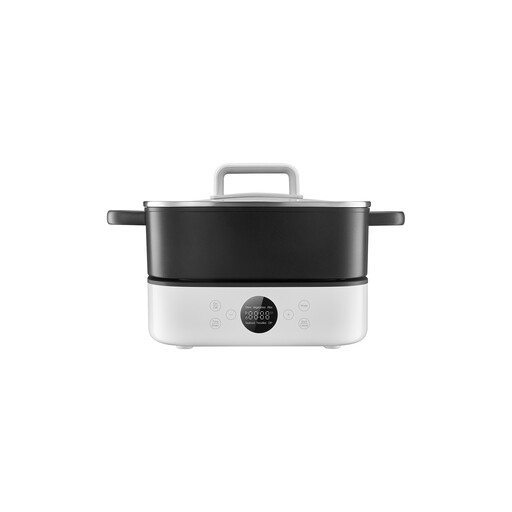
Why This Fits Their Persona: Suitable for households wanting a larger family hot pot cooker with more control than a basic two-setting model.
Six heat settings and timer functions provide more precise control than a simple high/low switch.
6L capacity, 2,000W rated power and a detachable cooking pot.

Why This Fits Their Persona: Its wide 7L vessel is designed for group dining, generous stews and shared hot pot meals.
The listed 30.5cm width and 8.5cm depth help buyers assess usable table and storage space before ordering.
1,600W power, high and low modes, glass lid, non-stick coating and UK plug.

Why This Fits Their Persona: A 5L format with multiple programmes can suit busy professionals preparing soups, rice, steamed food, pasta or slow-cooked meals.
Its listed programmes, adjustable DIY function and delay timer make the multifunction claim more specific.
14 listed cooking programmes, keep-warm function, 24-hour delay timer and dishwasher-safe pot.
We have compiled a complete, real-time list of products that fully satisfy these strict selection criteria and UK safety regulations.
Before using any electric hot pot cooker:
Running cost depends on the appliance’s wattage, cooking time and your electricity tariff. A smaller 600W portable hot pot cooker uses less power at maximum output than a 1,600W or 2,000W model, although it may take longer to heat a large quantity. Compare the rated wattage with your typical portion size rather than choosing solely by power.
Many models support hot pot, noodles, soup, stewing and light frying. Some also include steaming or dedicated slow-cook programmes. They are not automatically suitable for deep-frying, pressure cooking or baking, so check the manual and stated functions before attempting these methods.
Lifespan varies with construction, frequency of use and care. To help preserve the surface, use wooden or silicone utensils, avoid heating the pot empty and clean it with a soft sponge. If the coating becomes visibly damaged or begins to peel, stop using the cooking vessel and consult the seller’s product guidance.