
24/7 Customer Support

Free returns

Same-day & Next-day Delivery

Quality Guaranteed

Unlock Your Welcome Offers: FREE Delivery | Up to 80% OFF | Free 30-day JoyPlus trial
Download the APP
An electric hot pot cooker can turn a small kitchen, student room or dining table into a practical cooking space. It is useful for hot pot, noodles, soups, stews and one-pot meals, but choosing the wrong model can lead to overflowing broth, difficult cleaning or disappointing heating performance.
The product description alone does not always tell the full story. Before buying, UK households should look beyond phrases such as “multifunctional” and “fast cooking” and check the appliance’s capacity, power, surface material and safety instructions.
A 6L or 7L pot may sound suitable for a group, but the container should not normally be filled to the rim. Ingredients and bubbling broth need room to move safely. A large-capacity hot pot is useful for gatherings, but it also needs enough worktop space and a stable surface.
For one or two people, a 1.1L to 2L electric cooking pot may be easier to store and faster to clean. Choosing a large model for occasional personal meals can waste cupboard space and electricity.
A non-stick electric hot pot can make washing easier, but its coating still needs careful handling. Metal utensils, abrasive scourers and overheating an empty pot can damage the cooking surface. Check whether the cooking bowl is detachable and whether the manufacturer allows dishwasher cleaning.
Uncoated stainless steel avoids concerns about coating wear and can be suitable for boiling and simmering. However, it may show water spots or food residue unless it is cleaned and dried properly.
An electric hot pot appliance normally plugs directly into a socket, while a traditional divided hot pot is placed on a gas, electric, ceramic or induction hob. These are different product types.
A hob pan such as the MAXCOOK Tri-Ply 304 Stainless Steel Divided Hot Pot 30 cm can work on compatible hobs, but it is not a self-heating electric cooker. Always check whether the product uses a UK plug, the stated voltage and the required cooking surface before ordering.
Use the following as a practical starting point:
Capacity does not indicate how quickly a cooker heats. A 7L model may need more time and worktop space, while a smaller 1,000W cooker can bring a modest portion to the boil efficiently.
Power is measured in watts. A higher rating can support faster boiling, but it may also draw more electricity while operating. Look for useful heat control rather than wattage alone.
For example, the Drew & Cole Cleverpot has 300W and 600W settings, while larger models may offer 1,200W, 1,500W, 1,600W or 2,000W outputs. Low heat is useful for simmering soups and porridge; high heat is more appropriate for boiling broth or stir-frying where the product instructions permit it.
A 304 stainless-steel hot pot has an uncoated cooking surface and is generally suited to boiling and simmering. The MAXCOOK divided models use 304 stainless steel, a tri-ply construction and a composite base compatible with induction, gas, electric and ceramic glass hobs.
Coated cookers are often simpler to wipe clean, but users should follow the care instructions carefully. Check whether the lid, steamer basket or removable bowl is dishwasher safe, and never immerse an electric base, plug or cable in water.

Why This Fits Their Persona: Its compact 1.2L format suits students, couples and small UK kitchens where cupboard and worktop space are limited.
The stated capacity, two power settings and 220–240V specification make its intended scale clear rather than suggesting it is suitable for large gatherings.
Includes a glass lid and steam basket; the lid and basket are dishwasher safe according to the product information.
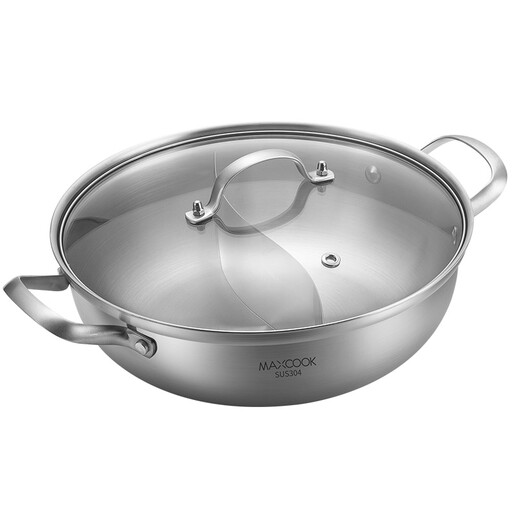
Why This Fits Their Persona: Suitable for diners who want two broths in one pan, such as a spicy and mild combination for family meals.
It is clearly a hob-based divided pan rather than a plug-in appliance, with stated compatibility for induction, gas, electric and ceramic glass hobs.
Uses uncoated 304 stainless steel and has dual handles, a divided design and dishwasher-safe construction.

Why This Fits Their Persona: The 7L bowl is designed for group dining, large portions of soup and shared hot pot meals rather than single servings.
The large dimensions and 1,600W rating make its size and power requirements visible before purchase; it is not presented as a compact personal cooker.
Offers high and low heat modes, a glass lid and a UK plug, with a stated 7L capacity for group cooking.
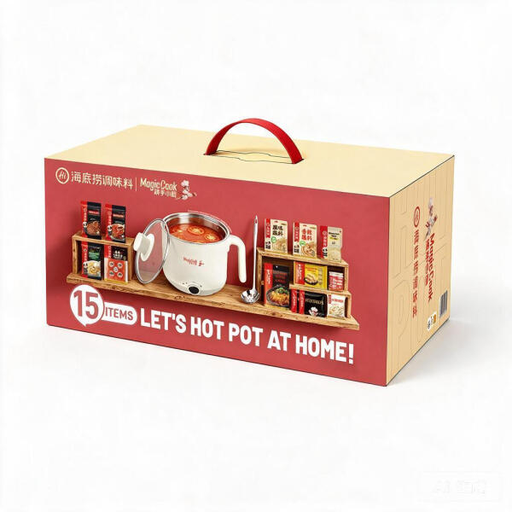
Why This Fits Their Persona: A convenient option for shoppers who want an Asian hot pot cooker and hot pot ingredients together for an at-home meal.
The listing identifies the included electric pot, soup bases, sauces and ingredients, helping buyers distinguish a kit from cookware-only listings.
Contains four soup bases, four dipping sauces, noodles, tofu skin rolls, vegetables and a slotted spoon.
For an easy Chinese hot pot cooker meal, prepare broth, leafy vegetables, mushrooms, sliced meat, noodles and tofu products separately. Frozen items such as FRESHASIA Hotpot Shrimp Paste 150g should remain frozen as directed and be cooked thoroughly until piping hot. Check allergen information carefully, particularly for crustaceans, soy, wheat, peanuts and sesame.
Keep the cooker on a flat, heat-resistant surface, avoid overfilling and keep handles, lids and steam vents away from children. Unplug the appliance before cleaning and allow it to cool naturally. For coated models, use soft utensils and a non-abrasive sponge.
We have compiled a complete, real-time list of products that fully satisfy these strict selection criteria and UK safety regulations.
Running cost depends on the appliance’s wattage, cooking time and your electricity tariff. A 600W model uses less power while operating than a 1,600W model, but it may take longer to heat a larger quantity. Compare the wattage with the portion size you normally cook rather than choosing by power alone.
Only where the accommodation or workplace permits personal cooking appliances. Use a model with the correct UK electrical specification, place it on a stable heat-resistant surface and keep ventilation clear. Compact 1.2L models are generally easier to store, but they still produce hot surfaces and steam.
Lifespan depends on frequency of use, coating care, heating controls and storage. Avoid running a pot empty, prevent water from reaching the electrical base and follow the manufacturer’s cleaning instructions. A stainless-steel model may suit buyers who prefer an uncoated surface, while a non-stick model requires gentler handling.