
24/7 Customer Support

Free returns

Same-day & Next-day Delivery

Quality Guaranteed

Unlock Your Welcome Offers: FREE Delivery | Up to 80% OFF | Free 30-day JoyPlus trial
Download the APP
An electric hot pot can be useful for far more than shared hot pot meals. Depending on its design, it may also work as a ramen cooker, noodle cooker, steamer cooking pot, slow cooker or one-pot cooker for soups, rice and stews. However, choosing by capacity or wattage alone can lead to an appliance that is awkward to clean, unsuitable for your household or unsafe for your available socket and worktop.
This guide from the Joybuy Product Recommendation Officer explains the practical checks that matter before buying a multifunctional electric cooker in the UK.
A pot labelled 5L or 7L will not usually be filled to the rim. Allowance is needed for boiling, stirring and steam expansion. For a single portion, a 1.0–1.6L mini electric pot is generally easier to store and quicker to use. Couples may prefer around 2.0–2.4L, while larger households may benefit from 5–7L.
Also check whether the advertised capacity refers to the total bowl volume or a recommended cooking volume. A deep pot may be useful for soup, but a wider opening can make shared serving and cleaning more convenient.
A non-stick hot pot can reduce sticking and make wiping easier, but the coating still needs careful handling. Metal utensils, abrasive sponges, overheating and dry boiling can shorten its useful life. Look for clear cleaning instructions and use silicone, nylon or wooden utensils.
Stainless steel is a different option. It can tolerate regular utensil use and is suitable for gas and induction when the base is compatible, but food may stick more readily if heat and oil are not managed correctly.
Not every portable electric cooking pot listed for the UK has the same connection. Confirm whether it has a UK plug, a detachable cable or a European two-pin plug requiring an appropriate solution. Do not use an unsuitable adapter for a high-power appliance.
Useful safety features include auto shut-off, dry-boil protection and overheat protection. These features do not replace supervision: hot liquids, steam and exterior surfaces can cause burns, and the base or cable must never be immersed in water.
Use the following as a practical starting point:
A compact model may suit a student room or small flat, but check accommodation rules before using cooking appliances in a dormitory or office.
Wattage indicates electrical input, not guaranteed cooking speed. A 600W model is appropriate for modest quantities, while 1,000–1,200W models can bring larger volumes to the boil more quickly. A 1,600–2,000W family electric hot pot is designed for substantial quantities but may require a suitable, safely rated socket.
Dual settings or adjustable controls are more useful than a single high-power mode. High heat can help with boiling and stir-frying; low heat is more suitable for porridge, soup, simmering and slow cooking. Never operate an electric pot empty unless the instructions specifically permit it.
If you regularly cook noodles, eggs or rice, a non-stick interior may reduce residue. If steaming matters, check whether the basket is included, removable and easy to wash. A detachable pot or cable can simplify storage, but confirm which parts are dishwasher-safe rather than assuming the whole appliance can be submerged.
For a hob-based alternative, the Maxcook 6.5L stainless steel pot is described as compatible with gas, induction, electric, ceramic and halogen hobs. This is not an electric appliance, but it may suit households that want one pot for different hobs.
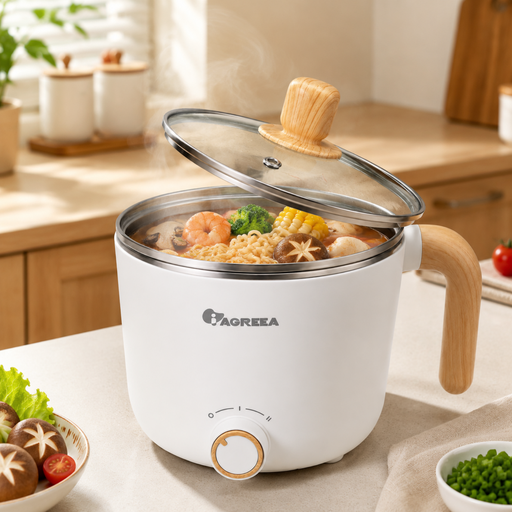
Why This Fits Their Persona: Its 1.0L size and 300W/600W controls suit students, solo tenants and anyone with limited cupboard or worktop space.
The compact capacity avoids paying for a large bowl that may be difficult to store or inefficient for one-person meals.
Stainless steel inner pot; dual power control; glass lid and functions for noodles, rice, soup and eggs.
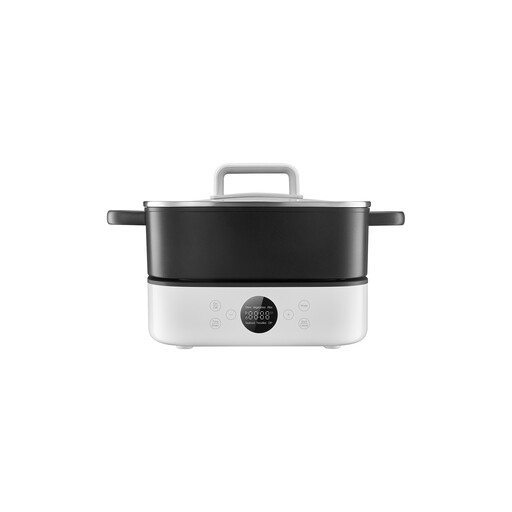
Why This Fits Their Persona: The 6L bowl, 2,000W rating, six heat levels, timer and detachable pot suit households wanting more control for shared meals.
The detachable design addresses the common cleaning problem associated with large fixed heating bases.
220–240V specification; six heat settings; timer; 6L stated capacity for approximately 4–6 diners.

Why This Fits Their Persona: Its large bowl and UK plug are suited to family gatherings, hot pot dinners and batch cooking in homes without convenient hob space.
The stated 7L capacity and 30.5cm opening make it easier to serve several people, rather than overcrowding a small pot.
1,600W power; high and low modes; glass lid; stated UK plug; non-stick interior.
For a ready-to-serve option, the Haidilao Hot Pot Gift Box – Soup Base + Ingredients + Electric Cooker, 2020g includes an electric cooker, four soup bases, four dipping sauces, noodles, sweet potato noodles, tofu skin rolls and vegetable packs. Check the combined allergen statement carefully: it includes soy, wheat-containing cereals, peanuts and sesame. Follow the cooking instructions and read each component’s packaging for storage and shelf-life information.
We have compiled a complete, real-time list of products that fully satisfy these strict selection criteria and UK safety regulations.
Running cost depends on wattage, cooking time and your electricity tariff. A 600W cooker uses 0.6kWh per hour at full power, while a 1,600W model uses 1.6kWh per hour. Actual consumption varies because thermostatic controls may cycle on and off. Compare the rated wattage with the portion size you normally prepare.
Check your accommodation’s written rules first. Some halls restrict hot plates, portable cooking pots or appliances with exposed heating elements. Use the cooker only on a stable, heat-resistant surface with ventilation, and never leave it unattended.
There is no universal lifespan. Careful use can help preserve the coating: avoid metal utensils, abrasive cleaners, dry boiling and sudden temperature changes. Stop using the appliance if the coating is visibly damaged, the cable is worn or the controls behave unexpectedly.